
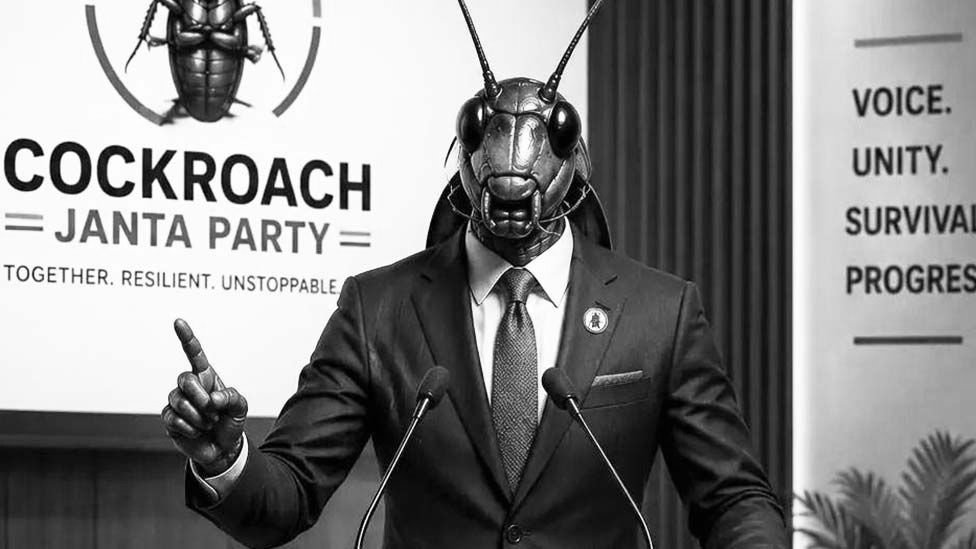
Cockroach Janta Party Storm: Satire, Street Protest and Political Fault Lines Deepen Across India
A satirical digital movement known as the Cockroach Janta Party (CJP) continues to ripple through India’s political and online spaces, triggering a wider debate over censorship, dissent and rising public frustration .
The controversy escalated this week after the group’s X (formerly Twitter) account was withheld in India following what platform notices described as a legal demand . The move came shortly after CJP’s rapid rise in popularity across social media, where it reportedly gathered millions of followers within days of its launch, drawing attention far beyond typical online satire. Soon after the restriction, a new handle titled “Cockroach is Back” surfaced, continuing the group’s messaging under the tagline “Cockroaches Don’t Die,” signalling that the campaign would persist despite platform action.
The movement, founded by Abhijeet Dipke , began as a satire-driven response to controversial remarks attributed to a judicial observation that compared unemployed youth to “cockroaches.” The comment, later clarified, nevertheless sparked widespread online reaction and became the symbolic trigger for the campaign. Since then, CJP has evolved into a broader digital protest platform using humour, memes and exaggerated political symbolism to highlight issues such as unemployment, inflation, corruption and dissatisfaction with public systems .
The rapid expansion of the movement has now drawn strong reactions from political leaders across the spectrum. Kerala Leader of Opposition Pinarayi Vijayan criticised the government’s action against the group’s online presence, calling it evidence of “intolerance” and “fear” of democratic expression . He argued that attempts to restrict such voices reflect an effort to suppress youth-led political anger and curtail constitutional freedoms.
In contrast, sections aligned with the ruling establishment have raised concerns over the opaque nature of the movement’s rapid digital growth and its potential as an organised influence campaign. Meanwhile, the CJP itself claims it is a satire-based collective reflecting public frustration rather than a formal political organisation.
Adding another dimension to the debate, election strategist Prashant Kishor said the overwhelming response to CJP should serve as a warning sign for policymakers. He argued that the movement reflects deepening public distress and distrust in institutions , particularly among young Indians facing unemployment and economic pressure.
Beyond online spaces, the movement has also inspired real-world demonstrations, including symbolic protests in which activists have dressed as cockroaches to highlight environmental and civic issues.
What began as internet satire has now evolved into a politically charged flashpoint, sitting at the intersection of humour, protest and digital regulation . With accounts being blocked, new handles emerging and political voices weighing in, the Cockroach Janta Party phenomenon is increasingly being seen as a mirror to India’s shifting landscape of dissent in the digital age.