
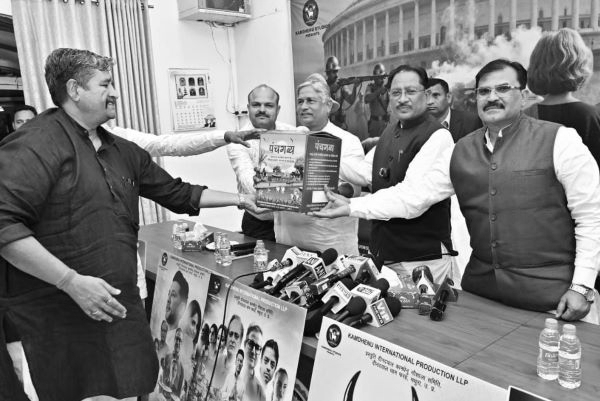
CM Vishnu Deo Sai Backs Film Godaan, Announces Tax Exemption in Chhattisgarh
Chhattisgarh Chief Minister Vishnu Deo Sai on January 27 launched the trailer, poster and a promotional song for the Hindi film Godaan , declaring that the movie will be made tax-free in Chhattisgarh ahead of its nationwide release. The film described by organisers as the country’s first feature centred on “Gaumata” (the cow) is produced and directed by Vinod Chaudhary and is slated to release on February 6, 2026 .
At the launch held at the Chief Minister’s official residence, Sai framed the film as both a cultural tribute and a public-awareness vehicle, stressing the spiritual, scientific and economic significance of cows in India. He used the platform to underline recent state steps for cattle welfare including raising the per-cow fodder grant for gaushalas from ₹20 to ₹35 and increasing financial assistance to shelters to ₹25 lakh , and the setting up of “Godhams” to manage stray cattle positioning the tax-free decision as complementary to these measures.
A state decision to make a film tax-free generally removes the state portion of the entertainment tax (the SGST share), which in practice reduces ticket prices by roughly 6–9% depending on ticket slab under current GST rules; the move is also treated as a form of government endorsement that can boost publicity and accessibility. While tax exemption does not eliminate central GST, the relative fall in ticket price can increase footfall in price-sensitive markets and add to box-office momentum for socially themed films.
Beyond ticket economics, the announcement carries a political and cultural signal . State governments across India including Chhattisgarh in past instances have often granted tax exemptions to films that align with a social or political narrative the government wishes to promote; such endorsements amplify reach among rural and middle-income audiences and add a legitimacy frame for the film’s message. Observers will watch whether neighbouring states follow suit, which would further widen the film’s low-cost access.
From an agricultural and environmental perspective, the film’s emphasis on cow-based organic manure and its place in sustainable farming taps into a broader policy push for organic inputs and rural livelihoods. If the film successfully links traditional reverence with tangible economic practices (for example, organic manure use, gaushala management, and stray cattle care models like Godhams), it could influence local adoption or at least stimulate policy discussion at state and district levels. That said, the real test will be whether cinematic messaging translates into measurable changes in farmer behaviour or gaushala funding over the coming months. (Context: no published study yet links specific films to measurable agricultural adoption; this is plausibly an influence channel rather than a direct policy instrument.)
A few practical things to watch after the release: (1) box-office trajectory in Chhattisgarh and nearby states if they also declare tax relief; (2) media and public response to the film’s scientific claims about cattle and organic manure (experts may fact-check those points); and (3) whether the state converts the publicity into longer-term budgetary support for gaushalas beyond one-time announcements. Past experience shows that tax-free status helps visibility, but long-term policy impact depends on sustained funding and implementation.