
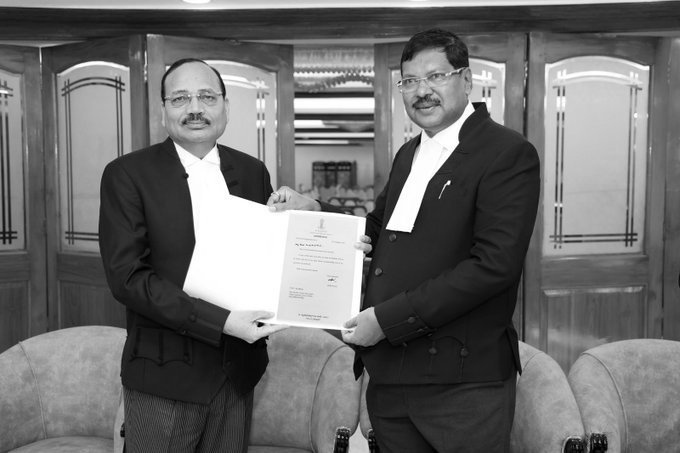
CJI Gavai recommends Justice Surya Kant as successor, oath on November 24
Chief Justice of India Bhushan Ramkrishna Gavai has formally recommended Justice Surya Kant as his successor, setting the stage for a smooth transition at the helm of the country’s judiciary. The recommendation has been sent to the Union Law Ministry, and once approved, Justice Surya Kant will take oath before the President of India at Rashtrapati Bhavan on November 24 , a day after CJI Gavai retires on November 23.
As per the Memorandum of Procedure , the outgoing Chief Justice recommends the senior-most judge deemed fit to assume the post, about a month before retirement. After the President issues the warrant of appointment , the new Chief Justice takes oath and formally assumes charge of the Supreme Court.
CJI Bhushan Ramkrishna Gavai , who took office on May 14, 2025, will retire after a brief but impactful tenure. He is the first Dalit Chief Justice of India in over a decade and only the third in the nation’s history . During his term, he presided over crucial constitutional and social justice matters and worked toward making the judiciary more accessible and transparent. His tenure saw advancements in digital case management , efforts to reduce pendency , and judgments that strengthened affirmative action policies and social equality .
Justice Surya Kant , currently the second senior-most judge of the Supreme Court, is known for his balanced, reform-oriented approach to constitutional law. Born on February 10, 1962 , in a middle-class family in Hisar, Haryana , he studied at Government College, Hisar, and obtained his law degree from Maharshi Dayanand University . Beginning his legal practice at the Punjab and Haryana High Court in 1984 , he became one of the youngest advocates to be designated as a Senior Advocate in 2001.
He was appointed a judge of the Punjab and Haryana High Court in 2004 , later serving as the Chief Justice of the Himachal Pradesh High Court in 2018. His elevation to the Supreme Court of India came in May 2019 , marking a steady rise through the judicial ranks built on merit and credibility.
Over the years, Justice Surya Kant has been part of several landmark judgments that shaped constitutional thought in India. He was on the bench that kept the colonial-era sedition law in abeyance , directing that no new FIRs be registered until the Centre completed its review. He also pushed for transparency in electoral rolls , asking the Election Commission to disclose the names of over 65 lakh voters excluded in Bihar.
He is widely recognized for championing gender equality within the legal system, having directed that one-third of seats in all bar associations be reserved for women. Justice Surya Kant also upheld the One Rank-One Pension (OROP) scheme for defence forces, ruling it constitutionally valid, and was part of the seven-judge bench that overruled the 1967 decision on Aligarh Muslim University’s minority status , a verdict with far-reaching implications for educational rights.
His role in major public interest cases has been equally notable. Justice Surya Kant was part of the bench that handled the Pegasus spyware allegations , emphasizing that the government cannot claim blanket immunity under the pretext of national security. He also oversaw the probe into Prime Minister Narendra Modi’s 2022 Punjab security breach , appointing a committee led by former Justice Indu Malhotra to ensure judicial accountability in security matters.
Justice Surya Kant will have a tenure of nearly 15 months , serving until February 9, 2027 . His elevation is seen as a continuation of the Supreme Court’s focus on reform, inclusion, and the rule of law. As he prepares to take oath before the President on November 24, his appointment represents both continuity and change, a bridge between judicial tradition and the evolving expectations of modern India.