
CJI Expresses Concern Over ‘Corruption in Judiciary’ Chapter in School Textbook
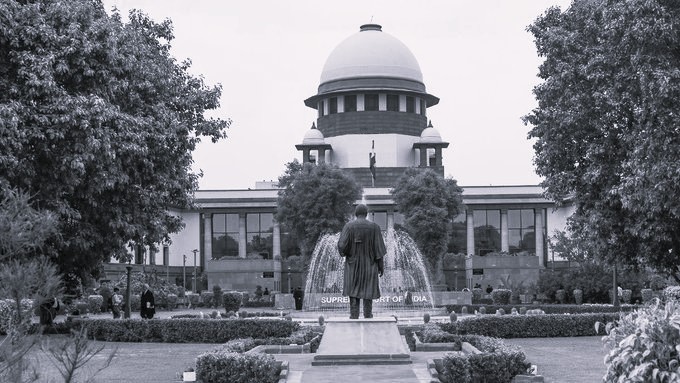
The Supreme Court has expressed concern over the inclusion of a section titled “Corruption in the Judiciary” in the Class 8 NCERT Social Science textbook and initiated a suo motu case on the issue on Wednesday. Chief Justice of India Surya Kant stated that he would not allow any attempt to tarnish the institution’s reputation. He said, “I have full awareness about this issue. We will wait for one day. This is an issue concerning the entire institution both the Bar and the Bench. I am receiving numerous calls and messages. I am taking up this matter suo motu. No matter how high one’s position is, no one will be permitted to attempt to lower the dignity of the institution.” Justice Jyoimalya Bagchi observed that the contents of the book appear to be against the basic structure principles of the Constitution .
Senior advocates Kapil Sibal and Abhishek Manu Singhvi raised the matter before the bench, arguing that students are being taught that corruption exists in the judiciary while there is no mention of corruption in sectors such as bureaucracy or politics. They contended that the chapter creates an impression that corruption is limited to the judiciary alone. Responding, the CJI stated that the issue appears to be planned and deep and that action is already being taken.
Reports indicate that the National Council of Educational Research and Training (NCERT) revised the chapter titled “The Role of the Judiciary in Our Society” in the new Class 8 textbook. Along with explaining court structure and access to justice, the chapter also highlights challenges faced by the judiciary, including corruption, case pendency, and shortage of judges . The section on corruption states that judges are bound by a code of conduct and must follow ethical norms both inside and outside court.
On Tuesday, Kapil Sibal wrote on X questioning why corruption in politics, ministers, government officials, investigative agencies, and governments was not mentioned if such issues were included for the judiciary. Following the controversy, the Supreme Court’s suo motu hearing has drawn nationwide attention.
Government sources said there is a possibility that the controversial portions related to corruption may be removed or revised . NCERT has already withdrawn the textbook from its website. The proceedings are being heard by a three-judge bench headed by CJI Surya Kant, along with Justice Jyoimalya Bagchi and Justice Vipul M. Pancholi, who strongly objected to the remarks in the book and emphasised protection of institutional dignity.
The textbook also cites data showing around 81,000 cases pending in the Supreme Court , 62.40 lakh cases in High Courts , and 4.70 crore cases in district and lower courts . It mentions that over 1,600 complaints were received between 2017 and 2021 through the Centralized Public Grievance Redress and Monitoring System. It further refers to former CJI B.R. Gavai , stating that corruption incidents negatively affect public trust, though government sources claim the statement was taken out of context.
According to Union Law Minister Arjun Ram Meghwal , 8,639 complaints were received against sitting judges between 2016 and 2025, including 1,170 complaints in 2024 alone. NCERT officials have declined to comment as the matter remains under judicial scrutiny, while government sources indicated that the content will be reviewed and necessary changes may be made.