
Civic sense in India: Lost, forgotten, or never there?
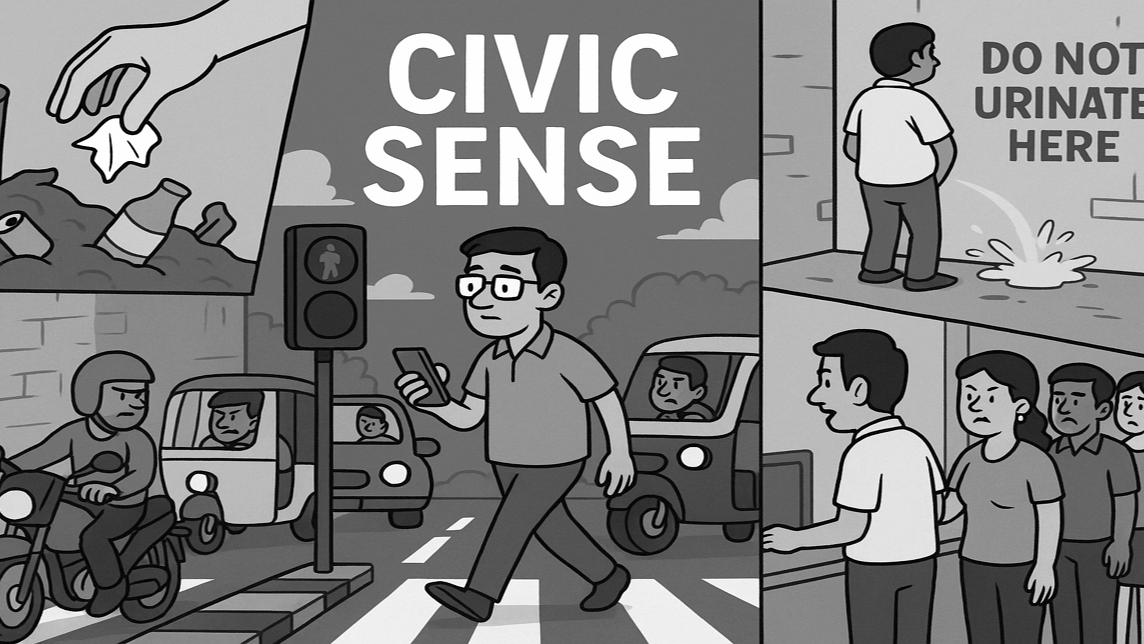
India, now the world’s most populous nation, stands at a paradoxical crossroads. On one hand, it boasts sprawling highways, metro networks, world-class airports, and urban development projects aimed at transforming daily life. On the other, a glaring lack of civic sense among citizens consistently erodes these achievements, revealing a social and cultural crisis as serious as any infrastructural challenge. Roads and highways, freshly laid and built with significant public funds, are misused or deliberately damaged within days. The Samruddhi Expressway in Maharashtra, where nails were hammered into lanes puncturing vehicle tyres, is just one example. Similarly, in Bihar, newly constructed roads were dug up illegally shortly after their inauguration. Public transport faces similar neglect,trains see passengers tossing garbage, defacing seats, or spitting in corridors; metro stations are littered despite cleaning staff working round the clock. In many cities, public parks and footpaths are trampled, graffiti mars walls, and public toilets often remain unusable because users refuse to maintain hygiene.
This pattern is not limited to a single state or region,it is national. Every major urban project, from smart city initiatives to eco-parks, struggles against misuse. People ignore traffic laws and boast about escaping challans after breaking signals. Trash is thrown openly on streets, drains remain clogged, and rivers and lakes suffer from pollution. The problem is systemic: citizens expect government-provided facilities to be maintained without taking any personal responsibility. In contrast, countries like Japan, South Korea, or China illustrate a strikingly different social contract. Public infrastructure is treated with respect; littering, vandalism, and careless behavior are socially unacceptable. Citizens in these countries internalize responsibility, and government investments translate directly into long-term usability and public benefit.
The reasons for India’s civic deficit are complex. Rapid urbanization, overpopulation, lack of education on public responsibility, and an ingrained culture of impunity all contribute. When individuals see neighbors littering, breaking rules, or defacing property without consequence, it normalizes such behavior. A vicious cycle emerges: government builds, citizens misuse, infrastructure decays, blame is shifted back to authorities, and corrective action becomes reactive rather than preventive. Even essential public services such as water supply, waste management, and street lighting are often neglected because citizens do not respect the systems designed to serve them.
The implications are enormous. Public health is compromised, economic potential is wasted, and societal frustration grows. Spitting on streets contributes to disease spread; misuse of highways and bridges leads to accidents; vandalism and graffiti increase maintenance costs. Government investments, which could uplift millions and improve quality of life, are undermined by civic negligence. Every rupee spent on infrastructure loses value when people fail to maintain it.
However, this reality also offers a critical lesson: infrastructure alone cannot transform society. Civic education, public accountability, and a culture of personal responsibility are equally vital. Initiatives like the Swachh Bharat Mission, Clean India campaigns, and community-driven public space management show that change is possible when citizens participate actively. Yet, these successes remain limited because widespread behavioral transformation is slow and often resisted. Civic sense is not an innate trait but a social skill, nurtured through education, law enforcement, community engagement, and cultural reinforcement.
India’s growth story, therefore, is incomplete without addressing the human factor. The country may lead the world in population and economic potential, but unless citizens internalize responsibility for public spaces and follow simple rules of coexistence, development will always be undermined. The reality is harsh: government builds, people misuse, progress stalls, and blame is shifted. Until civic sense becomes a collective priority, even the most ambitious infrastructure projects will struggle to deliver the intended benefits, and India’s streets, highways, and public spaces will continue to reflect neglect, chaos, and human indifference.