
China's Space Station To Host First Foreign Visitor As Pakistani Astronaut Joins Crew
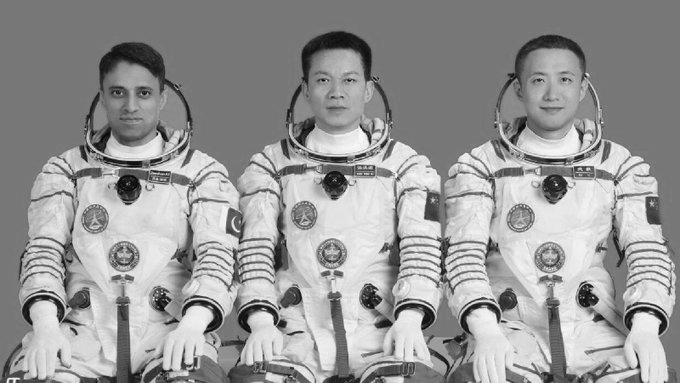
China is preparing to send its first foreign astronaut to the Tiangong space station, with Pakistani Air Force pilot Muhammad Zeeshan Ali selected for the upcoming Shenzhou-24 mission. The flight will also make Ali the first Pakistani to travel into space and mark the first joint crewed spaceflight involving Chinese and foreign astronauts.
The 40-year-old Ali will serve as a payload specialist alongside Chinese astronauts Tang Hongbo, the mission commander, and Wu Yi, the flight engineer. The spacecraft is scheduled to launch at 8.18 am Beijing time on Wednesday, November 25, from the Jiuquan Satellite Launch Center in northwest China aboard a Long March-2F rocket.
According to the China Manned Space Agency (CMSA), Ali will spend approximately one week aboard Tiangong before returning to Earth on the Shenzhou-23 spacecraft. The mission will involve an orbital crew rotation, routine station maintenance and scientific research. Around 90 experiments are planned, while Ali will participate in four joint China-Pakistan experiments covering biotechnology and materials science, including research involving photosynthetic microorganisms.
Ali underwent seven months of training in China after being selected under a space cooperation agreement signed between Beijing and Islamabad in February 2025. Fellow Pakistani candidate Khurram Daud was selected as his backup.
Tang Hongbo, who previously flew on the Shenzhou-12 and Shenzhou-17 missions, is set to become the first astronaut to visit Tiangong three times. Wu Yi, from China's third batch of astronauts, will make his first spaceflight.
Speaking before the launch, Ali said he carried the hopes of 250 million Pakistanis. He also explained that learning technical Chinese was essential because the spacecraft's switches, software and voice announcements operate in the language.
The mission represents a major step in China's efforts to expand international cooperation through Tiangong, which has been fully operational since 2022. Beijing is also pursuing its goal of sending astronauts to the Moon by 2030.