
China’s new superpower era - fueled by AI, shadowed by fear
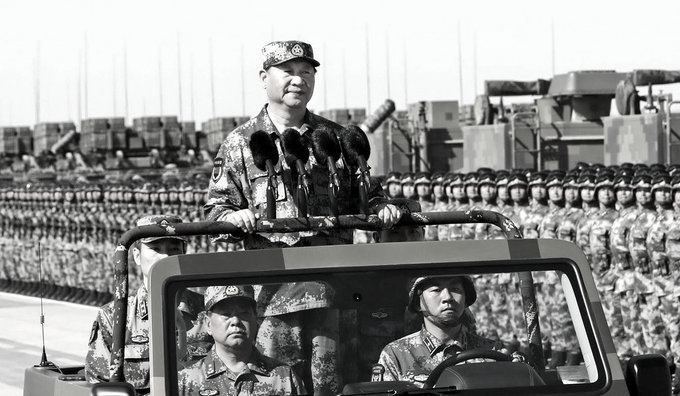
China’s People’s Liberation Army (PLA) has undergone a sweeping transformation under President Xi Jinping, evolving from a land-based defense force into a multidimensional military machine. Yet beneath this surface of technological triumph lies an institution riddled with political paranoia and internal cracks, symptoms of Xi’s drive to ensure absolute party control.
Beijing’s official defense budget in 2025 soared to US$266.85 billion, second only to the United States, which spends US$895 billion. Russia follows at US$126 billion, India at US$75 billion, and Saudi Arabia at US$74.76 billion. China’s defense spending has expanded more than thirteenfold in the past three decades, reflecting Xi’s vision of restoring China to global preeminence. This militarization is deeply tied to ideology: the “great rejuvenation of the Chinese nation”, a mission Xi believes demands both military dominance and strategic self-reliance.
The United States’ expanding footprint in the Pacific and Taiwan region has fueled this transformation. Washington’s alliances with Japan, the Philippines, and Australia have positioned advanced assets closer to China’s shores, pushing Beijing to counter with rapid modernization. Xi views this not merely as a geopolitical contest but an ideological clash - a test of China’s resilience against perceived Western containment.
Submarines, nukes, and AI - The engines of a new military age
China’s nuclear and naval expansion underpins its quest for deterrence and power projection. Its PLA Rocket Force (PLARF) now fields intercontinental ballistic missiles such as the DF-41, DF-31BJ, and DF-5C, alongside submarine-launched JL-2 and JL-3 systems. The country’s nuclear stockpile is estimated at around 600 warheads, projected to reach 1,500 by 2035, giving China one of the fastest-growing arsenals in the world.
At sea, the People’s Liberation Army Navy (PLAN) commands one of the largest undersea fleets globally, with over 70 submarines, including 10 nuclear-powered vessels. The Jin-class (Type 094) ballistic missile submarines (SSBNs) form the core of China’s sea-based deterrent, while the upcoming Type 096 class promises greater stealth and missile range. Attack submarines, such as the Type 093B Shang-class and Yuan-class (Type 039A/B) diesel-electric boats, are designed for anti-access and area-denial operations, particularly in the South China Sea.
Supporting these assets is a vast network of deep-sea sonar arrays, seabed sensors, and AI-powered surveillance grids. These systems, coupled with satellite reconnaissance and quantum communication experiments, allow China to track adversarial submarines and aircraft across the Indo-Pacific. The integration of AI into warfare has revolutionized the PLA’s strategy. Algorithms now analyze satellite data, manage logistics, and predict enemy movements. Swarm drones, autonomous underwater vehicles, and robotic combat systems are being tested in both naval and land exercises, signaling the dawn of “intelligentized warfare.”
Beyond the seas, China’s military reach extends to a growing web of overseas facilities. Bases in Djibouti, Gwadar (Pakistan), Ream (Cambodia), and Bata (Equatorial Guinea), along with logistical hubs in Sri Lanka, Myanmar, and the UAE, strengthen Beijing’s global mobility. These installations support the PLAN’s evolution into a true blue-water navy, capable of global deployments to protect trade routes and project influence far beyond Asia.
The Rocket Force Purge - Xi’s fury and the system’s fracture
Even as China’s military expands outward, it faces turmoil within. In 2023-2024, the PLA was shaken by one of the most dramatic internal crackdowns in its history, the Rocket Force Purge. Triggered by reports of corruption, falsified readiness data, and shocking negligence, the scandal reached its climax when investigators discovered that some missile fuel tanks contained water instead of propellant. The revelation reportedly infuriated Xi Jinping, who viewed it as a betrayal of his flagship modernization campaign.
Top leaders including Commander Li Yuchao, Deputy Commander Liu Guangbin, and Political Commissar Xu Zhongbo were abruptly removed and replaced by outsiders, a rare and humiliating measure within China’s hierarchical system. Officially justified as “disciplinary enforcement,” the purge’s true aim was twofold: to restore technical integrity and eliminate potential disloyalty within the nuclear command chain.
However, this purge has raised new fears that political loyalty now outweighs military competence. Officers are increasingly reluctant to take initiative, wary of political scrutiny. Analysts warn that while Xi’s drive for “purity” stren gthens central control, it may undermine operational readiness in a crisis.
The purge also exposes a deeper contradiction in Xi’s strategy: a military designed to project global confidence but internally constrained by fear. The PLA’s command structure is tighter, but its creativity and trust have suffered. As a result, China’s impressive arsenal from submarines and hypersonic missiles to AI-driven drones may not fully compensate for the anxiety that pervades its ranks.
China’s ascent as a military superpower is undeniable. Its nuclear submarines patrol the world’s oceans, its satellites scan the skies, and its AI labs churn out tools of modern warfare. Yet the Rocket Force Purge reminds the world that behind the polished façade lies a brittle core one where fear of betrayal competes with the pursuit of excellence. Xi Jinping’s military revolution may have armed China for the future, but it has also exposed the peril of building power faster than trust.