
China’s GDP hits historic USD 20 trillion mark, meets 5% growth target in 2025
China’s economy grew by 5 per cent in 2025 to a record USD 20.01 trillion , buoyed by resilient exports that offset weak domestic demand and the impact of renewed US trade tariffs, official data showed on Monday. However, growth momentum faded toward the end of the year, with expansion slowing to 4.5 per cent in the final quarter , highlighting persistent structural strains in the world’s second-largest economy.
Data released by the National Bureau of Statistics (NBS) showed China’s gross domestic product reached 140.19 trillion yuan , crossing the USD 20 trillion threshold for the first time. The annual growth rate met Beijing’s official target of around 5 per cent, though the fourth-quarter slowdown marked the weakest quarterly performance since late 2022, when the economy was still grappling with COVID-19 disruptions. On a quarter-on-quarter basis, GDP expanded by 1.2 per cent in the last three months of 2025.
Chinese authorities said the economy advanced “under pressure” amid a complex domestic and external environment, claiming key economic and social development goals under the 14th Five-Year Plan (2021–25) had been achieved, setting the stage for the next planning cycle beginning this year.
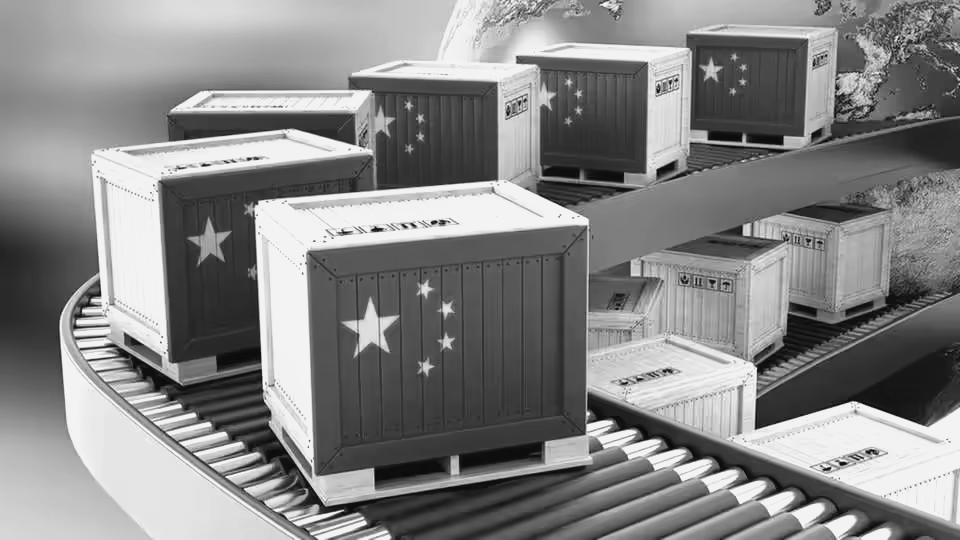
A major driver of growth was the external sector. China recorded a record goods trade surplus of about USD 1.19 trillion in 2025 , as strong exports helped compensate for sluggish consumption and investment at home. While shipments to the United States fell sharply following President Donald Trump’s renewed tariff offensive, exporters successfully redirected goods to markets in Southeast Asia, South America, Africa and Europe, cushioning the overall impact.
Official figures show that net exports accounted for 32.7 per cent of China’s economic growth in 2025 , the highest contribution since 1997, underscoring the economy’s increasing reliance on external demand. Customs data showed exports totalled USD 3.77 trillion , while imports stood at USD 2.58 trillion .
Despite the export strength, China’s domestic market remained the economy’s weak spot. Retail sales of consumer goods rose 3.7 per cent year on year , missing expectations and pointing to fragile household confidence. Consumption contributed 52 per cent of GDP growth , while investment accounted for just 15.3 per cent , reflecting subdued private sector activity.
The prolonged property sector downturn continued to weigh heavily on domestic demand. Property investment contracted 17.2 per cent in 2025, extending a multi-year decline triggered by falling home prices and developer debt stress. Private sector investment fell 6.4 per cent , while manufacturing investment edged up a modest 0.6 per cent , according to the NBS.
Per capita disposable income rose 5 per cent in nominal terms to 43,377 yuan (about USD 6,192) , but analysts say rising savings and job insecurity have kept consumers cautious. While official data put the surveyed urban unemployment rate at 5.2 per cent , unofficial estimates suggest joblessness, especially among youth, remains significantly higher.
Industrial output provided some support, with value-added industrial production rising 5.9 per cent last year. The services sector also emerged as a relative bright spot, underpinned by artificial intelligence, technology investment and financial market activity, analysts said.
Commenting on the data, Kang Yi , commissioner of the statistics bureau, said China’s economy had withstood multiple pressures to maintain stable growth but warned that intensifying external risks and long-standing domestic challenges continued to constrain development.
Economists say China’s growth has become increasingly imbalanced, leaning heavily on exports at a time when global concerns are rising over a flood of cheap Chinese goods. The International Monetary Fund has urged Beijing to address structural imbalances and accelerate efforts to boost domestic demand and investment.
China’s growth trajectory contrasts with that of India, which has outpaced China in recent years with growth rates above 7 per cent , driven largely by stronger domestic consumption and services-led expansion. While China remains a manufacturing powerhouse, its ageing population, property slump and cautious consumers are capping medium-term growth prospects.
Looking ahead, market attention is turning to how Beijing will revive household spending, a top policy priority outlined at December’s Central Economic Work Conference. Analysts at Standard Chartered expect China to set a 2026 growth target between 4.5 per cent and 5 per cent , with policies likely to be less expansionary as authorities focus on longer-term economic transformation.
“China appears to be refocusing on fostering self-sustained growth,” analysts said, warning that without a stronger domestic revival, exports alone may not be enough to lift growth meaningfully higher.