
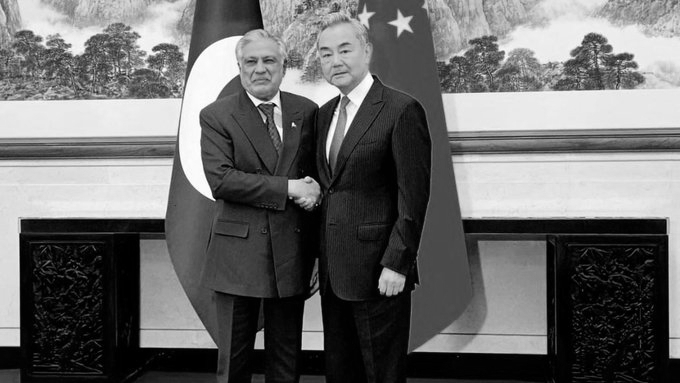
China, Pakistan Call for Immediate Ceasefire, Unveil Five-Point Plan on West Asia
China and Pakistan on Tuesday jointly proposed a five-point peace plan to end the ongoing conflict in West Asia, calling for an “immediate cessation of hostilities” and early resumption of dialogue, while underlining the need to safeguard critical energy and trade routes.
The proposal followed talks between Chinese Foreign Minister Wang Yi and Pakistan’s Deputy Prime Minister and Foreign Minister Ishaq Dar, who briefed Beijing on his recent engagements with regional powers, including Turkiye, Egypt and Saudi Arabia, aimed at facilitating dialogue.
In a joint statement, China and Pakistan outlined a five-point peace plan including an immediate cessation of hostilities, initiation of peace talks, protection of civilians and non-military targets, ensuring maritime security in the Strait of Hormuz, and upholding the primacy of the UN Charter.
The Strait, through which nearly a fifth of the world’s oil passes, remains crucial for energy-dependent economies like China and Pakistan. Any disruption could trigger volatility in global oil markets and impact industrial stability. Both countries emphasised the need for the safe passage of commercial vessels and protection of stranded ships and crew.
China also confirmed that three of its oil vessels recently transited the Strait, thanking relevant parties for coordination, amid reports of heightened monitoring by Iran, which has been asserting control over shipping movements in the region.
Analysts view the joint initiative as part of Beijing’s broader effort to project itself as a global peacemaker , building on its role in the Iran-Saudi Arabia rapprochement 2023. For Pakistan, the move aligns with its strategic partnership with China while enhancing its diplomatic profile.
The initiative also reflects concerns over the security of key trade corridors linked to the Belt and Road Initiative and the China-Pakistan Economic Corridor, both of which depend on stable maritime routes in the Gulf.
With the United States involved in the conflict, the proposal signals a push by China and Pakistan for a multilateral, dialogue-driven approach under international frameworks, while protecting their long-term strategic and economic interests in the region.