
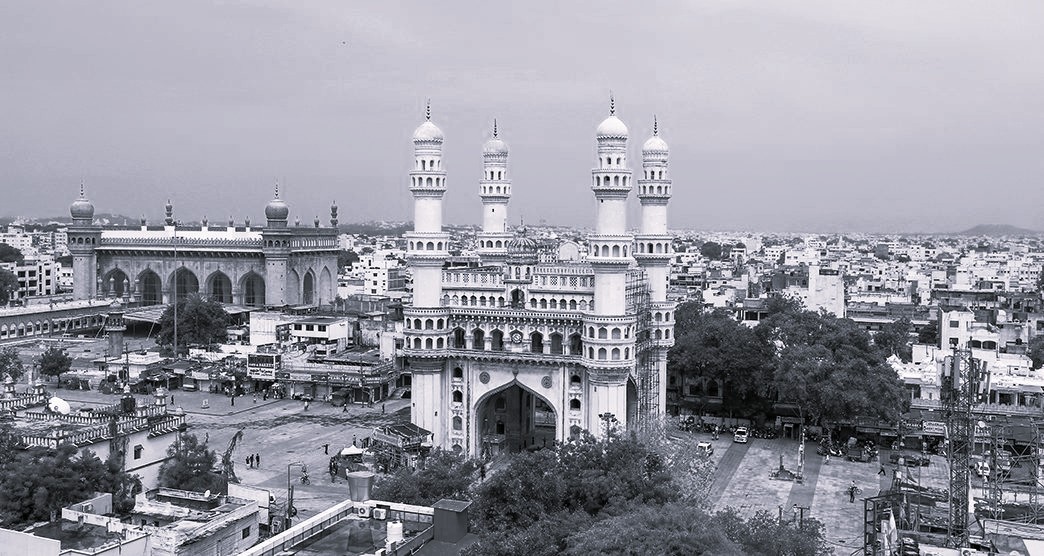
Charminar: A Mirror to Royal Grandeur
Charminar stands as the crown jewel of Hyderabad and a symbol of its rich historical heritage. Built in 1591, this magnificent structure is more than just a tourist spot; it is a reflection of the culture and majesty of the Nizam era. Located in the heart of the city with its four grand minarets, it captivates both architecture enthusiasts and history seekers alike. The bustling markets surrounding Charminar, the aroma of mouth-watering biryani, and the vibrant pearl shops offer a unique experience to every traveler.
The area around Charminar is the true address of Hyderabadi culture. For those planning a one-day trip, nearby attractions like Mecca Masjid, Laad Bazaar, Chowmahalla Palace, Salar Jung Museum, and the Nizam Museum, along with the authentic flavors of the Old City, await.
History of Charminar
Charminar was built in 1591 by Sultan Mohammed Quli Qutub Shah. While some say he built this square-shaped structure with its intricate carvings in honor of his wife, Bhagmati, there are various historical accounts regarding its origin:
Eradication of Plague:
The most popular belief is that it was built to commemorate the end of a deadly plague that had ravaged the city. It is believed the Sultan built Charminar as a mark of gratitude to Allah after his prayers for the people were answered. The four pillars are said to be dedicated to the first four Caliphs of Islam.
Shia Taziya Model:
Some suggest it was built in the shape of a Shia 'Taziya' in memory of Prophet Muhammad's son-in-law. Others believe the Sultan first laid eyes on his beloved Bhagmati at this very spot.
Second Islamic Millennium:
According to the 17th-century French traveler Jean de Thévenot and Persian texts, it was built to mark the beginning of the second Islamic millennium.
Founding of the City:
An inscription on its foundation stone reads, "Lord, fill this city with people as You have filled the river with fish." Historian Mohammed Safiullah notes that it was designed as the central grid point for the city's construction.
Construction and Repairs
Construction began in 1589 and was completed within two years at a cost of 9 lakh rupees (approx. 2 lakh Huns/gold coins). The structure weighs about 14,000 tons and has a 30-foot-deep foundation.
In 1670, a minaret collapsed due to a lightning strike and was repaired for 58,000 rupees. In 1820, Sikander Jah carried out further repairs costing 2 lakh rupees. Legend has it that a secret tunnel exists between Charminar and Golconda Fort for the royal family to escape during emergencies, though no such tunnel has ever been discovered.
Architecture of Charminar
Designed by Iranian architect Mir Momin Astarabadi, Charminar is built of granite and lime mortar. Each side measures 20 meters, and the four minarets stand 48.7 meters tall. The minarets are divided into four stories with beautifully carved rings.
There are 149 steps to reach the upper floor, which houses the oldest mosque in Hyderabad on its western side. The mosque contains 45 prayer spaces ( musallah ) and a small water tank ( wazu ) with a fountain. The pillars resemble lotus leaves, a hallmark of Qutub Shahi architecture. Clocks were added to the four sides in 1889.
Nearby Attractions
Mecca Masjid
Located very close to Charminar, this is one of the largest mosques in the world. It is named so because the bricks used for its central arch were made from soil brought from Mecca.
Started in 1617 by Sultan Mohammed Quli Qutub Shah and completed 77 years later in 1694 during Aurangzeb's reign. The main hall can accommodate 10,000 people. It houses the marble graves of the Asaf Jahi (Nizam) rulers. A local legend says that anyone who sits on the two black stone benches in the courtyard will surely return to Hyderabad. Visitors must dress conservatively (women are advised to wear a headscarf). Entry is free.
Laad Bazaar (Choodi Bazaar)
A 400-year-old market famous for its exquisite lacquer bangles ( lac bangles ) studded with stones. It also offers pearls, zari-work fabrics, and traditional perfumes ( attar ).
Chowmahalla Palace
The former residence of the Nizams, completed between 1857 and 1869. The name means "Four Palaces."
Highlights:
The Khilwat Mubarak (Durbar Hall) features massive Belgian glass chandeliers and a marble throne.
Museum:
It showcases vintage cars (including a Rolls Royce), weapons, and rare paintings. It received the UNESCO Asia-Pacific Heritage Merit Award in 2010.
Salar Jung Museum & Nizam Museum
Salar Jung Museum:
Located on the banks of the Musi River, it features the world's largest one-man collection of artifacts, including the famous 'Musical Clock' and the 'Veiled Rebecca' marble statue.
Nizam Museum (Purani Haveli):
Houses gifts received by the last Nizam and his massive wardrobe (the world's largest).
Flavors of Old City
A visit is incomplete without starting with Irani Chai and Osmania biscuits and ending with the world-famous Hyderabadi Biryani or tea at Nimrah Café.
Tip:
The area is always crowded; visiting in the early morning is recommended for the best experience.