
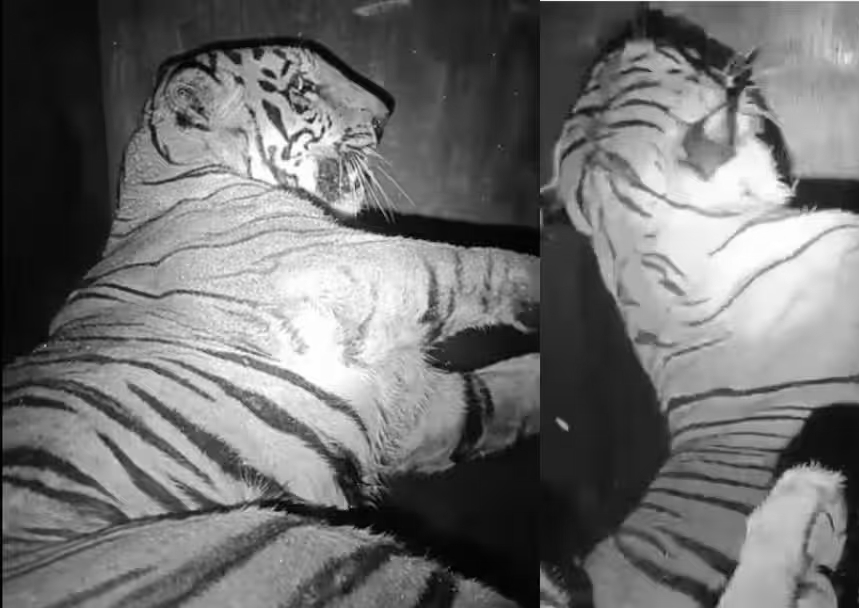
Chandrapur Tigress T-2 Captured After Killing Four Women, Shifted to Transit Care Centre
A 14-year-old tigress T-2 , responsible for killing four women in Chandrapur district , has been captured after a sustained and coordinated operation by the Maharashtra forest department , officials said on Sunday.
The women were killed on May 22 in compartment 1836 of a forest area near Gunjewahi village in Sindewahi tehsil, around 70 km from Chandrapur district headquarters, triggering an intensive multi-day search operation across the forest landscape.
The tigress was tranquilised near a pond in the Pawanpar beat area on Saturday evening after being tracked by specialised teams using combing operations, surveillance inputs, and field verification. A sharpshooter from the Tadoba Rapid Response Team (RRT) carried out the darting operation after locating the animal.
Following capture, officials confirmed the tigress was safely immobilised and transported under supervision to a holding cage. She has now been shifted to a transit treatment centre in Chandrapur , where veterinary teams are monitoring her health condition.
The operation involved a large-scale deployment of the Special Tiger Protection Force (STPF) , Rapid Response Teams, forest guards, and field staff, supported by drone surveillance, motion-sensor cameras, and camera traps spread across the forest zone to track movement and confirm identity.
Officials said on-site verification confirmed the tigress as T-2 , the same animal responsible for the fatal attacks, after which the capture was authorised and completed by evening.
No cubs were found at the capture site. However, authorities have now launched an expanded search operation after confirming that the tigress is believed to have three cubs, aged around 16–18 months , still unaccounted for in the forest.
A strengthened 77-member multi-agency team , including STPF units, RRT personnel, forest guards, trackers, and surveillance operators, has been deployed to locate the cubs. The search is being supported by drones, live monitoring systems, and extensive camera trap networks placed across suspected movement corridors.
Officials said the cubs’ location and safety have become the top priority, and further action regarding the tigress will depend on the outcome of the ongoing search and assessment of field conditions.