
CEPA 2.0: India and South Korea Target Balanced Trade and Industrial Cooperation
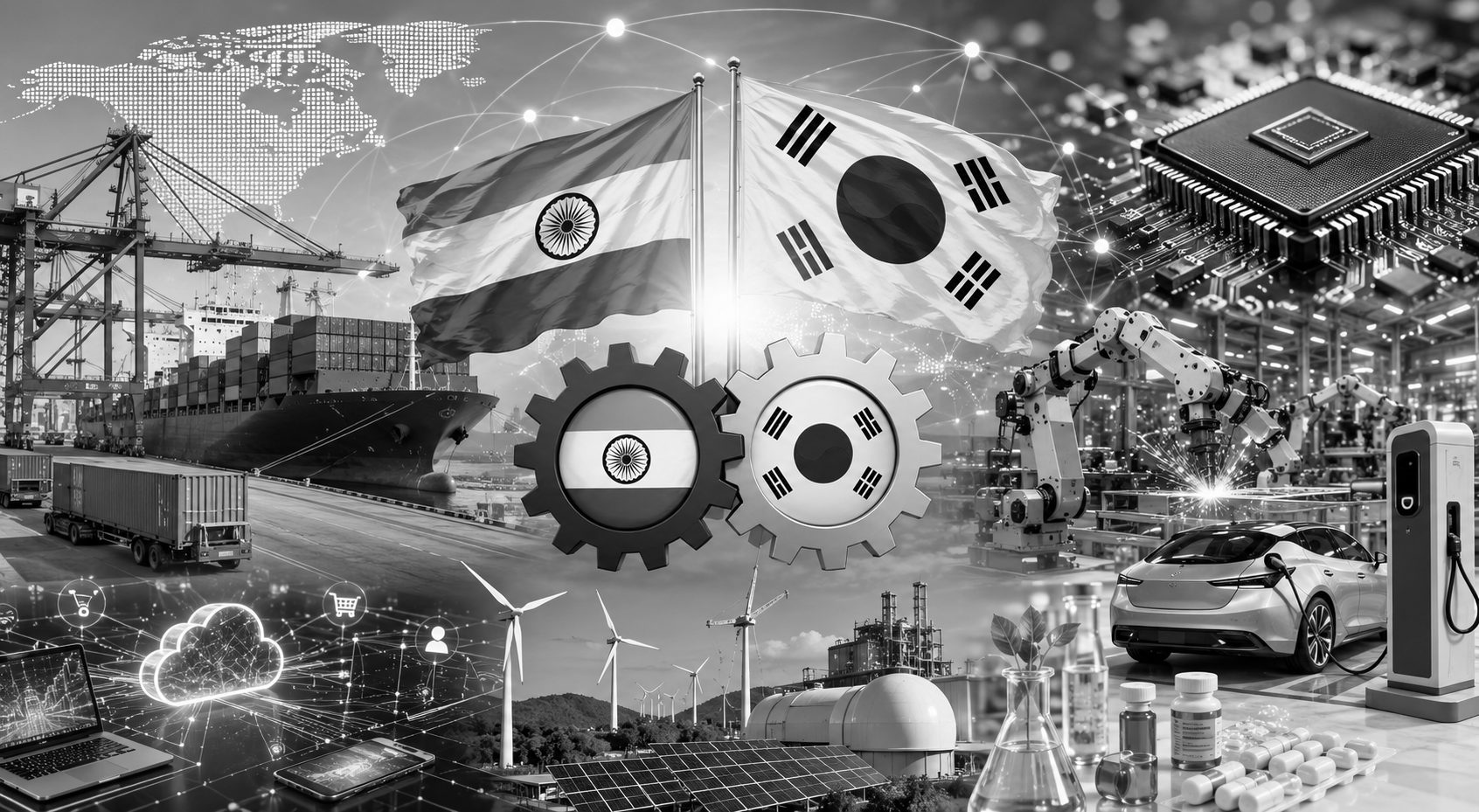
India and South Korea have stepped up efforts to reshape their economic partnership with the conclusion of the 12th round of negotiations for upgrading the India-Korea Comprehensive Economic Partnership Agreement (IK CEPA) in New Delhi. The latest talks signal a renewed push by both countries to address trade imbalances while expanding cooperation in emerging sectors such as digital trade, supply chains and advanced manufacturing.
The negotiations, held from May 25 to 27 , followed the joint declaration signed during the April 2026 India visit of South Korean President Lee Jae-myung . During the visit, Union Commerce and Industry Minister Piyush Goyal and Korean Trade Minister Yeo Han-koo agreed to accelerate the long-pending CEPA upgrade process as part of a broader “ Futuristic Partnership ” vision between the two nations.
The talks were co-chaired by Kapil Chaudhary , Joint Secretary in India’s Department of Commerce, and Park Geun-oh , Director General for Trade Agreement Policy at South Korea’s Ministry of Trade, Industry and Energy. Both sides reviewed the progress made so far and reiterated their commitment to concluding a modernised and mutually beneficial agreement in a time-bound manner.
A major focus of the negotiations was India’s growing trade deficit with South Korea. The original CEPA, which came into force in 2010, was intended to boost bilateral trade and investment. However, Indian officials believe the agreement has disproportionately benefited Korean exports. India’s imports from South Korea rose to $21.35 billion in 2025-26 , while exports stood at nearly $6 billion , pushing the trade deficit to $15.35 billion .
Indian policymakers have argued that imports of high-value Korean goods such as electronics, automobiles, machinery, steel and chemicals have increased significantly over the years, while Indian exporters continue to face market access barriers and strict standards requirements in South Korea.
During the latest round, negotiators discussed key areas including Trade in Goods , Trade in Services , Investment , Rules of Origin , and Sanitary and Phytosanitary standards . In a significant development, both countries also agreed to establish dedicated sub-groups for discussions on digital trade , supply chain cooperation , and strategic industrial collaboration .
The widening scope of the negotiations reflects changing global economic realities. India and South Korea are increasingly seeking to build resilient supply chains and reduce vulnerabilities linked to global manufacturing disruptions and overdependence on concentrated production hubs.
South Korean companies including Samsung Electronics , Hyundai Motor Company , LG Electronics , and Kia Corporation already have a major presence in India’s manufacturing ecosystem. The upgraded CEPA is expected to deepen cooperation in sectors such as semiconductors, clean energy, electric mobility, artificial intelligence, batteries and advanced manufacturing .
Both countries have also set an ambitious target of expanding bilateral trade to $50 billion by 2030 . Analysts believe the CEPA upgrade is now evolving beyond a conventional free trade agreement into a broader strategic and technology partnership aimed at strengthening economic security and industrial cooperation in the Indo-Pacific region.