
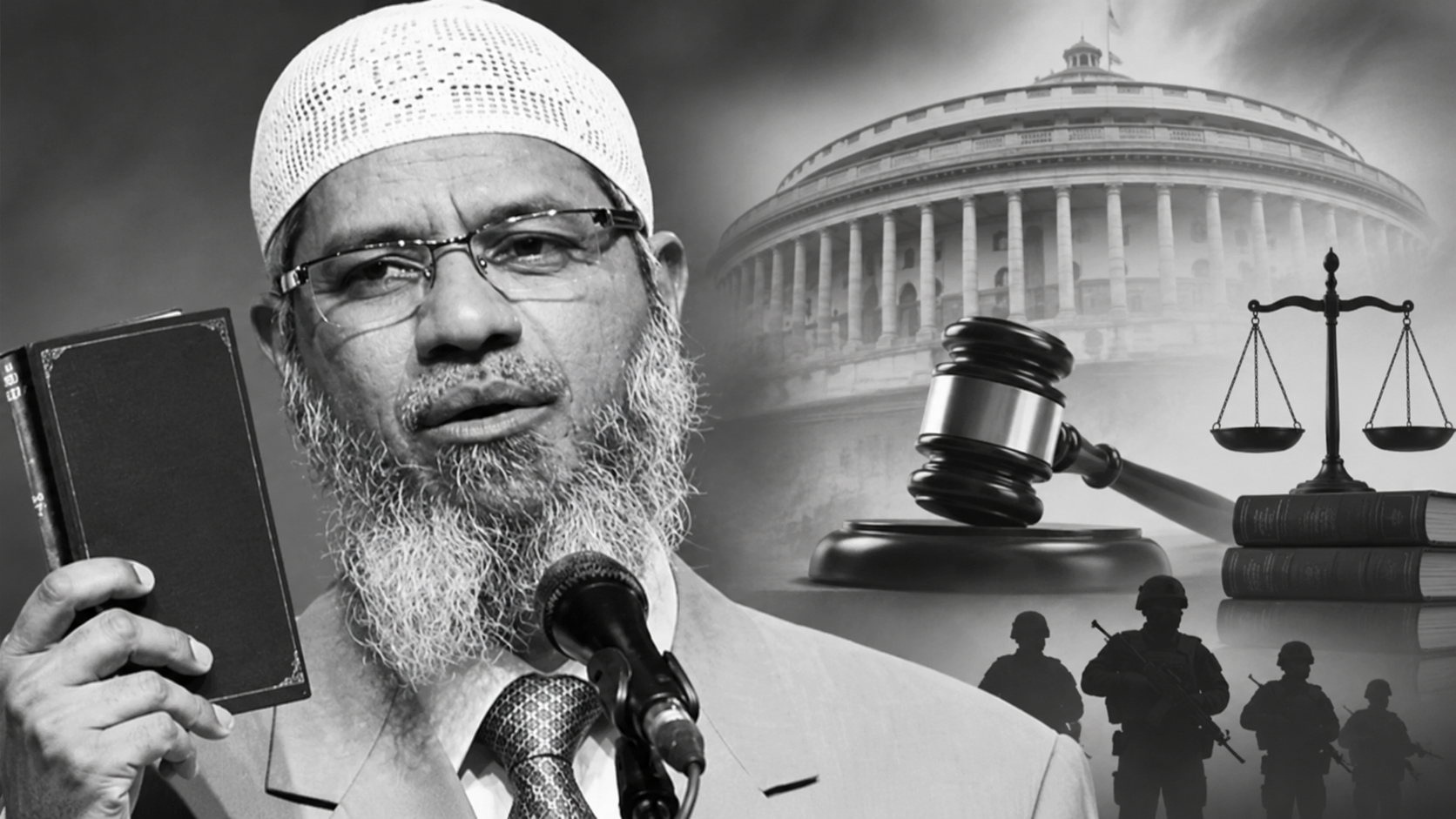
Centre Widens UAPA Action Against Zakir Naik's Islamic Research Foundation
The Centre has authorised state governments and Union Territory administrations to exercise financial and property-related enforcement powers under the Unlawful Activities (Prevention) Act (UAPA), 1967, against fugitive preacher Zakir Naik's Islamic Research Foundation (IRF), widening the scope of action against the organisation beyond the Central government. In a Gazette notification issued on November 26, the Ministry of Home Affairs (MHA) invoked Section 42 of the anti-terror legislation to delegate powers under Sections 7 and 8 to state and UT authorities, enabling them to restrict financial transactions, investigate suspected funding arrangements and regulate premises allegedly being used for the activities of the banned organisation.
The directive follows the Centre's November 13 decision to extend the five-year ban on IRF under Sections 3(1) and 3(3) of the UAPA. First declared an unlawful association on November 17, 2016, the organisation's prohibition was renewed in 2021 and has now entered its third consecutive five-year period. Earlier declarations were upheld by UAPA tribunals in May 2017 and March 2022.
Under Section 7, authorities can prohibit the transfer or use of funds, securities and financial assets suspected of supporting the unlawful association. It also enables authorised officers to investigate relevant financial dealings. Section 8 empowers authorities to notify houses, buildings and other premises suspected of being used for the organisation's activities, regulate access and restrict the use of specified movable properties.
However, the provisions do not mean automatic confiscation of all associated assets. Affected persons can challenge financial restrictions before the District Judge within 15 days and premises-related orders within 30 days. Separately, Section 4 requires the latest prohibition to undergo scrutiny by a UAPA Tribunal, which must decide the matter within six months. Section 42 has previously been used to delegate similar enforcement powers in cases involving Jamaat-e-Islami and the Jammu and Kashmir Liberation Front in 2019.
Meanwhile, India's efforts to secure Naik's return from Malaysia remain unresolved. His passport was revoked in 2017 following an NIA request. India approached INTERPOL for a Red Corner Notice that year, but its initial application was considered premature because a chargesheet had not been filed. A renewed request followed in January 2018, alongside an extradition request to Malaysia. On November 3, 2026, Malaysia informed its Parliament that it had decided not to extradite Naik to India.