
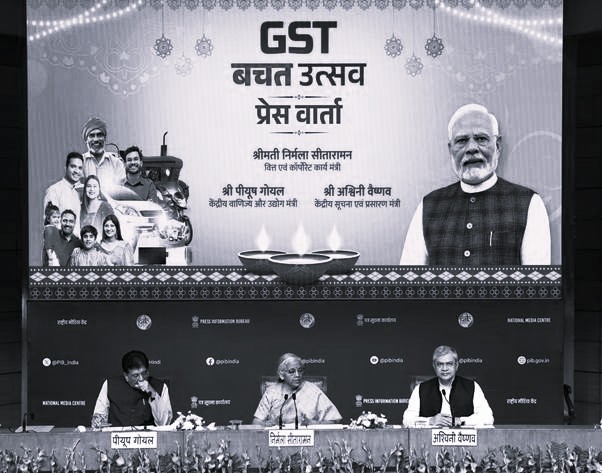
Centre says Next-Gen GST has passed benefits to consumers across 54 products
In a strong endorsement of the government’s latest tax reforms, three key Union Ministers Finance and Corporate Affairs Minister Smt. Nirmala Sitharaman, Commerce and Industry Minister Shri Piyush Goyal, and Railways, Information & Broadcasting, Electronics & IT Minister Shri Ashwini Vaishnaw jointly addressed the media in New Delhi today on the GST Bachat Utsav, highlighting its transformative impact on affordability, consumption, and manufacturing.
Benefits of GST reforms reaching consumers: FM Sitharaman
Finance Minister Nirmala Sitharaman said that the Next-Gen GST Reforms, announced by Prime Minister Narendra Modi and implemented from the first day of Navratri, mark a major milestone in India’s indirect tax system. “These reforms simplify the process, reduce slabs from four to two, and resolve classification issues all ahead of schedule,” she stated.
She noted that the Finance Ministry has been closely monitoring prices of 54 essential products to ensure that benefits of the revised tax structure reach the end consumers. “The Next-Gen GST benefits have been fully passed on across all 54 items,” she affirmed, adding that this reflects the Centre–State cooperation through the GST Council to pass on greater benefits to the people .
‘Double Dhamaka’ for Every Household: Piyush Goyal
Commerce and Industry Minister Piyush Goyal described the reforms as a “Double Dhamaka of relief and prosperity for every household.” He thanked the Prime Minister and Finance Minister for implementing the reforms during Navratri, calling it “the biggest reform since independence.” “The indirect tax system impacts 140 crore Indians, and the decision to provide ₹2.5 lakh crore in combined tax relief is unprecedented,” Shri Goyal said.
He added that the multiplier effect of these reforms is already visible in investment, business, and industry, driving a surge in India’s economy and boosting consumer spending. Highlighting sectoral growth, he noted that Maruti, Mahindra, and Tata Motors achieved record sales this Navratri, a reflection of rising consumer confidence and disposable income.
Electronics boom and semiconductor milestone: Ashwini Vaishnaw
Union Minister Ashwini Vaishnaw highlighted the robust expansion of India’s electronics sector, attributing it to the stability brought by GST reforms. “This Navratri, electronics sales surged by 20–25% year-on-year, with record demand across product categories. Even 85-inch TVs were sold out,” he said. He added that India’s electronics manufacturing sector has seen double-digit growth, creating over 25 lakh new jobs, and that India has surpassed its neighbour in smartphone exports to the U.S.
In a significant technological breakthrough, two semiconductor plants CG Semi and Kaynes have started production, marking a critical step towards India’s self-reliance in the semiconductor ecosystem. Referring to macroeconomic data, Shri Vaishnaw said India’s GDP of ₹335 lakh crore last year included ₹202 lakh crore from consumption and ₹98 lakh crore from investment. “Consumption has grown nearly 10% this year, an additional ₹20 lakh crore demonstrating how GST reforms have strengthened the virtuous cycle of demand and investment,” he said.
Economic Outlook brightens ahead of Diwali
All three Ministers emphasised that the Next-Gen GST Reforms have made India’s tax regime simpler, more inclusive, and growth-oriented. The combined focus on consumer relief, manufacturing momentum, and investment growth, they said, is driving India’s transformation into the world’s fastest-growing large economy.