
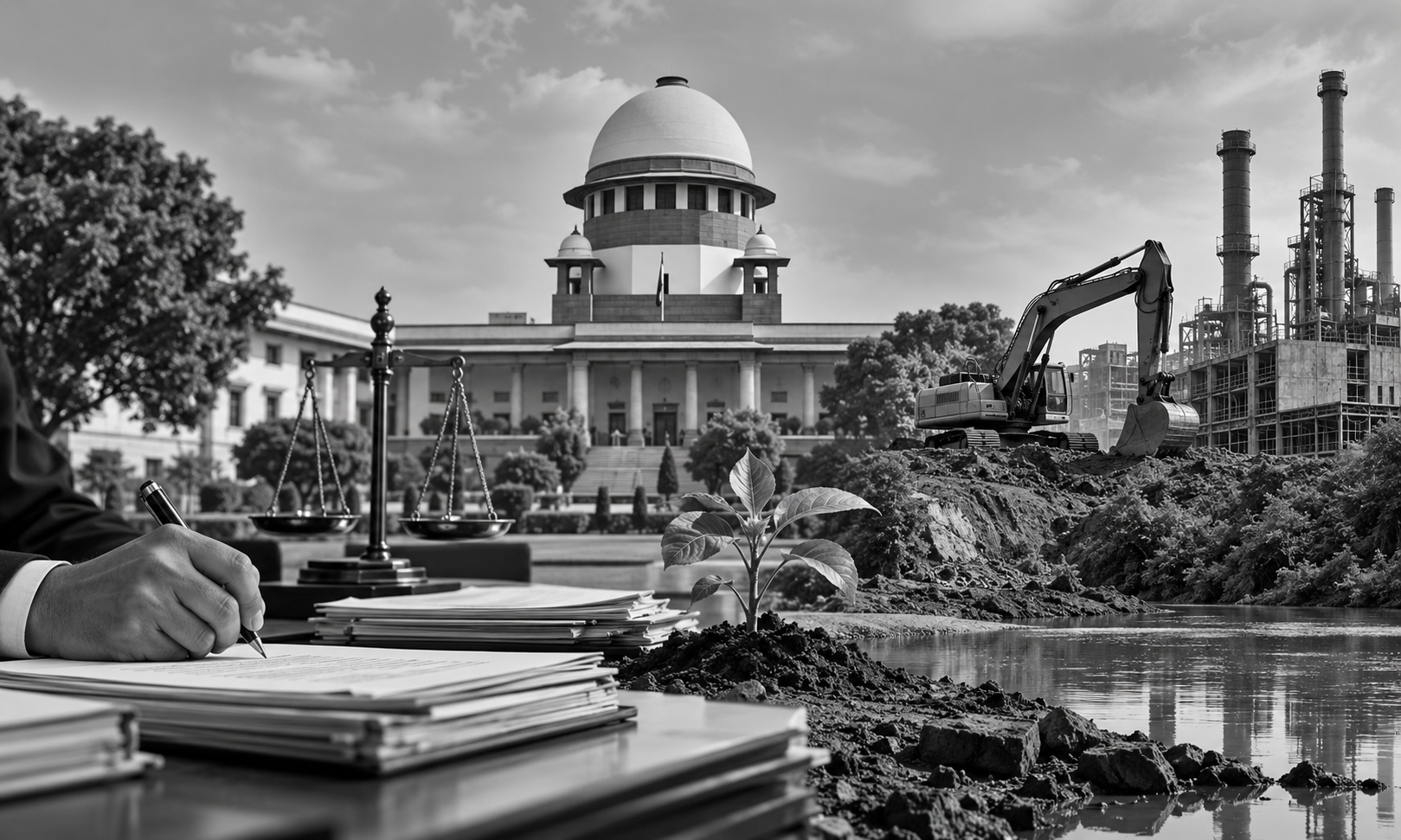
Centre Resumes Processing of Pending Post-Facto Environmental Clearance Cases
The Union Environment Ministry has directed its central and state-level environmental authorities to resume appraisal of pending post-facto Environmental Clearance (EC) proposals, following the Supreme Court’s July 2026 judgment that laid down a fresh legal framework for dealing with projects that had violated the prior-clearance requirement.
The Ministry’s September 30 direction to Expert Appraisal Committees (EACs), State-level Environment Impact Assessment Authorities (SEIAAs) and pollution control boards comes after the Supreme Court ordered that pending applications under earlier post-facto clearance mechanisms be taken to their logical conclusion in accordance with law. However, the Ministry has made it clear that no fresh applications can be accepted under the earlier mechanisms.
Post-facto ECs concern projects that have already begun construction, expansion or modernisation without obtaining the mandatory prior clearance. India’s environmental framework, particularly the EIA Notification, 2006, is based on the principle that potentially damaging projects should undergo environmental assessment before work begins. The objective is to assess pollution, ecological impacts, resource use and community concerns before environmental damage occurs.
The current framework dates back to March 14, 2017, when the Ministry issued Notification S.O. 804(E), creating a one-time mechanism for projects operating in violation of the prior-clearance requirement. Applications were initially permitted for six months and, following court proceedings, the window was extended until April 13, 2018. The mechanism envisaged environmental damage assessment, remediation, compensation and resource augmentation.
In July 2021, the Ministry introduced an Office Memorandum (OM) prescribing a Standard Operating Procedure for environmental violations. Unlike the 2017 notification, the OM was an administrative instruction. The Supreme Court subsequently held that an OM could not create an open-ended mechanism effectively altering the statutory environmental-clearance regime.
The legal position changed again in May 2025, when the Supreme Court struck down the earlier framework. A review petition followed, and the Court reconsidered the matter before delivering its July 29, 2026 judgment in Vanashakti v. Union of India.
The Court upheld the validity of the limited 2017 mechanism but quashed the 2021 OM. It directed authorities to take pending applications to their logical conclusion, while allowing reconsideration of proposals rejected or returned because of earlier court orders. At the same time, it barred fresh applications under the old mechanisms.
The latest Ministry direction therefore represents a limited reopening of the appraisal process, not a new amnesty. Projects will still have to undergo environmental scrutiny, including assessment of ecological damage and remedial measures.
The policy challenge now lies with regulators: resolving the backlog without weakening the principle that environmental clearance must ordinarily be obtained before a project begins. For industry, the message is equally significant - historical cases may be processed, but future violations cannot rely on post-facto clearance as a routine compliance route.