
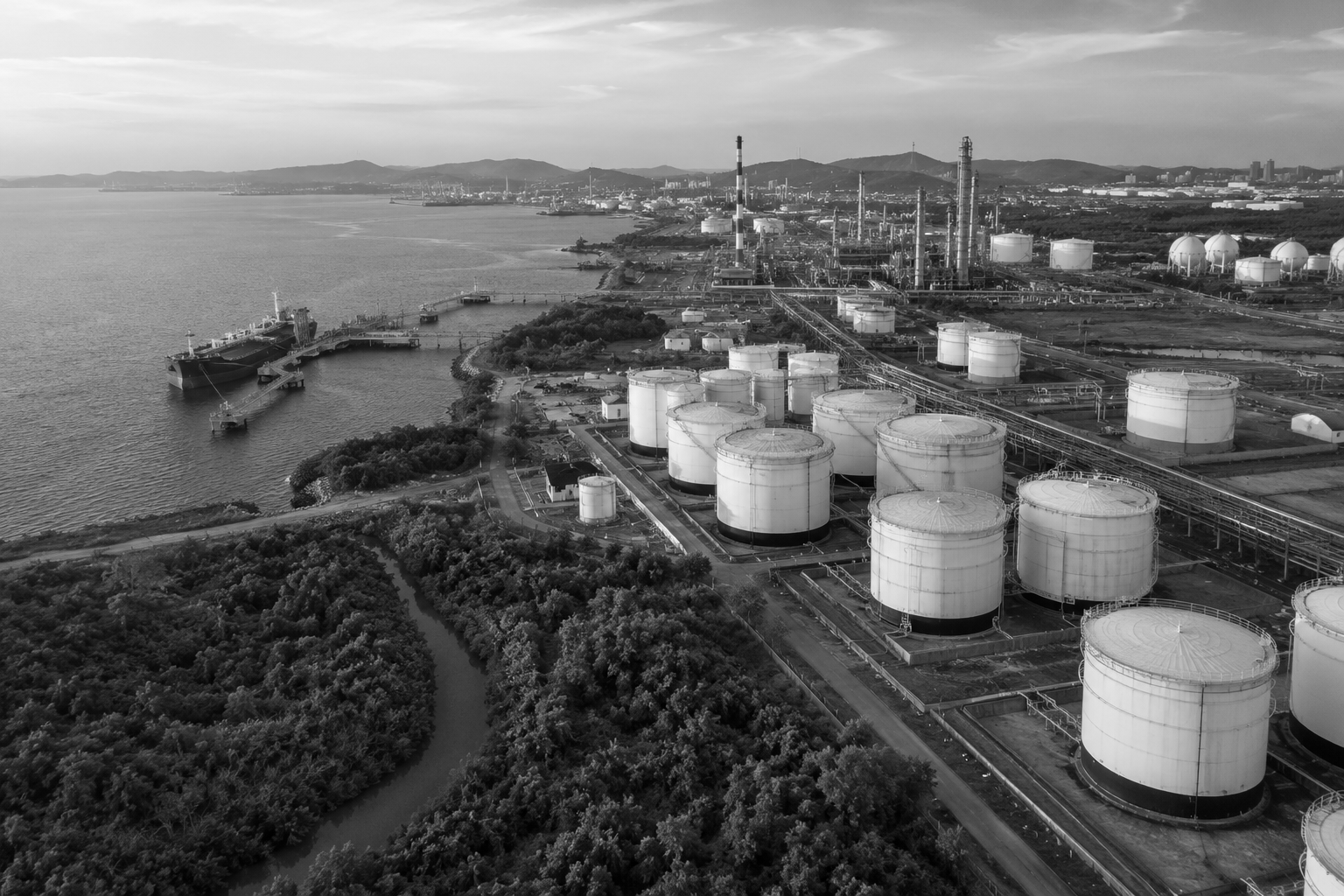
Centre Proposes New Coastal Storage Permissions for Petrochemical Feedstocks
India’s coastal environmental regulations are undergoing another significant shift as the Union Environment Ministry moves to permit the storage of additional petroleum-linked chemicals inside Coastal Regulation Zones (CRZs) , highlighting the growing influence of energy and industrial priorities on environmental policymaking.
In a draft notification issued this week, the ministry proposed allowing the receipt and storage of Linear Alkyl Benzene (LAB), N-Paraffin, and Carbon Black Feedstock (CBFS) in CRZ areas, except in ecologically sensitive CRZ-IA zones . The proposal follows recommendations from the sectoral Expert Appraisal Committee (EAC) , the CRZ-specific EAC, and the National Coastal Zone Management Authority (NCZMA) .
According to the draft, the NCZMA concluded that these products have “comparatively lower hazardous chemical characteristics” than petroleum products already permitted in CRZ areas, including crude oil, liquefied petroleum gas (LPG), and kerosene.
The proposal reflects a broader trend in India’s environmental governance, where coastal regulations are increasingly being adapted to support industrial expansion, energy logistics, and port-led economic growth. Originally introduced in 1991 to protect fragile shorelines and coastal ecosystems, CRZ rules cover India’s entire coastline, including the Andaman and Nicobar Islands and Lakshadweep Islands . They regulate activities near seas, estuaries, creeks, rivers, and backwaters affected by tidal action.
However, experts note that successive amendments — particularly the CRZ Notification, 2019 — have gradually expanded the list of permissible activities in coastal regions. Infrastructure linked to ports, tourism, LNG terminals, petrochemical storage, and coastal roads has increasingly received regulatory backing in the name of economic development and energy security.
India’s dependence on coastal infrastructure has grown rapidly alongside rising imports of crude oil, LNG, LPG, and petrochemical feedstocks. Coastal cargo traffic has nearly doubled over the past decade, increasing from about 161 million tonnes in FY2013-14 to nearly 339 million tonnes in FY2024-25 , intensifying demand for storage terminals and liquid cargo facilities near ports.
Major coastal energy hubs already operate at locations such as Paradip Port , Visakhapatnam Port , Mundra , Dahej , Ennore Port , and the Kochi LNG Terminal . India also maintains strategic petroleum reserves at Visakhapatnam, Mangaluru, and Padur .
Environmental groups, however, warn that repeated relaxations in CRZ rules could weaken protections for vulnerable coastal ecosystems. While the latest proposal excludes sensitive CRZ-IA regions containing coral reefs and mangroves, critics argue that expanding industrial storage near coastlines could still increase risks of pollution, chemical leaks, and ecological degradation at a time when climate change is already intensifying coastal erosion and extreme weather events across India.