
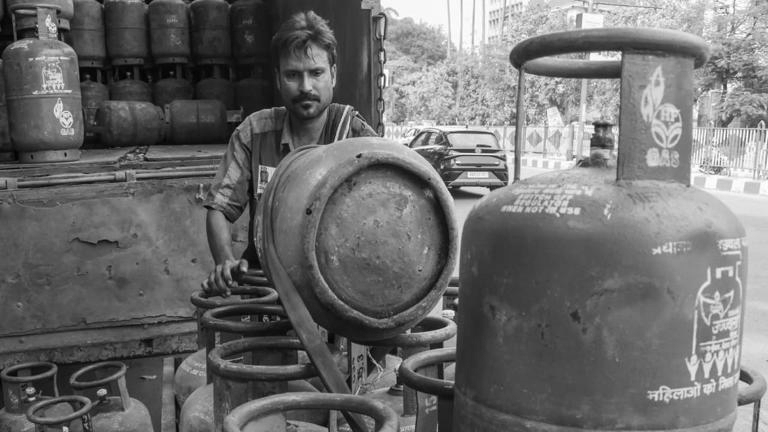
Centre Expands 5 Kg LPG Access to Power Clean Cooking for Migrant Workforce
The Ministry of Petroleum & Natural Gas (MoPNG) has unveiled a major reform to expand access to 5 kg Free Trade LPG (FTL) cylinders , targeting migrant workers, students, and low-income urban households who often remain outside the formal LPG ecosystem. By removing supply caps and doubling daily allocations across all States and Union Territories from April 7 , the government aims to address both rising demand and long-standing barriers to clean cooking access.
This move comes at a time when global LPG supply pressures , partly influenced by geopolitical tensions in West Asia , have tightened availability and heightened concerns over affordability. Domestically, the policy responds to the structural challenges faced by India’s vast migrant population many of whom lack permanent address proof , frequently relocate, and depend on informal housing arrangements . These constraints have historically limited their access to subsidised LPG connections, pushing them toward polluting fuels or unsafe informal markets .
A key highlight of the reform is the simplification of the purchase process . Consumers can now obtain a 5 kg cylinder using a basic ID such as Aadhaar or PAN card , along with a self-declaration , eliminating the need for permanent address verification. This shift marks a transition toward a more portable and user-centric energy access model , where LPG availability is no longer tied strictly to fixed households but adapted to the realities of a mobile workforce .
Early data indicates strong and immediate demand . Between March 23 and April 9 , over 8.9 lakh cylinders were distributed nationwide, with a peak single-day sale exceeding 1.1 lakh units on April 7 . The rapid uptake underscores the presence of latent demand that was previously constrained by procedural hurdles rather than lack of interest.
From an economic standpoint, the initiative carries broader implications. In industrial hubs, limited access to cooking fuel has contributed to worker distress and even reverse migration , affecting productivity. By ensuring portable and easily accessible LPG , the government is effectively supporting labour stability alongside energy access. Parallel measures to maintain LPG supply for industries reflect a dual strategy sustaining production while safeguarding workforce welfare.
Unlike subsidised domestic LPG, the 5 kg FTL cylinders operate on a market-based pricing model , with refills costing around ₹630–₹631 and cylinders priced higher upfront. However, the smaller size reduces immediate cash outflow , making it a practical solution for daily wage earners and short-term users . This approach prioritises affordability in usage cycles rather than overall subsidy dependence .
To ensure last-mile reach, distribution is being expanded through LPG distributors, petrol pumps, and local retail points , with State governments and Oil Marketing Companies (OMCs) coordinating supply logistics. Additionally, over 1,600 awareness camps have been conducted nationwide to promote adoption and safe usage. Despite these efforts, awareness gaps remain a key challenge , with many potential beneficiaries still unfamiliar with the scheme or access process.
The initiative also aligns with India’s broader push toward clean energy transition , aiming to reduce reliance on biomass fuels such as firewood and coal , which contribute to indoor air pollution and health risks. Complementing flagship schemes like Pradhan Mantri Ujjwala Yojana (PMUY) , which focuses on rural households, the 5 kg LPG expansion extends the clean cooking mission into urban and migrant segments .
Overall, the government’s push for 5 kg LPG cylinders represents a significant shift in energy governance from a static, household-based model to a flexible, demand-driven system . By combining policy reform, simplified access, and expanded distribution , it seeks to close a critical gap in India’s urban energy landscape while reinforcing the goal of inclusive and universal clean cooking access .