
Centre Drives Jal Jeevan Mission 2.0 with Reform-Linked Push for Rural Water Security
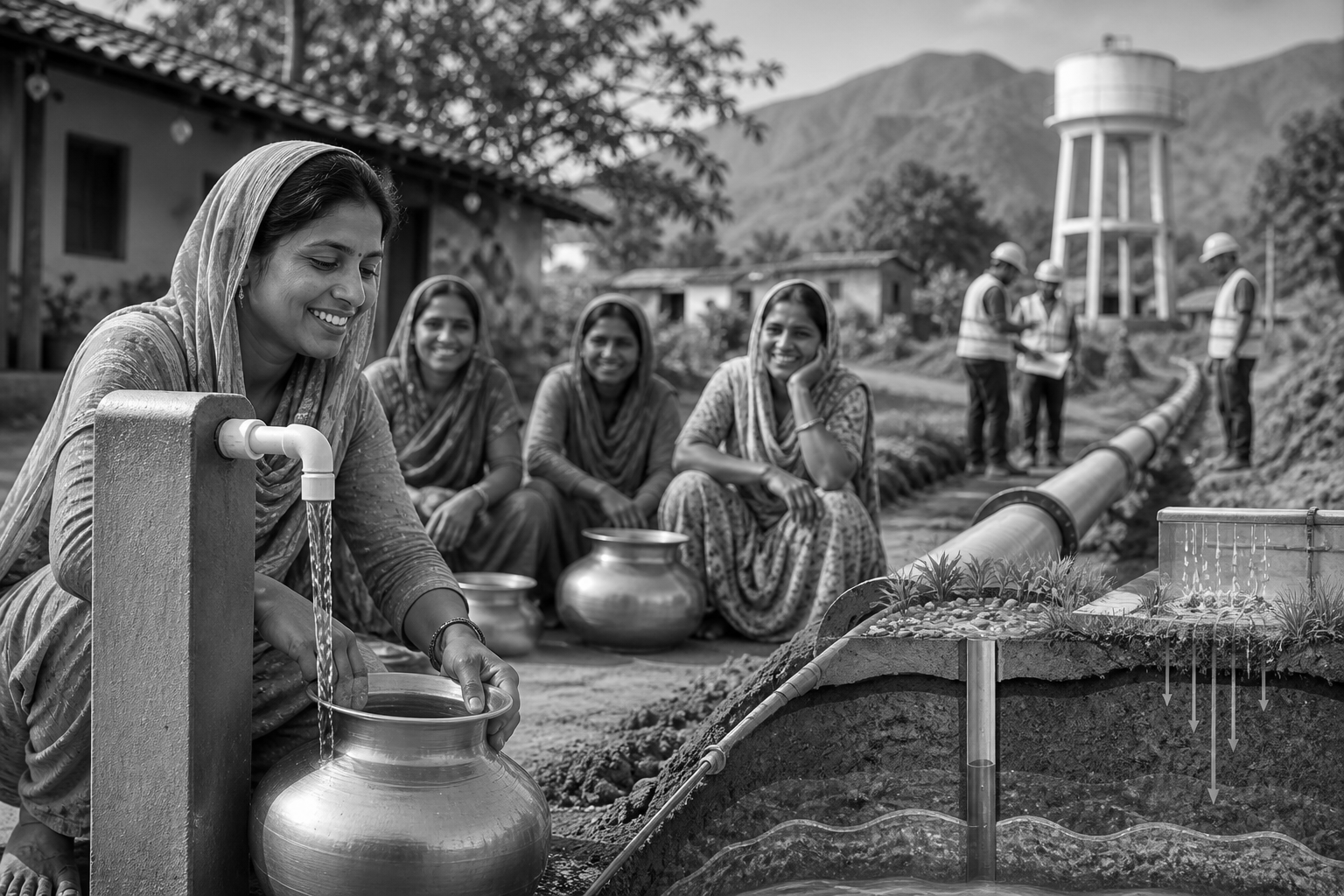
India’s ambitious rural water supply programme, the Jal Jeevan Mission (JJM) , is entering a crucial second phase with the Centre sharpening its focus on sustainability, service delivery, and accountability . Launched in 2019, the scheme aims to provide functional household tap connections (FHTC) to every rural household, and has already transformed access to drinking water across large parts of the country.
With rural tap water coverage rising from less than 20% in 2019 to over 75% today , the government is now shifting its emphasis from infrastructure creation to ensuring reliable and continuous water supply . The mission timeline, initially set for 2024, has been extended to 2028 , reflecting both the scale of the challenge and the Centre’s commitment to universal coverage.
Recent progress in states such as Uttarakhand, Karnataka and Tripura where coverage ranges between 86% and 98% highlights the scheme’s rapid expansion. However, the Centre has made it clear that future funding and support will depend not just on coverage figures but on quality of service and long-term sustainability .
Operating under the Ministry of Jal Shakti , JJM follows a centrally sponsored model , with costs shared between the Centre and states. To drive reforms, the government has introduced performance-linked Memorandums of Understanding (MoUs) that tie financial assistance to outcomes such as operation and maintenance (O&M), community participation, and grievance redressal systems . This marks a decisive shift towards result-based governance .
Institutional strengthening is central to this transition. States are being encouraged to establish District Water and Sanitation Missions (DWSM) and District Technical Units (DTUs) , while Gram Panchayats and village-level committees are being empowered to manage local water systems. This decentralised model promotes “Jan Bhagidari” , ensuring that communities play a direct role in maintaining infrastructure and sustaining water supply.
The mission also integrates source sustainability measures , including rainwater harvesting, groundwater recharge, and greywater management , particularly crucial for water-stressed regions.
As JJM moves into its next phase, the Centre’s approach reflects a broader shift in public policy from building assets to delivering citizen-centric services . By linking funds to reforms and strengthening local governance, the government aims to ensure that every rural household receives not just a tap connection, but safe, dependable, and sustainable drinking water .