
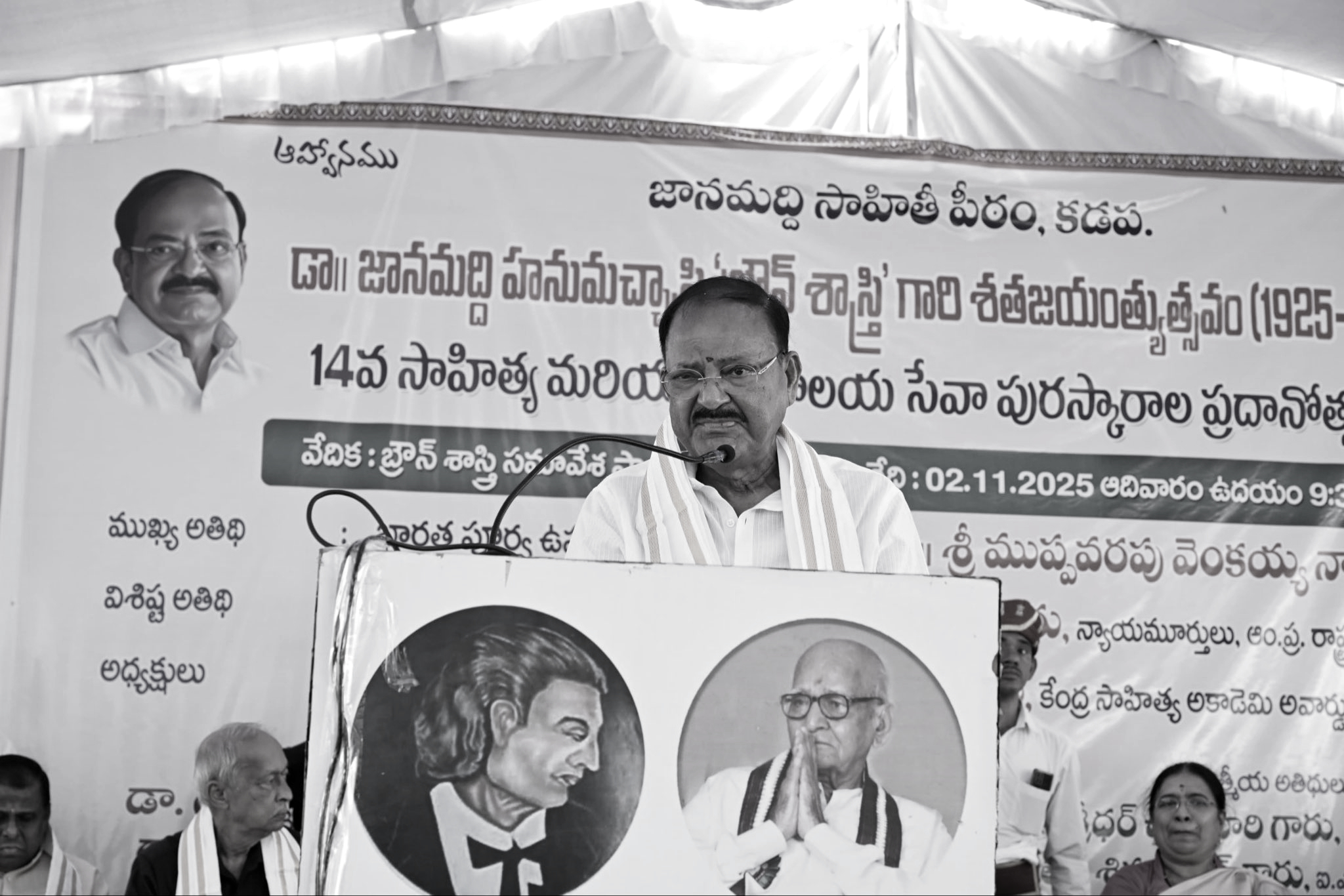
Centenary of Janamaddi Hanumachastri marked with tributes to Telugu heritage
Former Vice-President of India M. Venkaiah Naidu paid rich tributes to noted Telugu scholar Shri Janamaddi Hanumachhastri Garu (1926–2014) on the occasion of his centenary, recalling his lifelong contribution to the preservation and promotion of the Telugu language. In his message, shared on his official social media account, Mr. Naidu also remembered Charles Philip Brown (1798–1884)—the English civil servant and Indologist widely known as the Father of the Telugu Renaissance —for his unparalleled service to the language and literature of Andhra Pradesh.
In his post, Mr. Naidu expressed reverence to both scholars and extended special congratulations to Shri Janamaddi Vijayabhaskar Garu, son of the late Hanumachhastri, for his continued efforts in maintaining the C.P. Brown Memorial Library in Kadapa. He also appreciated Yogi Vemana University (YVU) for supporting the preservation of this historic institution, urging everyone to come forward to protect and develop the library.
Mr. Naidu emphasised that love for one’s mother tongue should go beyond symbolic celebrations. “We must love and master our mother tongue. We should admire and learn our sister languages. After that, we should respect other languages and learn them as needed,” he stated. Stressing the emotional and creative power of language, he added that the preservation of mother tongues must become a people’s movement. He urged Telugu enthusiasts and literary figures to find creative ways to teach the language easily to children, suggesting that each individual demonstrate love for Telugu by teaching it to at least ten children.
C.P. Brown’s Legacy
Charles Philip Brown, who served in the Madras Presidency under the East India Company, is remembered for his pioneering work in Telugu literature and linguistics. Born in Calcutta on November 10, 1798, to Rev. David Brown, a senior chaplain in Bengal, C.P. Brown arrived in Madras in 1817 and was appointed as an assistant in Cuddapah (Kadapa) in 1820.
During his tenure, he established a centre for Telugu scholars at his residence in Yerramukkapalli, employing about 20 pundits at his own expense to collect, copy, and edit ancient Telugu manuscripts. The facility came to be known locally as “Brown’s College.” It became a hub for the revival of Telugu classics at a time when Brown himself observed that “Telugu literature was dying out; the flame was flickering in the socket.”
Brown funded the transcription and commentary of thousands of palm-leaf manuscripts, sometimes even borrowing money to sustain his work. He spent over ₹ 30,000—a considerable sum in the 19th century—on wages for pundits and scribes. His most notable contributions include compiling the Telugu–English and English–Telugu dictionaries (1852–1854), editing classical works of Vemana, and writing major grammatical and prosodic studies.
Scholars regard him as the first European to apply modern philological and comparative methods to Telugu studies, introducing what he called the “European method of study.” His publications remain standard references in Telugu linguistics even today.
Janamaddi Hanumachhastri’s Contribution
More than a century later, Shri Janamaddi Hanumachhastri, a scholar and literary historian from Kadapa, devoted his life to researching and promoting C.P. Brown’s legacy. Born in 1926, Hanumachhastri was known for his deep commitment to Telugu literature, his editorial work on Telugu classics, and his efforts to preserve the memory of the British Indologist who had revived the language.
He founded the C.P. Brown Memorial Library Trust in Kadapa and served as its founder-secretary for several decades. Through his initiative, the C.P. Brown Memorial Library building was constructed on or near the site of Brown’s original residence in Yerramukkapalli and inaugurated in 1995. The library grew into an important centre housing thousands of books, manuscripts, and research documents related to Telugu literature.
Transition to Yogi Vemana University
In recognition of its cultural and academic value, the library was formally taken over by Yogi Vemana University, Kadapa, on November 1, 2006, and upgraded into the C.P. Brown Memorial Oriental Research Centre. The university has since been maintaining and managing the institution, supporting ongoing research and documentation in the field of Telugu language and literature.
Before the university’s takeover, the library was sustained by a private trust led by Hanumachhastri, with contributions from scholars and patrons across Andhra Pradesh. Under YVU’s management, it continues to function as a research and resource centre, preserving Brown’s manuscripts and promoting new studies in classical and modern Telugu.
A Shared Legacy of Language and Learning
C.P. Brown’s 19th-century mission to revive Telugu literature and Janamaddi Hanumachhastri’s 20th-century efforts to institutionalise that legacy are now seen as part of the same cultural continuum. Their work has ensured that the Telugu language’s literary and historical richness remains accessible to future generations.
On Hanumachhastri’s centenary, the remembrance by M. Venkaiah Naidu has been viewed as a reaffirmation of the enduring importance of language preservation. His appeal for collective participation in promoting mother tongues resonated strongly among scholars, students, and cultural enthusiasts alike.
The continued operation of the C.P. Brown Memorial Oriental Research Centre in Kadapa stands today as a living tribute to both the English Indologist who rekindled Telugu literature and the Telugu scholar who dedicated his life to preserving that revival for posterity.