
Census 2027: Uttarakhand, Chhattisgarh Lead India’s Shift to Fully Digital Population Count
India has begun an ambitious push toward its first fully digital Census 2027 , combining large-scale technological innovation with strong on-ground execution and rising citizen participation across states. The ongoing first phase the House Listing and Housing Census (HLO) marks a crucial step in building a comprehensive national database for evidence-based policymaking and inclusive development.
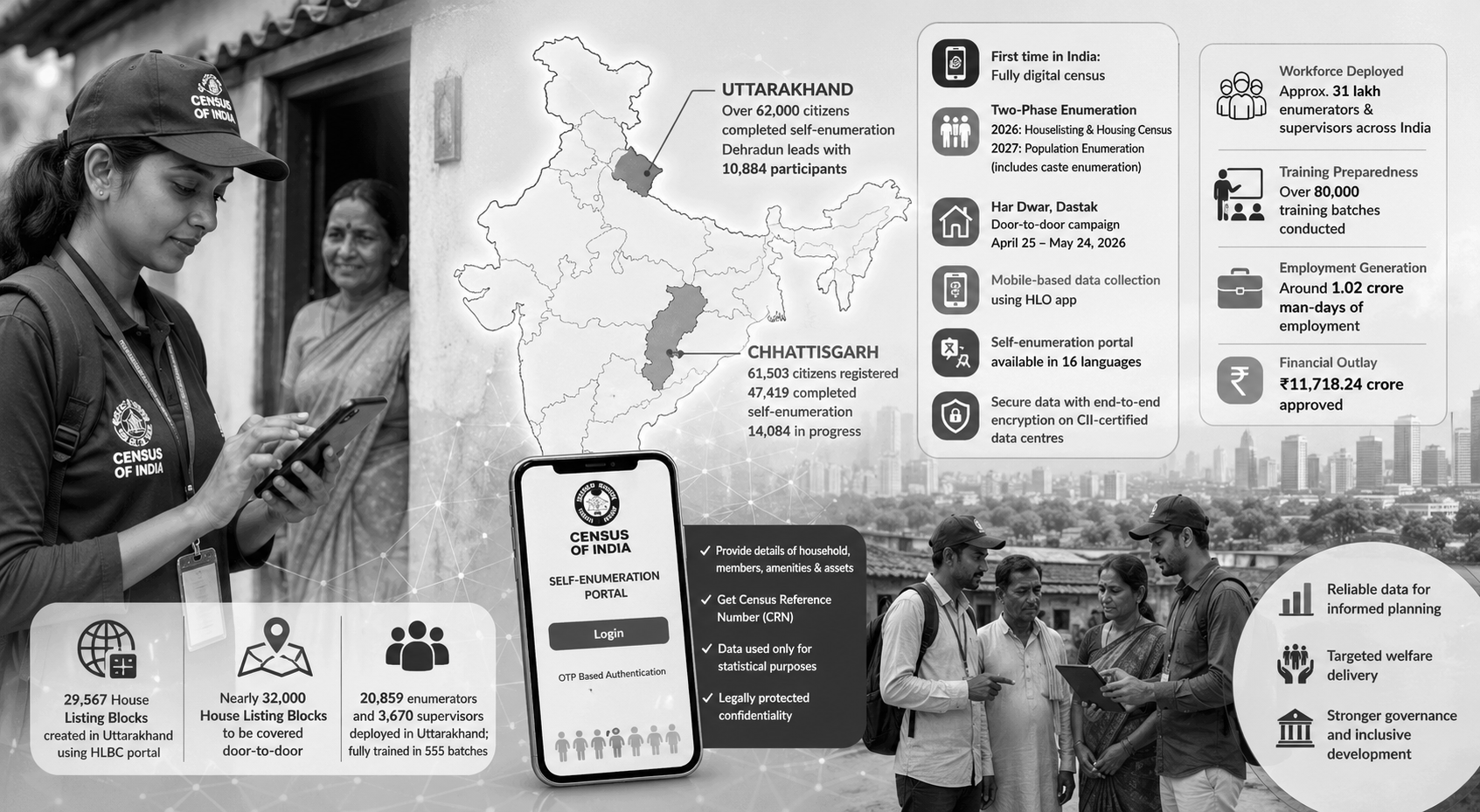
In Uttarakhand , the campaign officially commenced on April 25, 2026, under the banner “Har Dwar, Dastak” , with door-to-door enumeration scheduled until May 24. The state has already witnessed encouraging public engagement, with over 62,000 citizens completing self-enumeration , led by Dehradun district where 10,884 residents participated. To support the exercise, authorities have deployed 20,859 enumerators and 3,670 supervisors , trained across 555 batches using the HLO mobile application . The state has been digitally mapped into 29,567 House Listing Blocks , with nearly 32,000 blocks to be covered during field operations.
A similar momentum is visible in Chhattisgarh , where 61,503 citizens have registered for digital self-enumeration. Of these, 47,419 individuals have successfully submitted their data, while 14,084 users are in progress. Officials highlight that the OTP-based authentication system and generation of a unique Census Reference Number (CRN) have enhanced both accuracy and transparency. The digital approach has significantly reduced the workload on enumerators while improving data reliability. Authorities have also established helplines and deployed trained personnel to assist citizens, ensuring accessibility across demographics while maintaining strict data confidentiality protocols .
At the national level, Census 2027 represents a landmark transformation as India’s first fully digital census , backed by a robust institutional framework under the Census Act, 1948 . With a financial outlay of ₹11,718.24 crore , the exercise will be conducted in two phases—Houselisting in 2026 and Population Enumeration in 2027. Notably, the upcoming census will include caste enumeration , following a key decision by the government in April 2025, expanding the scope of socio-economic data collection.
The digital ecosystem supporting the census includes advanced platforms such as the Census Management & Monitoring System (CMMS) for real-time tracking, the Houselisting Block Creator (HLBC) for geo-referenced mapping, and a secure self-enumeration portal available in 16 languages . These tools ensure seamless coordination from data collection to processing, minimizing errors and enabling faster dissemination of results.
To guarantee security and public trust, the government has implemented a multi-layered data protection framework , including end-to-end encryption and hosting on Critical Information Infrastructure (CII)-designated data centres compliant with global standards. Personal data collected during the census remains strictly confidential under legal provisions and cannot be disclosed or used beyond statistical purposes.
The scale of the operation is unprecedented, with approximately 31 lakh enumerators and supervisors mobilized nationwide and over 80,000 training batches conducted to ensure operational efficiency. The exercise is also expected to generate around 1.02 crore man-days of employment , reflecting its economic as well as administrative significance.
As India moves toward the Census Moment set for March 1, 2027, the integration of digital tools, citizen participation, and administrative preparedness is expected to deliver faster, more accurate, and granular data. Experts emphasize that this transformation will strengthen governance by enabling targeted welfare delivery , improved infrastructure planning, and a deeper understanding of the country’s evolving demographic landscape.
With strong participation from states like Uttarakhand and Chhattisgarh and a robust national framework in place, Census 2027 is poised to become a defining milestone in India’s journey toward data-driven governance and inclusive growth .