
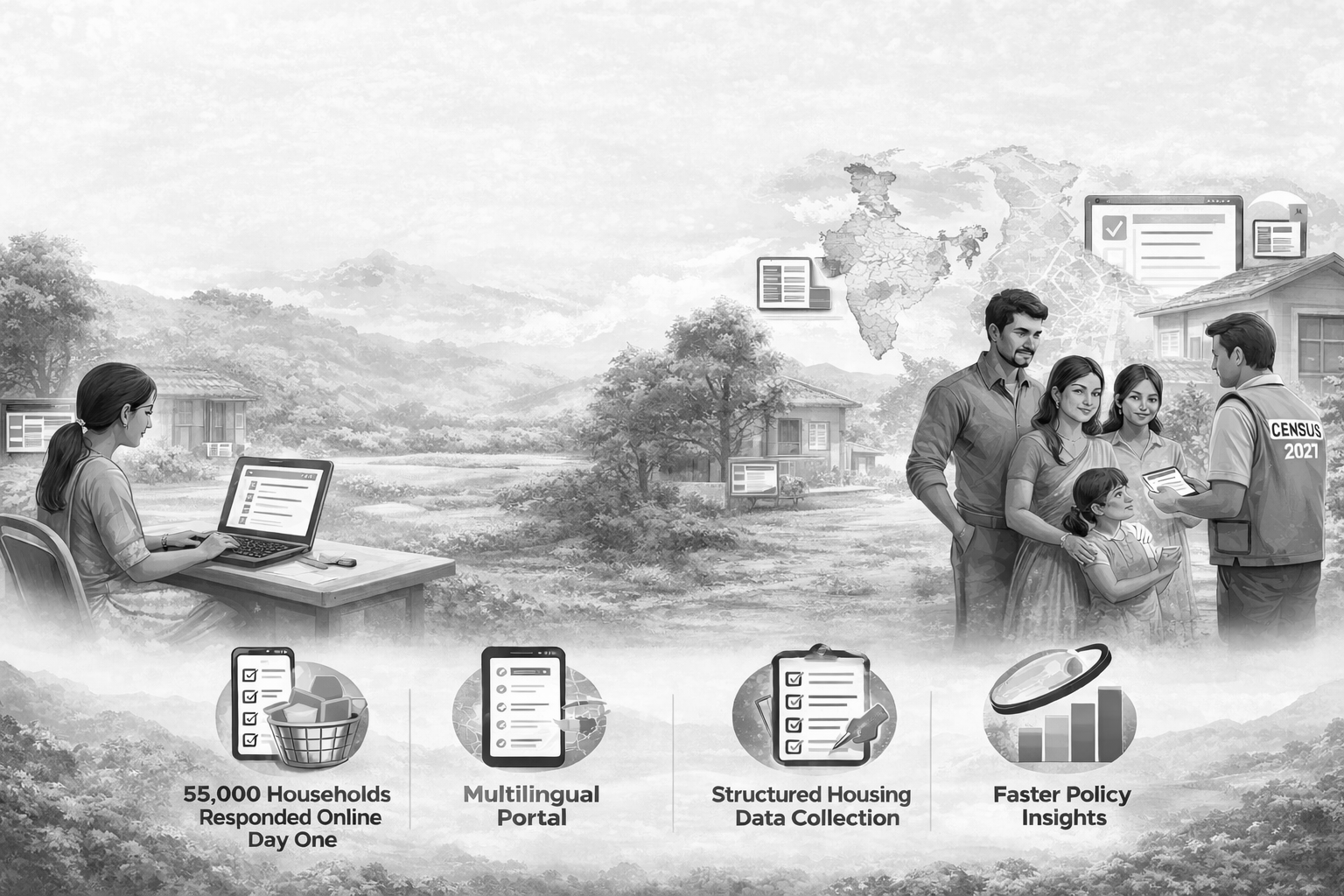
Census 2027: A Hybrid Model That Combines Self-Enumeration with Field Verification
India’s Census 2027 has begun with a significant digital push, with nearly 55,000 households across eight states and Union Territories opting for self-enumeration on the very first day. The facility has been rolled out in regions including Andaman and Nicobar Islands, Goa, Karnataka, Odisha, Sikkim, Mizoram, Lakshadweep , and select areas of Delhi, where residents can submit their details online before an enumerator’s visit. This marks the first time India is integrating a web-based portal into its population count, allowing citizens to log in using a mobile number, complete the questionnaire in 16 regional languages , and generate a unique Self-Enumeration ID for verification during field visits.
The census is being conducted in two phases, beginning with the Houselisting and Housing Census , which runs from April 1 to September 30, 2026 , with each state and Union Territory assigned a 30-day survey window . In selected regions, field operations are scheduled between April 16 and May 15, following a 15-day digital window that enables households to complete entries in advance. This phase includes 33 structured questions covering housing conditions, amenities, and assets, forming the basis for policy decisions, welfare targeting, and development planning.
Unlike the 2011 Census , which was entirely paper-based and dependent on manual data collection, Census 2027 introduces a hybrid approach that combines digital participation with door-to-door enumeration . While citizens can now actively input their own data, enumerators will continue physical verification to ensure accuracy and inclusion. The introduction of digital submission and verification through SE IDs creates a two-layer validation system , reducing errors and improving reliability compared to earlier methods.
This transition is expected to significantly improve efficiency, with digital systems enabling faster processing and quicker availability of data for governance. At the same time, the census remains a critical tool for shaping policies, guiding infrastructure development, and ensuring equitable distribution of resources. However, its success will depend on addressing challenges such as digital literacy , internet access in remote areas, and ensuring robust data security . Overall, Census 2027 represents a decisive step toward a more data-driven governance model, blending technology with traditional methods to make India’s largest administrative exercise more efficient, inclusive, and future-ready.