
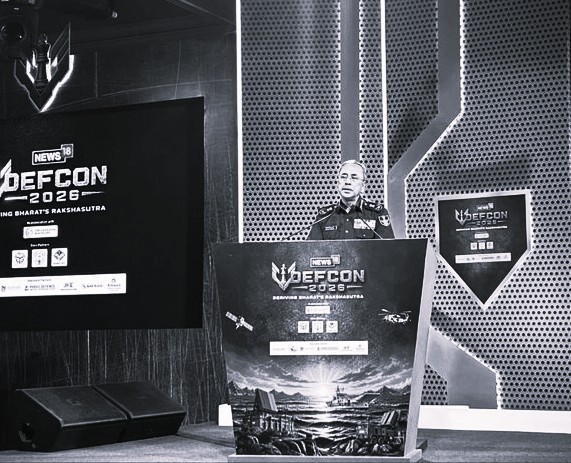
CDS Chief N.S. Raja Subramani Outlines Roadmap for Multi-Domain Defence
Stressing that “there is no safe place” in case of a conflict, CDS Gen N.S. Raja Subramani has said India cannot afford to prepare for one conflict at a time as future battlefields will increasingly be simultaneous, connected and contested across multiple domains. Speaking at News18 DefCon 2026 in New Delhi on September 24, he said the speed of learning and adaptability had become critical combat capabilities, with the ability to learn and adapt faster providing a crucial battlefield advantage.
Gen. Subramani outlined his five-point “BUILD” framework - Battlefield, Understanding the economics of war, Integration of technology, data and industry, Learning and adaptation, and Delivery at scale - as the foundation for India's future defence ecosystem. He said persistent surveillance and drones were making concealment increasingly difficult, while the distinction between forward and rear areas was disappearing. The Russia-Ukraine conflict, he noted, had demonstrated how unmanned systems could expand battlefields and compress detection-to-engagement time from hours to minutes or seconds.
The CDS has also called for stronger integration of networks, data, software and algorithms, saying military systems must communicate across Services and provide commanders with decision advantage rather than simply more information. He compared the scale of integration required in defence with India's UPI network and called for military equivalents that can operate at scale. He also urged India to move artificial intelligence from demonstrations to warfighting, including intelligence, mission planning, logistics and decision support, even when battlefield communications are degraded.
Gen. Subramani assumed charge as India's third CDS and Secretary, Department of Military Affairs, on May 31, 2026. A veteran of more than four decades, he previously served as Military Adviser at the National Security Council Secretariat, Vice Chief of Army Staff and GOC-in-C, Central Command. His career spans operational, intelligence and strategic assignments, and he has received the PVSM, AVSM, SM and VSM.
His tenure has coincided with a stronger push for jointness, indigenous technology and scalable defence manufacturing. Major contracts signed since his appointment include the ₹1,943-crore lease of two MQ-9B Sea Guardians for the Navy, a ₹449-crore contract for 20 indigenous GNSS jammers with at least 75% indigenous content, and a ₹425-crore contract for 12 Marine Gas Turbine Generator sets. More recently, the Defence Ministry signed a ₹586-crore contract for indigenous Auxiliary Power Units for T-72 and T-90 tanks, aimed at improving operational readiness and sustainability.
However, major programmes such as the 26 Rafale-Marine aircraft deal, signed in April 2025, predate his appointment. His emerging defence vision instead places emphasis on jointness, unmanned systems, technology integration, indigenous capability and delivery at scale - reflecting his assessment that future military strength will depend not merely on possessing advanced weapons, but on the ability to produce, adapt, replenish and sustain them rapidly.