
Caste, Quotas and Merit: Why India’s Reservation Policy Faces New Legal Tests
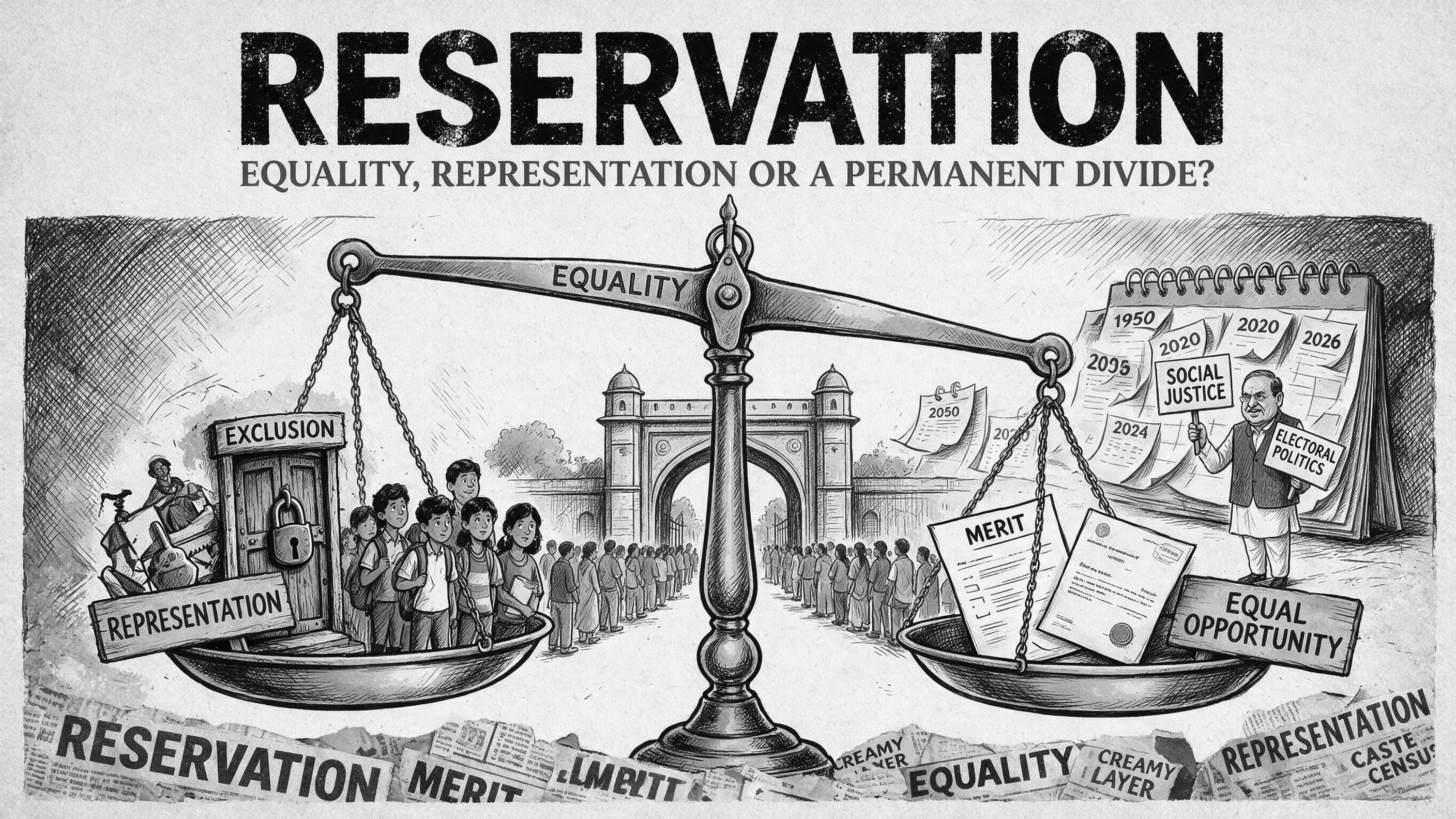
India’s reservation system sits at the intersection of equality, social justice and representation. It permits affirmative action to address historical and structural disadvantages.
Articles 15 and 16 form the core. Article 15(4) enables special provisions for socially and educationally backward classes, SCs and STs in education, while Article 15(5) extends this power to admissions, including private unaided institutions, subject to constitutional limits. Article 15(6), introduced through the 103rd Amendment, permits up to 10% EWS reservation for groups outside existing SC, ST and OBC quotas. Article 16(4) permits reservation in public employment for backward classes inadequately represented, with Articles 16(4A) and 16(4B) addressing SC/ST promotions and unfilled reserved vacancies. Article 46 promotes the educational and economic interests of weaker sections, while Article 335 links SC/ST claims with administrative efficiency.
The Supreme Court’s landmark Indra Sawhney judgment (1992) established the general 50% ceiling on vertical reservations, while recognising that extraordinary circumstances could justify departures. The Court has also required the exclusion of the creamy layer among OBCs, so benefits reach genuinely disadvantaged sections. EWS reservation was upheld in 2022, allowing the 10% quota outside SC/ST/OBC categories.
Recent jurisprudence has reshaped the debate. In State of Punjab v. Davinder Singh (2024), a seven-judge Constitution Bench allowed states to sub-classify SCs to ensure benefits reach more disadvantaged groups, subject to evidence and constitutional safeguards.
Major debates now include whether the 50% ceiling should be reconsidered, especially for states claiming exceptional social conditions; whether a caste census should provide updated data for policymaking; and how the OBC creamy-layer threshold should evolve. Another contentious question is whether a creamy-layer principle should apply to SC/ST communities, an issue generating significant political and legal disagreement.
At its heart, the reservation debate pits competing ideas of merit and substantive equality. Supporters stress inherited disadvantage and unequal starting points; critics argue that quotas can become entrenched and dilute merit. The continuing legal challenge is to balance representation, fairness and social justice without allowing affirmative action to become arbitrary or indefinite.