
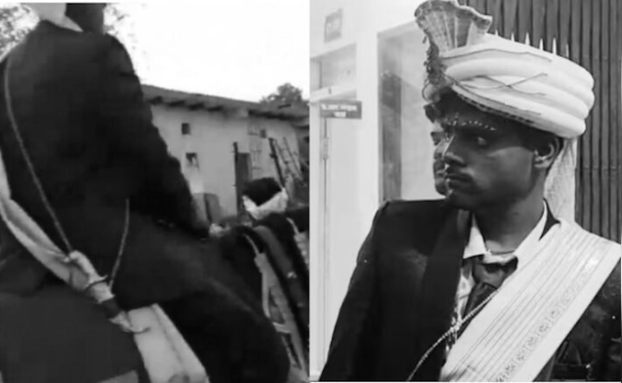
Caste Cruelty on Wedding Day: Dalit Groom with Disability Assaulted for Riding Horse in MP
What should have been the happiest day of his life turned into a moment of public humiliation and violence . In Madhya Pradesh’s Damoh district , a Dalit groom with a physical disability was assaulted, forced off a horse, and abused on caste lines during his own wedding procession, exposing once again how casteism continues to thrive in plain sight .
The incident occurred in Bijauri Pathak village , where the groom was part of a traditional pre-wedding procession . Riding a horse, a symbol of dignity and celebration in Indian weddings, became the flashpoint. Video footage of the incident shows a group of men forcibly pulling him down, beating him, and hurling casteist abuses , leaving little ambiguity about the nature of the attack.
Beyond the physical assault, it is the emotional toll that lingers. On a day meant to mark joy, pride, and new beginnings , the groom was instead stripped of dignity in front of his family and community . The sense of disenchantment and betrayal is hard to ignore, a stark reminder that for many, even moments of celebration are still subject to deeply entrenched social hierarchies .
Police have detained four accused , booking them under the Scheduled Castes and Scheduled Tribes (Prevention of Atrocities) Act along with relevant legal provisions. Authorities have also indicated that stringent action under the National Security Act (NSA) may be invoked. Security has been tightened in the village to prevent further escalation.
Yet, the sequence of events raises troubling questions. Action gathered pace only after the incident went viral on social media , triggering widespread outrage. Such patterns reinforce the perception that enforcement is often reactive , stepping in decisively only when public scrutiny becomes unavoidable.
The symbolism of a Dalit groom riding a horse has repeatedly triggered violence across regions, underscoring how hierarchies of caste continue to dictate social boundaries . And while such incidents often emerge from villages, caste bias is not confined to rural India . It persists, sometimes less visibly, across political spaces, government contracting, hiring practices, and college campuses , shaping access, dignity, and opportunity.
Laws exist. Cases are registered. But incidents like this highlight a deeper failure — the absence of a sustained, systemic effort to eradicate caste prejudice . Without that, each episode risks becoming a familiar cycle of shock, arrests, and eventual fading from public memory .
For the groom in Damoh, however, this will not fade. His wedding day will be remembered not for celebration, but for the humiliation of being punished for asserting dignity .