
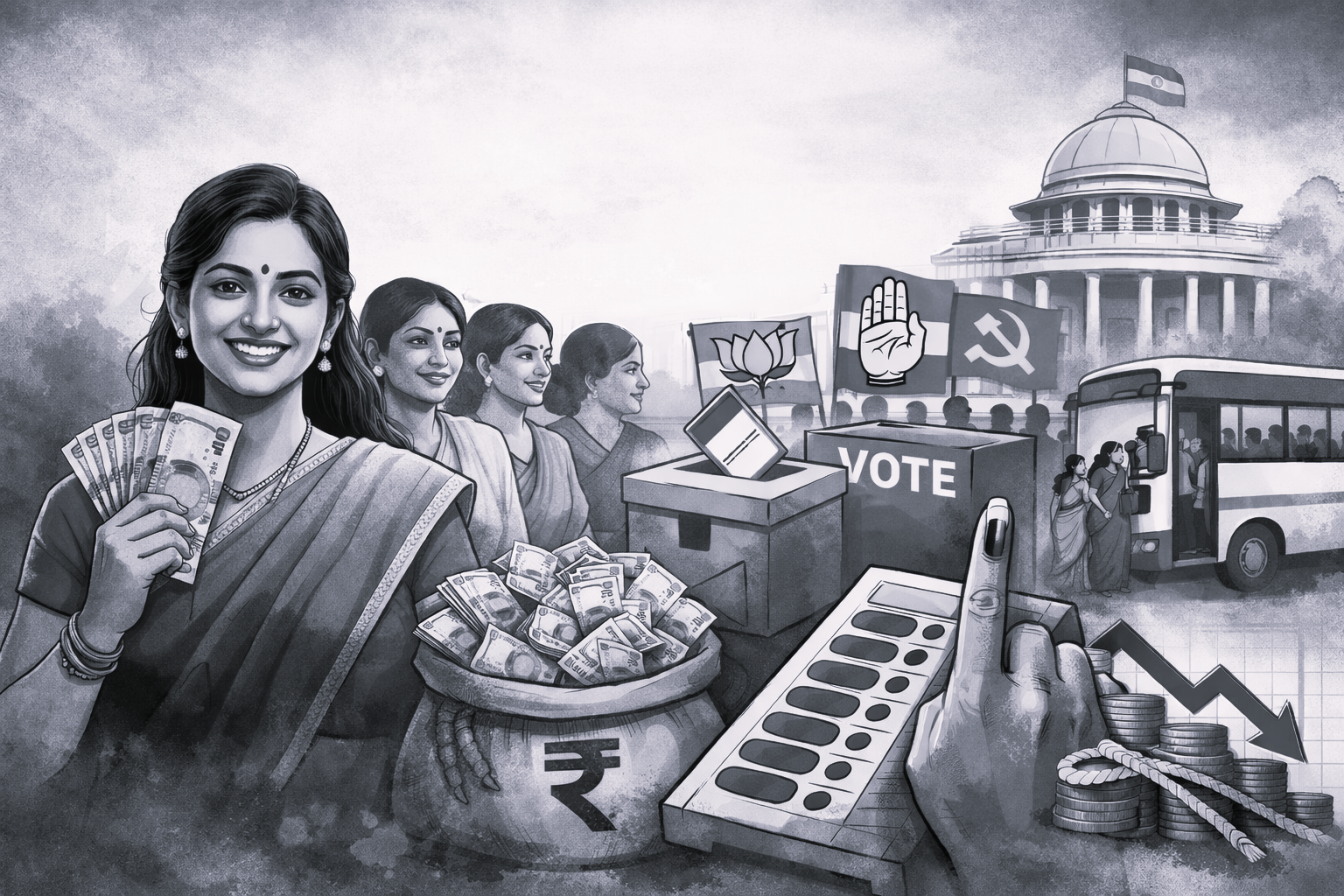
Cash for Votes? Women Welfare Schemes — Social Revolution or Electoral Strategy?
A significant shift has taken place in India’s political landscape over the past decade. Once dominated by caste, religion, and region-based vote-bank politics, the focus has increasingly moved toward gender politics. As elections approach, political parties now believe that winning over women voters is the most reliable route to electoral success.
Welfare schemes that transfer direct cash to the bank accounts of women — often the head of the household or homemaker — now occupy a prominent place in election manifestos across states. With women emerging as key decision-makers in rural households and female voter turnout steadily rising, direct cash transfers have become a powerful tool to attract their support.
Recently, Assam Chief Minister Himanta Biswa Sarma implemented the ‘Orunodoi’ scheme, which has drawn nationwide attention. In a single tranche, the government deposited ₹9,000 each into the accounts of nearly 40 lakh women from eligible families, spending ₹3,600 crore. The government argues that this large-scale transfer will improve the financial condition of poor households. Though it was described as a gift for the Assamese festival ‘Bohag Bihu’, critics argue that releasing such a massive amount just ahead of the 2026 elections carries a clear political strategy.
Under the Orunodoi scheme, beneficiaries receive ₹1,250 per month to support expenses such as nutrition, medicines, and essential household needs. However, analysts point out that releasing four months’ arrears in a lump sum during the election season could influence voter sentiment. Having cash in hand during a festival may create goodwill that could translate into votes. Yet the larger question remains: does this approach genuinely reduce poverty, or does it merely provide temporary relief?
Assam is not alone. Many Indian states have introduced similar welfare programmes targeting women and allocating substantial portions of their budgets to such schemes. Karnataka provides ₹2,000 per month under the ‘Gruha Lakshmi’ scheme, Madhya Pradesh offers ₹1,250 through the ‘Ladli Behna Yojana’, Tamil Nadu provides ₹1,000 under the ‘Magalir Urimai Thogai’ scheme, while West Bengal’s ‘Lakshmir Bhandar’, introduced by Chief Minister Mamata Banerjee, has become a political game changer in the state.
Political analysts believe women are no longer “silent voters” but decisive voters. While men often participate openly in political debates, women tend to vote quietly for candidates or parties they believe will benefit their families. Parties therefore highlight that direct transfers to women’s bank accounts enhance financial independence and dignity, reducing reliance on husbands for household expenses and providing a sense of security in managing family finances.
The 2023 Telangana Assembly elections are often cited by analysts when discussing the political impact of welfare schemes targeting women. During the campaign, the Congress party announced several promises, including free bus travel for women and financial support for women heads of families under the ‘Gruha Jyothi’ scheme. These promises generated extensive discussion among women voters in both rural and urban areas. Analysts say that along with issues such as price rise, unemployment, and governance concerns, welfare schemes offering direct benefits to women became a major campaign theme.
Observers also note that anti-incumbency sentiment against the then ruling BRS government influenced the outcome. Ultimately, the Congress secured a clear majority and came to power. Analysts caution, however, that election outcomes depend on multiple factors and cannot be attributed solely to welfare schemes.
History also shows that cash transfers alone do not ensure electoral success. The 2019 Andhra Pradesh elections offer a clear example. Then Chief Minister N. Chandrababu Naidu distributed ₹10,000 each to DWCRA women under the ‘Pasupu-Kumkuma’ scheme. Despite spending thousands of crores just months before the the election, voters eventually favoured Y. S. Jagan Mohan Reddy. This indicates that anti-incumbency, credibility, and broader social issues also influence voter decisions.
The issue of welfare giveaways or “freebies” has also been debated in the Supreme Court of India. In the case S. Subramaniam Balaji vs State of Tamil Nadu, the Court observed that promises of welfare schemes in election manifestos are not illegal. However, it expressed concern about states making commitments beyond their financial capacity and suggested that the Election Commission of India frame guidelines to regulate such promises. Despite these concerns, political parties continue to rely heavily on welfare pledges.
Cash transfer programmes are not unique to India. Countries such as Brazil and Mexico have implemented internationally recognised initiatives like ‘Bolsa Família’ and ‘Prospera’. However, these programmes often include conditions such as ensuring children attend school or receive vaccinations. Governments release funds only when such criteria are met. In contrast, critics argue that many Indian programmes lack such conditions and focus mainly on direct cash distribution.
Another major concern is the financial burden on state treasuries. Allocating thousands of crores annually to cash schemes is putting pressure on state budgets. States like Assam and Karnataka are spending a significant share of their revenue on such commitments. With limited avenues for increasing income, governments often resort to borrowing, pushing state debts into lakhs of crores. Economists warn that this debt burden may eventually fall on future generations.
Direct cash transfers may increase consumption, but they may also reduce investments in long-term assets such as roads, irrigation projects, schools, and hospitals. Governments often face the dilemma of whether to prioritise welfare spending or infrastructure development. As an economic principle suggests, feeding someone today does not eliminate tomorrow’s hunger, but building a factory can provide livelihoods for generations.
Once people become accustomed to receiving free cash, expectations may rise in subsequent elections. Political analysts describe this trend as “freebie culture”. If one party promises ₹1,000, another may promise ₹2,000, creating a competitive bidding environment. Critics argue that such competition risks turning votes into transactional commodities and could harm democratic institutions.
Despite criticism, governments defend these initiatives by arguing that money placed in the hands of women is rarely wasted, as women tend to prioritise their children’s health, nutrition, and education. In a patriarchal society, such transfers are also seen as a step toward financial independence and empowerment for women. Government data suggests these programmes have stimulated small businesses and strengthened local rural economies.
Experts argue that political parties must act responsibly when announcing such schemes. Before introducing a programme, governments should clearly explain the cost involved and the sources of funding. There is also a growing demand for stricter rules by the Election Commission, such as prohibiting the announcement of new cash transfer schemes within six months before election notifications.
Welfare is a citizen’s right and development is the state’s responsibility. When the balance between the two is disturbed, governance becomes unstable. Providing financial assistance to women can bring meaningful social change, but such programmes should not be driven purely by electoral gains. Welfare initiatives must aim at permanently reducing poverty rather than offering temporary relief. Only then can India achieve genuine economic empowerment and sustainable development.