
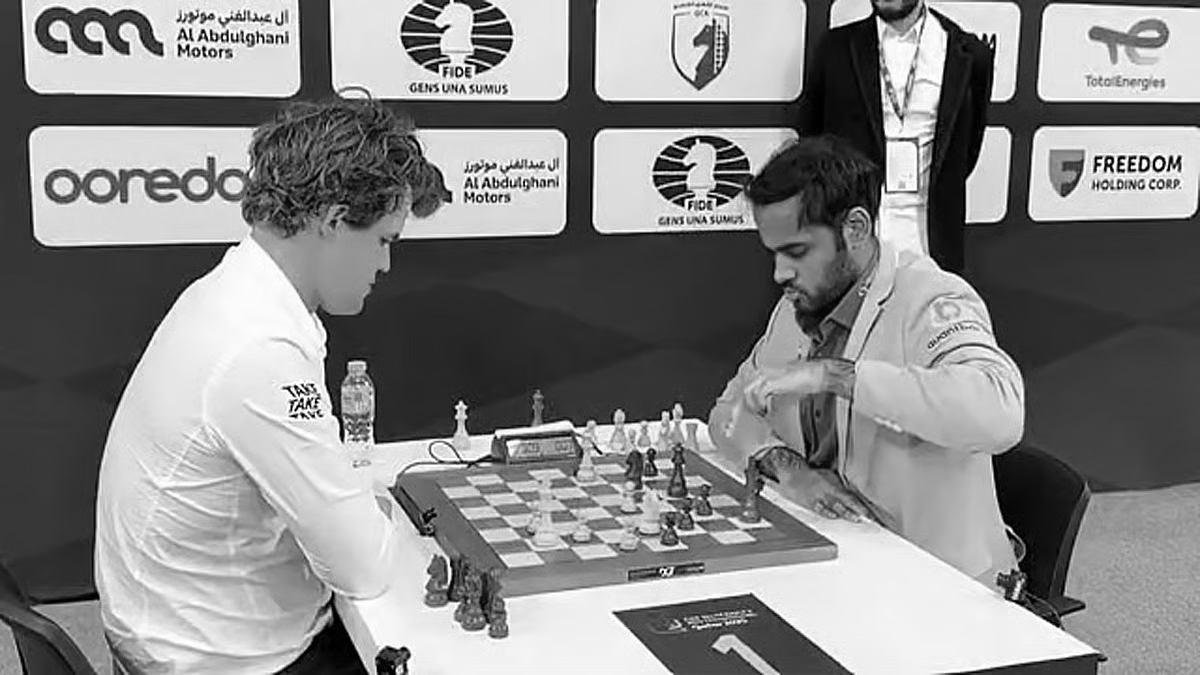
Carlsen Reigns Supreme in Blitz, Erigaisi Settles for Bronze
Magnus Carlsen’s dominance at the World Blitz Championship once again underlined why he remains the most formidable force in fast-time-control chess. The Norwegian grandmaster showcased his trademark resilience, repeatedly recovering from difficult positions and early setbacks to turn matches in his favour. Even when trailing or under pressure, Carlsen demonstrated an unmatched ability to stabilise games, seize small inaccuracies, and convert them into decisive advantages.
A major factor behind Carlsen’s “unstoppable” run was his exceptional command over endgames and time scrambles. In blitz chess, where seconds often decide outcomes, Carlsen’s intuitive understanding of positions and calm decision-making allowed him to outplay opponents who were otherwise evenly matched. His experience built over nine world blitz titles enabled him to simplify complex positions, avoid unnecessary risks, and capitalise on opponents’ time trouble.
Carlsen’s psychological strength also played a critical role. Unlike many players, he rarely lets a single loss affect his momentum. Throughout the tournament, he responded to defeats with immediate counterattacks, shifting pressure back onto his rivals. This mental toughness, combined with deep pattern recognition developed over years at the top level, proved decisive in the knockout stages and the final.
Indian Grandmaster Arjun Erigaisi, despite finishing with a commendable bronze medal, fell short primarily in the knockout phase. While he was outstanding during the Swiss qualification rounds even defeating elite players such as Carlsen and Nodirbek Abdusattorov the semifinals exposed the fine margins that separate podium finishes from titles in blitz chess.
Erigaisi struggled to convert advantageous positions under extreme time pressure in the semifinal against Abdusattorov. In the opening game, he held the initiative with the white pieces but failed to capitalise, eventually losing after a long battle. That early setback shifted the momentum, and Abdusattorov’s superior handling of tense endgame situations tilted the match decisively in his favour.
Another area where Erigaisi lacked was experience in short knockout matches at the highest level. Unlike the Swiss system, where consistency is rewarded, knockout blitz matches offer no room for recovery. A single miscalculation or missed opportunity can decide the contest. While Erigaisi has proven he belongs among the world’s elite, refining his conversion skills and time management in high-pressure knockout games will be key to future title challenges.
Meanwhile, the Women’s World Blitz Championship also produced high-quality chess and a familiar champion. Kazakhstan’s Bibisara Assaubayeva clinched the world blitz crown, reaffirming her status as one of the strongest players in fast formats. She defeated Ukraine’s Anna Muzychuk in the final to add another prestigious title to her resume.
Assaubayeva’s victory highlighted her consistency, sharp tactical vision, and comfort in rapid decision-making under pressure. The women’s event featured a strong field, including several former world champions and top contenders, making her triumph a significant achievement in an increasingly competitive landscape.
Overall, the championship reinforced Magnus Carlsen’s enduring supremacy in blitz chess, showcased Arjun Erigaisi’s rapid rise on the global stage despite minor shortcomings, and celebrated Bibisara Assaubayeva’s continued dominance in the women’s game.