
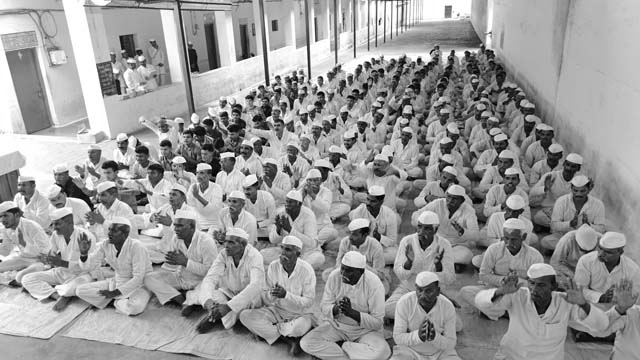
Capacity building programme on psychological risk identification launched at Sabarmati Central Prison
A five-day Capacity Building Programme on Psychological and Behavioural Risk Identification for Frontline Workers (Ward Watchmen) is being conducted at Sabarmati Central Prison, Ahmedabad . The programme is organised by the Psychosocial Care Centre (PCC) —a joint initiative of the Gujarat State Legal Services Authority (GSLSA) and Rashtriya Raksha University (RRU) —in collaboration with the Prison and Correctional Administration of the Government of Gujarat.
The initiative is being implemented under the leadership of Dr. Bimal N. Patel, Vice-Chancellor, Rashtriya Raksha University, and Dr. S. L. Vaya, Lifetime Professor at RRU, with a focus on rehabilitation, reintegration and reformation of prison inmates, along with capacity building of prison staff.
The programme aims to enhance mental health awareness within prisons, strengthen the ability of frontline workers to identify psychological and behavioural risk factors, and equip them with practical s elf-help and risk-reduction skills. It is primarily designed for inmates serving as ward watchmen, who play a critical role in maintaining internal safety and discipline within the prison system. The first batch comprising 70 ward watchmen commenced on February 3 , while the second batch began on February 9, 2026.
The programme was inaugurated by Hon’ble Jail Superintendent Shri Gaurav Agrawal , IPS , who, in his address, highlighted the importance of mental health awareness, early identification of psychological risks and timely help-seeking within the prison environment. He appreciated the initiative and commended the efforts of the PCC team for addressing an important yet often overlooked aspect of correctional administration.
Similar initiatives focusing on mental health awareness and rehabilitation are being undertaken in other prisons across India and abroad . Central jails in states such as Rajasthan, Odisha, Punjab and Haryana have introduced programmes involving psychological counselling , staff sensitisation, yoga, meditation and structured inmate –administration interactions to improve mental well-being and reduce behavioural risks. Internationally, prison systems in the UK and parts of Europe have implemented staff training and psychosocial support programmes aimed at early risk identification, stress management and inmate rehabilitation, reflecting a growing global shift towards correctional reform through mental health-focused interventions.
Prison staff extended their collective support for the successful conduct of the programme. The inaugural session concluded with a formal vote of thanks and a reaffirmation by Rashtriya Raksha University of its continued commitment to rehabilitation, reintegration and reform within the correctional administration system.