
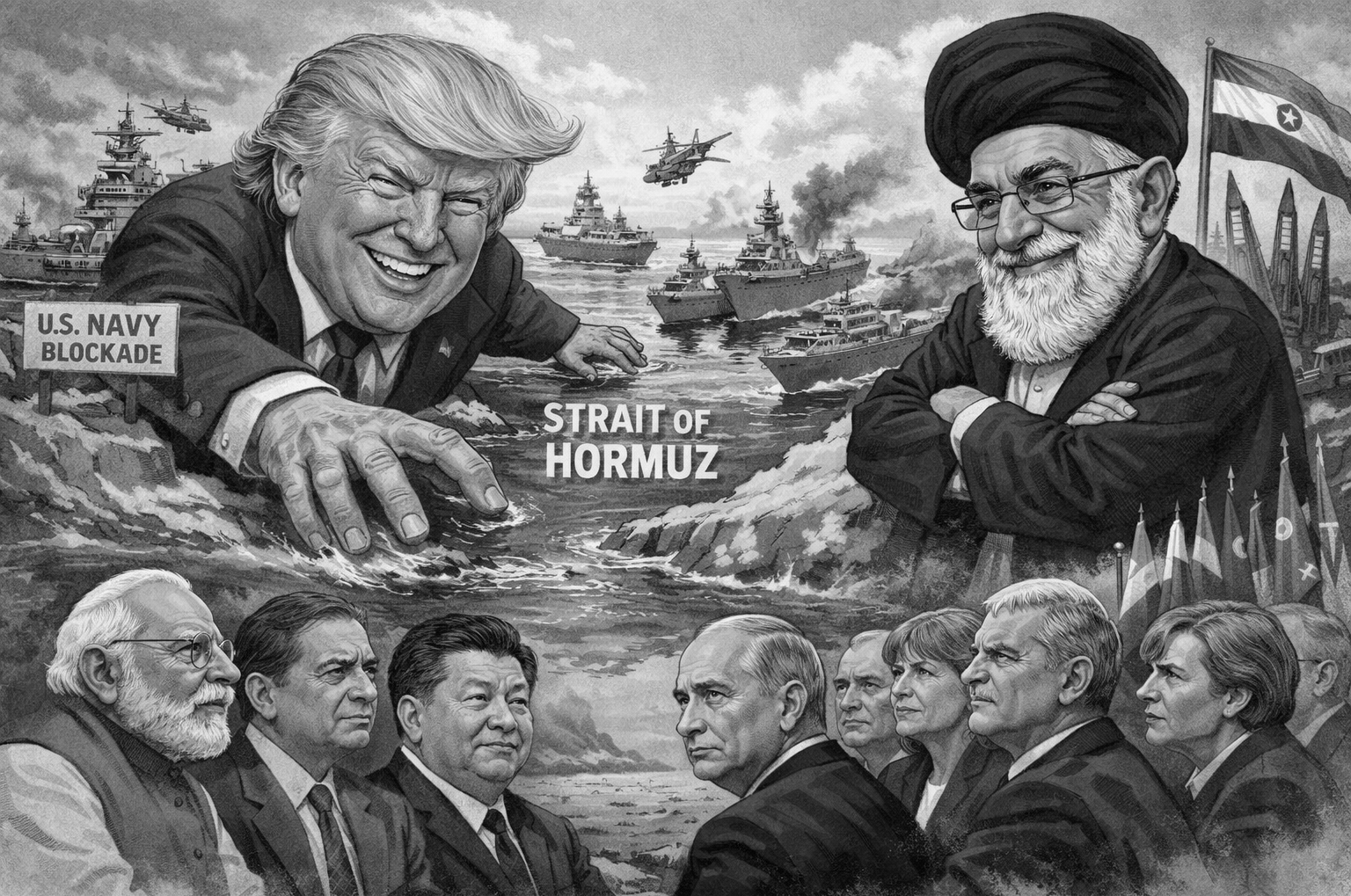
Can't Win the Talks, So Claim the Waterway: Trump's Blockade Threat at Hormuz
Twenty-one hours. That is how long the most consequential diplomatic encounter between the United States and Iran since the 1979 Islamic Revolution lasted and it produced precisely nothing. Negotiations between the two nations, aimed at ending six weeks of war, concluded without an agreement, with each side blaming the other in the time-honoured tradition of failed diplomacy. What followed, however, was anything but traditional. Rather than absorbing the loss quietly, President Donald Trump reached for the one lever he apparently believes he owns and announced a naval blockade of the Strait of Hormuz , a waterway that, by every measure of international law and geography, is not his to claim.
The talks in Islamabad were, by any account, a serious undertaking on paper. Vice President JD Vance arrived in Pakistan alongside special envoy Steve Witkoff and Jared Kushner, Trump's son-in-law, forming a delegation that carried the full symbolic weight of Washington. Across the table sat Iran's Parliament Speaker Mohammad Bagher Ghalibaf and Foreign Minister Abbas Araghchi , a 70-strong Iranian delegation that had traveled to Pakistan with its own considerable expectations. It was the first direct engagement between the two countries at this level since the 1979 Iranian Revolution, a genuinely historic moment, squandered in real time.
And through every one of those 21 gruelling hours , Trump himself was on the phone . Vance said he had spoken with Trump as many as a dozen times during the talks, and also with Secretary of State Marco Rubio, Treasury Secretary Scott Bessent, and Admiral Brad Cooper, head of US Central Command. A dozen calls in a single negotiating session. One might charitably call that hands-on leadership . One might less charitably call it what it looks like, a president so desperate for a win , so visibly anxious about the outcome , that he could not resist hovering over his own delegation's shoulder from thousands of miles away. For a man who declared mid-negotiation that "whether we make a deal or not makes no difference to me, because we've won".
The core American demand was Iran's nuclear ambitions , specifically, a firm, long-term commitment that Tehran would never seek to build a nuclear weapon. Vance put it plainly: "We need to see an affirmative commitment that they will not seek a nuclear weapon and they will not seek the tools that would enable them to quickly achieve a nuclear weapon, not just now, not just two years from now, but for the long term." Iran, which has maintained for years that its nuclear programme is strictly civilian in nature, refused to offer that pledge. And just like that, the talks were over.
Vance, to his credit, acknowledged the US had been "quite flexible" and "quite accommodating," which is a remarkable thing to say about a negotiation you just lost. He called it the "final and best offer" , leaving it on the table for Iran to consider, before boarding Air Force Two and heading home. Iran's semi-official Tasnim news agency said that "excessive" US demands had hindered any agreement, while Iranian state broadcaster described America's position as one of overreach and unchecked ambition .
Then came the part where Trump decided that if he couldn't win at the negotiating table, he would simply lay claim to an international waterway . The President declared, effective immediately, that the US Navy would prevent ships from passing through the Strait of Hormuz, accusing Iran of extorting them. He announced that no ships would enter or leave the strait, and that no one who pays Iran would be granted passage, as though the Strait of Hormuz were a toll booth on a highway he had personally built. In the same post, he accused Iran of blocking the very waterway he was himself now blocking, apparently without a trace of irony.
Here is the inconvenient reality that no amount of Truth Social posting can alter: the Strait of Hormuz does not belong to the United States . It is an international waterway flanked by Iran on one side and Oman on the other. It is governed by international maritime law. I t is not American territory, not an American asset, and not America's to "clear," "claim," or "blockade" by presidential decree. Trump's announcement was not the act of a sovereign nation exercising its rights, it was the act of a frustrated superpower throwing its weight at a door it does not own , hoping the sheer force of American military presence will make the legal questions disappear. It is, in the bluntest terms, a dominance play dressed up as justice .
Iran's response was one of cool confidence. Iranian officials reacted to the failed talks with the demeanour of a side that believes it holds the stronger hand and they may not be wrong. Former State Department negotiator Aaron David Miller noted that Iran "holds more cards than the Americans," pointing out that Tehran still has its highly enriched uranium, still controls the geography of the strait, and that the regime has survived a war that was supposed to break it. A "terrifying capacity to undermine security and stability," as Miller put it and none of those cards have been surrendered.
Israeli strikes on southern Lebanese towns continued through the very nights that diplomats sat in Islamabad.