
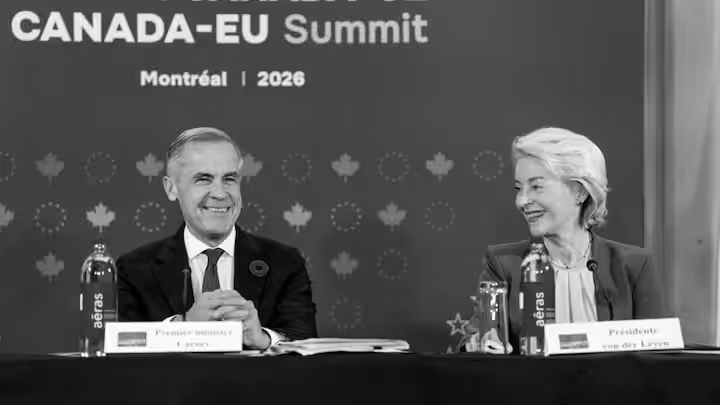
Canada Seeks Closer EU Ties As Carney Targets Associate Status By June 2027
Canadian Prime Minister Mark Carney expects to conclude negotiations in June 2027 on making Canada the European Union's first associate member, as Ottawa and Brussels launch a broader strategic alliance covering Ukraine aid, defence, critical minerals and artificial intelligence (AI).
The announcement followed a two-day Canada-EU summit in Montreal on October 29-30, attended by Carney, European Commission President Ursula von der Leyen and European Council President António Costa.
The leaders launched the Alliance for the Future, aimed at strengthening economic security, resilient supply chains and strategic independence. Von der Leyen said other countries would also be welcome to join, describing the partnership as necessary amid growing global instability and the use of trade as an instrument of political pressure.
Carney said the alliance would help countries withstand economic shocks and protect their sovereignty. The initiative comes amid US President Donald Trump's tariffs, threats to make Canada the 51st US state and tensions with traditional American allies.
On associate membership, Carney said he would attend a European leaders' meeting in June to conclude negotiations. However, the term was excluded from the summit's joint declaration following objections from some EU member states, including Germany. Instead, both sides agreed to define an 'ever-closer association', short of full membership, by their 2027 summit. Von der Leyen described the proposal as an association without accession.
A major announcement was Canada's intention to contribute an initial 500 million euros to the EU's 90-billion-euro Ukraine support loan, allowing Kyiv to purchase military equipment from Canadian suppliers.
The partners also signed a framework enabling the European Investment Bank to finance Canadian critical-minerals projects and concluded negotiations on a digital trade agreement. Canada joined Europe's high-performance computing initiative, providing researchers and businesses access to advanced supercomputers, including JUPITER.
Further cooperation will cover AI, quantum computing, satellite connectivity, cybersecurity, Arctic security and the Galileo navigation programme. Canada and the EU will also explore secure undersea data cables, increased liquefied natural gas exports and expanded student exchanges through Erasmus+.
Defence ties are expanding through the EU's 150-billion-euro SAFE programme. Canadian companies have secured contracts to supply military radios to Poland and helmets to Latvia.