
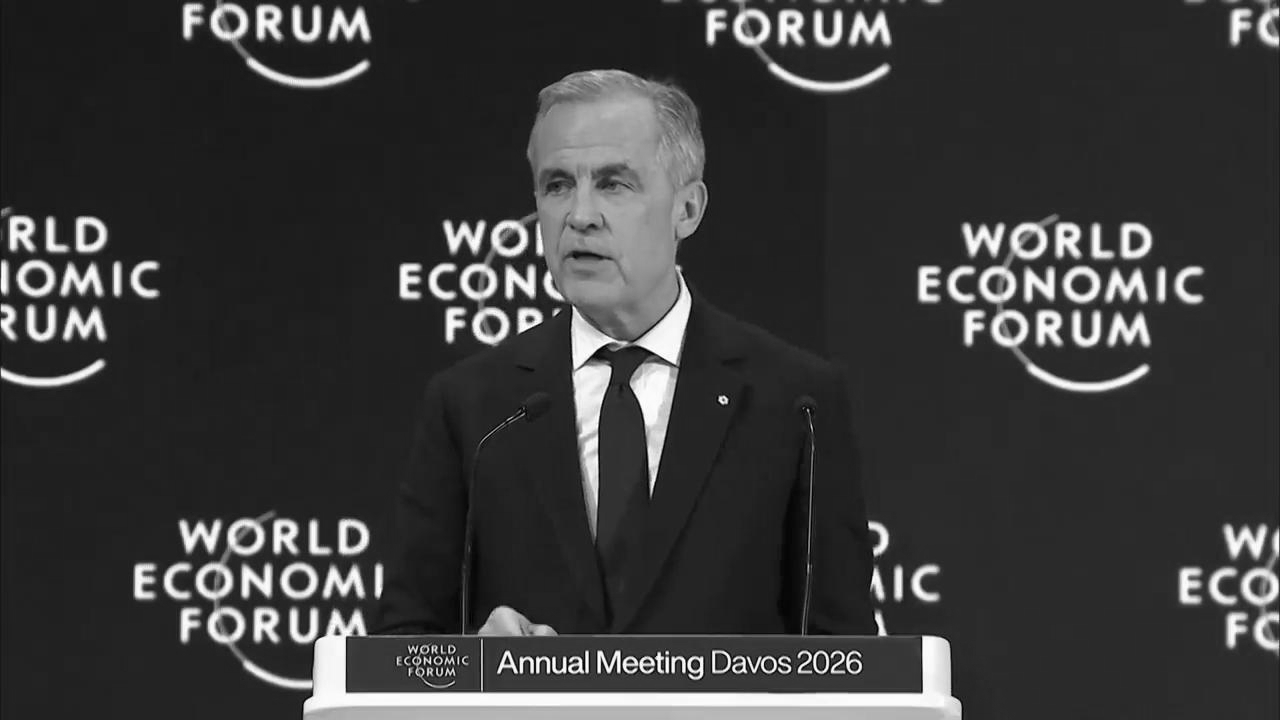
Canada breaks ranks at Davos, PM Carney admits West gamed global rules
Amid speeches by presidents, prime ministers, central bankers and corporate titans at the World Economic Forum , what stood out most this year was the unusually candid admission by Canadian Prime Minister Mark Carney that the West itself had long manipulated the so-called rules-based international order .
Addressing the Davos gathering, Carney acknowledged that countries like Canada prospered under the system not because the rules were fair, but because the system itself was built on selective enforcement.
In one of the most striking passages of his speech, the Canadian leader conceded:
“We knew the story of the international rules-based order was partially false. That the strongest would exempt themselves when convenient. That trade rules were enforced asymmetrically. And that international law applied with varying rigour depending on the identity of the accused or the victim.”
The admission marked a rare moment of openness from a Western leader, articulating what many nations in the Global South have long argued that the order was never truly rules-based, but power-based.
Carney said the arrangement endured because it offered predictability and protection to its beneficiaries. But that bargain, he said, has now collapsed as great powers increasingly weaponise trade, finance and supply chains .
The Canadian prime minister warned that the world was no longer witnessing a gradual evolution but a “rupture, not a transition,” defined by tariffs as leverage , financial infrastructure as coercive tools , and economic integration turning into a source of subordination rather than cooperation .
The timing of Carney’s admission was significant. His remarks came amid escalating tensions triggered by U.S. President Donald Trump’s renewed push to acquire Greenland and Washington’s growing readiness to deploy tariffs and trade restrictions against allies to extract political concessions. Canada has publicly opposed both moves, viewing them as departures from traditional alliance norms .
Carney argued that middle powers such as Canada now face a stark choice between silent subordination and collective resistance . He urged countries caught between rival great powers to diversify dependencies , strengthen domestic economic resilience , and cooperate to reduce vulnerability to coercion.
However, the speech also exposed deep contradictions . While condemning selective enforcement of global rules, Carney continues Canada’s political and diplomatic support for Israel , even as Gaza has been devastated by prolonged military operations that have killed tens of thousands of civilians and reduced large parts of the territory to rubble.
His government has also endorsed U.S. actions against Venezuela , including Washington’s kidnapping of President Nicolás Maduro , an operation widely criticised as a violation of international law .
These positions have drawn criticism from analysts who argue that Western concern for sovereignty and legality surfaces only when Western interests are directly threatened .
Trump responded swiftly. Speaking from Davos a day later, the U.S. president dismissed Carney’s remarks and declared that Canada “lives because of the United States,” adding that Ottawa should be “grateful.” He defended tariffs as legitimate tools of negotiation and made clear that American power would be exercised without apology , including in the strategically vital Arctic region .
The public exchange laid bare a widening rift within the Western alliance . While Carney acknowledged that the rules were bent by those who wrote them , Trump dispensed with pretence altogether, underscoring that power, not principle , now defines global conduct.
Together, the speeches reflected a moment Davos rarely hears an admission of Western hypocrisy by a Western leader , not born out of a change of heart, but from having fallen out of favour with the very system that once protected him.