
“Can India unlock its potential? Kapur, Subramanian offer sharp answers at Manthan”
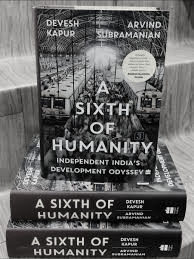
Manthan, the public-discourse platform known for promoting vibrant and meaningful conversations since 2005, hosted another thought-provoking session on December 10 at Vidyanarayana School, Hyderabad. The event drew a hall full of eager, middle-aged and senior intellectuals who gathered to listen to renowned political scientist Devesh Kapur and economist Arvind Subramanian , co-authors of the critically acclaimed book A Sixth of Humanity .
Devesh Kapur, the Starr Foundation Professor of South Asian Studies at Johns Hopkins University’s School of Advanced International Studies, is a leading scholar whose work appears in major global publications. Arvind Subramanian, former Chief Economic Adviser to the Government of India, is currently a Senior Fellow at Brown University and a widely cited expert on India, China and global economic shifts.
India’s Distinctive Development Journey
The discussion revolved around A Sixth of Humanity , a book that explores India’s unusual development path. According to the authors, India chose an unconventional model embracing democracy before development, prioritising high-skill services over low-skill manufacturing, and adopting a globalisation model that benefitted top talent but often bypassed the poor. As a result, the country became partly capitalist without fully establishing strong foundations in infrastructure, health and education.
Still, India has seen significant achievements: a resilient democracy, social stability and decades of economic growth. The state’s capacity to build infrastructure and deliver essential services has improved dramatically, though many challenges remain.
Tax Terrorism, Cash Transfers & the Political Economy
Responding to audience questions, the authors explained how businesses today often face “tax terrorism” a climate where companies experience aggressive tax enforcement, unpredictable notices and the constant fear of penalties or prosecution. They noted that such an environment discourages investment and limits entrepreneurial risk-taking.
They also spoke about the political use of welfare payments. Cash transfers, they said, have increasingly become a “toy” for politicians popular, easy-to-deliver benefits that are strategically timed around elections rather than being part of long-term policy design. While transfers can help the poor, their growing use as electoral tools strains government finances and distorts Centre–state relations.
The Pressure of Frequent Elections
The authors noted that governments now operate with little policy-breathing room due to continuous elections. Instead of the traditional 4–5 year cycle, political activity today often leaves barely a year between major polls. Decisions like sudden property-tax hikes before local elections reflect this compressed political calendar. “We cannot have elections without money,” they remarked, highlighting how fiscal choices are shaped by electoral compulsions.
Identity, Language & the Challenges of Belonging
The conversation also touched on India’s social diversity. Even as the country promotes the idea of “one nation,” linguistic and regional identities remain strong. A Rajasthani settling in Tamil Nadu may still be seen as a Rajasthani even after years, revealing how deeply cultural boundaries shape belonging.
Why Low-Skill Manufacturing Matters Especially for Women
A key theme of the event was India’s need to expand low-skill manufacturing, a sector that can absorb millions of workers. Unlike high-skill sectors that employ only a small portion of the population, low-skill industries can create broad-based employment including jobs for women , who often face barriers in entering the workforce. The authors stressed that increasing such jobs could significantly enhance women’s economic participation and help narrow gender gaps , as seen in several East Asian economies.
They pointed out that while countries like China command nearly 30 percent of global low-skill exports, India stands at just 2 percent, missing a major opportunity.
India’s Blind Spot: Ignoring Labour-Intensive Services
The speakers also highlighted an important structural issue: India focuses heavily on skill-based, high-tech and specialised sectors, but largely overlooks the vast potential of labour-intensive, service-based jobs.
Sectors such as tourism, retail, logistics, hospitality, home services and caregiving could generate millions of stable jobs, yet they remain underprioritised. The authors argued that India’s development model must shift from a narrow skill-centric vision to a more inclusive employment approach that values service-based industries and low-skill opportunities.
The Learning Outcomes Challenge
While India has numerous welfare schemes such as mid-day meals, the speakers emphasised that policymakers still fail to focus on actual learning outcomes , which remain alarmingly weak. Improving education quality, they said, is critical for future growth.
A Future Rooted in Cautious Optimism
Despite the challenges outlined, Kapur and Subramanian end their book on a hopeful note. They believe India stands at a decisive moment, with a young population, expanding state capacity and the potential to reshape its economic and social trajectory if it strengthens federal cooperation, expands employment opportunities and prioritises inclusive development.
The Manthan event concluded with deep engagement from the audience, leaving them reflecting on India’s complex but promising journey into the future.