
Can India Build a Circular Economy from Its Mountains of Waste?
For decades, India’s growing cities have followed a familiar pattern when it comes to garbage: collect it, transport it and dump it. But as urban populations expand, consumption rises and land becomes increasingly scarce, that model is reaching its limits. Haryana’s decision to establish four integrated waste-to-energy plants could therefore represent more than another infrastructure announcement. It points towards a larger shift in how Indian cities may deal with the mountains of waste they generate every day.
The Haryana government has signed MoUs for plants across the Hisar, Ambala, Faridabad and Gurugram clusters, with a combined capacity to process 5,000 tonnes of municipal waste per day and generate 50 MW of energy. The projects, expected to become operational by October 2028, will be developed by Oil Green Energy Limited, a wholly owned subsidiary of Oil India Limited. The proposed network includes a 500-tonne-per-day, 5 MW facility in Hisar, serving the wider Hisar cluster; a 900-TPD, 9 MW plant in Ambala; a 1,600-TPD, 16 MW facility in Faridabad; and the largest project, a 2,000-TPD, 20 MW plant in Gurugram. But the real significance of Haryana's plan is not merely the 50 MW headline.
Waste is not one material
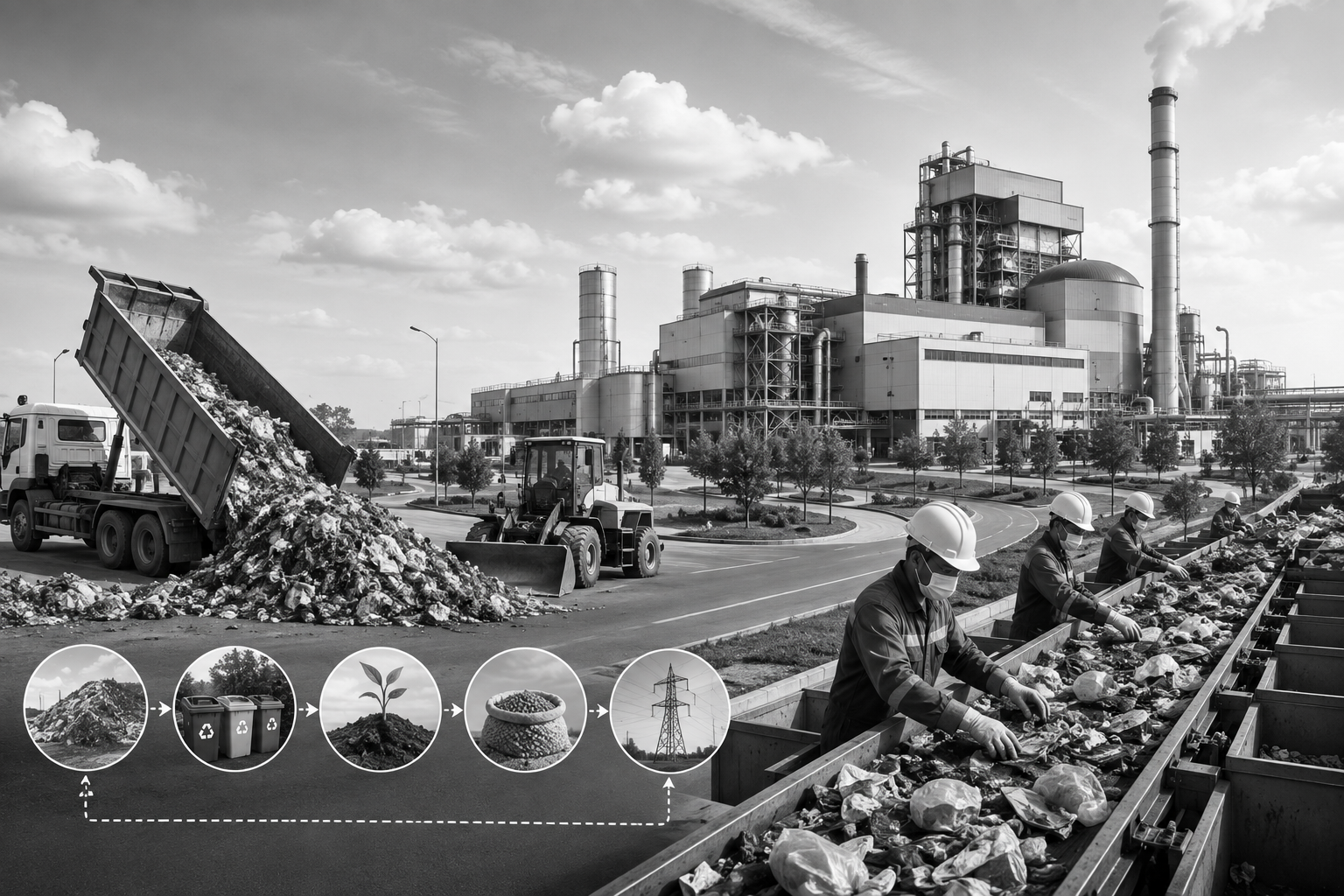
The most important lesson from modern waste management is that all garbage should not be treated alike. Municipal waste is a mixture of organic matter, plastics, paper, metals, glass, textiles and inert material, and the future of waste processing lies in separating these streams and directing each towards its most suitable use. The ideal chain begins with segregation and pre-processing, after which recoverable paper, metals, glass and plastics can enter recycling markets, while organic or wet waste can be processed into compost, biogas or Compressed Biogas (CBG). Combustible material that cannot be economically recycled can be converted into Refuse-Derived Fuel (RDF) or used for suitable waste-to-energy applications, leaving only the final fraction that cannot be recovered for scientific disposal. The emerging hierarchy is therefore clear: segregate, recover, recycle, process organic waste, convert residual waste into fuel or energy, and dispose of only the final rejects.
More than electricity
The importance of the waste economy extends far beyond power generation because processed waste can potentially supply several industries. Recovered plastic, paper, metals and glass can return to manufacturing supply chains, while organic waste can produce compost and soil products for agriculture, horticulture and landscaping. Biogas can be upgraded into CBG, opening possibilities for transport and industrial fuel markets, while RDF can provide an alternative fuel stream for industries, particularly the cement sector, one of the major potential users of processed combustible waste. Construction and demolition waste can also be transformed into recycled aggregates, blocks and pavers, supporting the infrastructure and construction sectors. The waste-processing facility of the future may therefore increasingly resemble a resource-recovery hub, supplying multiple industries rather than functioning merely as a single-purpose power plant.
Lessons from Hyderabad
India already has examples of large integrated waste-processing infrastructure, and Hyderabad's Jawaharnagar Integrated Municipal Solid Waste Management facility offers an important lesson about the scale and complexity involved. Its waste-to-energy operations have relied on RDF produced from municipal waste, underlining the fact that the power plant is only one part of a much larger system.
Before waste can generate electricity, it must be collected, transported, received, sorted and processed; recyclable materials have to be recovered, organic fractions managed and residual combustible material prepared for further treatment. Large projects therefore succeed or fail not simply because of the technology installed at the end of the process, but because of the entire waste-management chain that feeds it. The most important lesson is simple: do not select technology first and then look for waste; study the waste first and choose the technology that fits it, because a city with high-moisture, poorly segregated waste cannot necessarily use the same technology effectively as a city with a cleaner and more combustible waste stream.
Why Gurugram matters
The urgency behind Haryana’s new programme is particularly visible in Gurugram and the long-running challenge of the Bandhwari landfill, where accumulated garbage has highlighted the limits of transporting waste outside cities and expecting landfills to absorb it indefinitely. Union Minister Rao Inderjit Singh has stressed the need to move quickly and ensure that Haryana's latest projects do not suffer the same fate as earlier waste-to-energy proposals that failed to materialise. His warning highlights another major lesson for the sector: India's waste challenge is not only about technology, but also about execution. MoUs and announcements are only the beginning, and successful projects require assured waste supply, viable financing, suitable land, regulatory clearances, trained operators and long-term environmental monitoring. For Haryana, the transition from agreements on paper to functioning facilities will ultimately be the real test.
Land: the next major challenge
For cities and entrepreneurs alike, land is one of the most difficult parts of the waste-management equation, particularly in metropolitan regions where large parcels are expensive and scarce. A major mixed-waste facility requires space not only for machinery but also for receiving and sorting waste, material storage, internal truck movement, environmental infrastructure, wastewater and leachate management, safety buffers and future expansion. This is why smaller and decentralised facilities could become increasingly important, with metros potentially adopting a hub-and-spoke model in which compact facilities closer to the city focus on collection, segregation and material recovery, while larger regional facilities handle biogas, CBG, RDF, advanced recycling and energy recovery. Such a structure could reduce pressure on both expensive urban land and massive centralised dumpsites.
The opportunity for MSMEs
The Haryana model is too large for most small businesses to replicate, but the future waste economy does not belong only to companies building giant plants. MSMEs can find opportunities in specialised segments such as Material Recovery Facilities, plastic recycling, organic-waste processing, biomethanation, RDF production, waste logistics and plant operations, allowing smaller businesses to enter specific parts of the larger value chain. For an entrepreneur with limited land, the smarter strategy may be to focus on one waste stream, one technology and one reliable customer.
A compact dry-waste MRF can recover valuable materials and supply authorised recyclers, an organic-waste unit can serve markets, hotels or institutions, and a specialised RDF facility can prepare combustible residual material for industrial users. The key lesson is that an MSME does not need to own the entire waste-management system to become an important part of the waste economy.
The real test for Haryana
The proposed projects will be supported through a shared financing arrangement, with 25% of the capital cost expected from the Centre, 25% from the Haryana government and urban local bodies, and the remaining 50% invested by Oil Green Energy Limited. However, the MoUs are only the beginning, as the plants must still progress through the applicable project-development, environmental and pollution-control processes before becoming operational.
If Haryana succeeds in delivering the four facilities by October 2028, its larger achievement may not simply be the production of 50 MW of power, but the demonstration of a different model for India's cities: waste is not a single problem waiting to be dumped or burned, but a stream of resources waiting to be separated, recovered and returned to the economy. The future of waste management will not belong to one technology or to the company that burns the most garbage but to systems capable of extracting the maximum possible value from every tonne of waste before anything reaches a landfill. That may be Haryana’s biggest bet: not merely turning 5,000 tonnes of waste a day into 50 MW of energy, but helping redefine waste as the beginning of another economic cycle.