
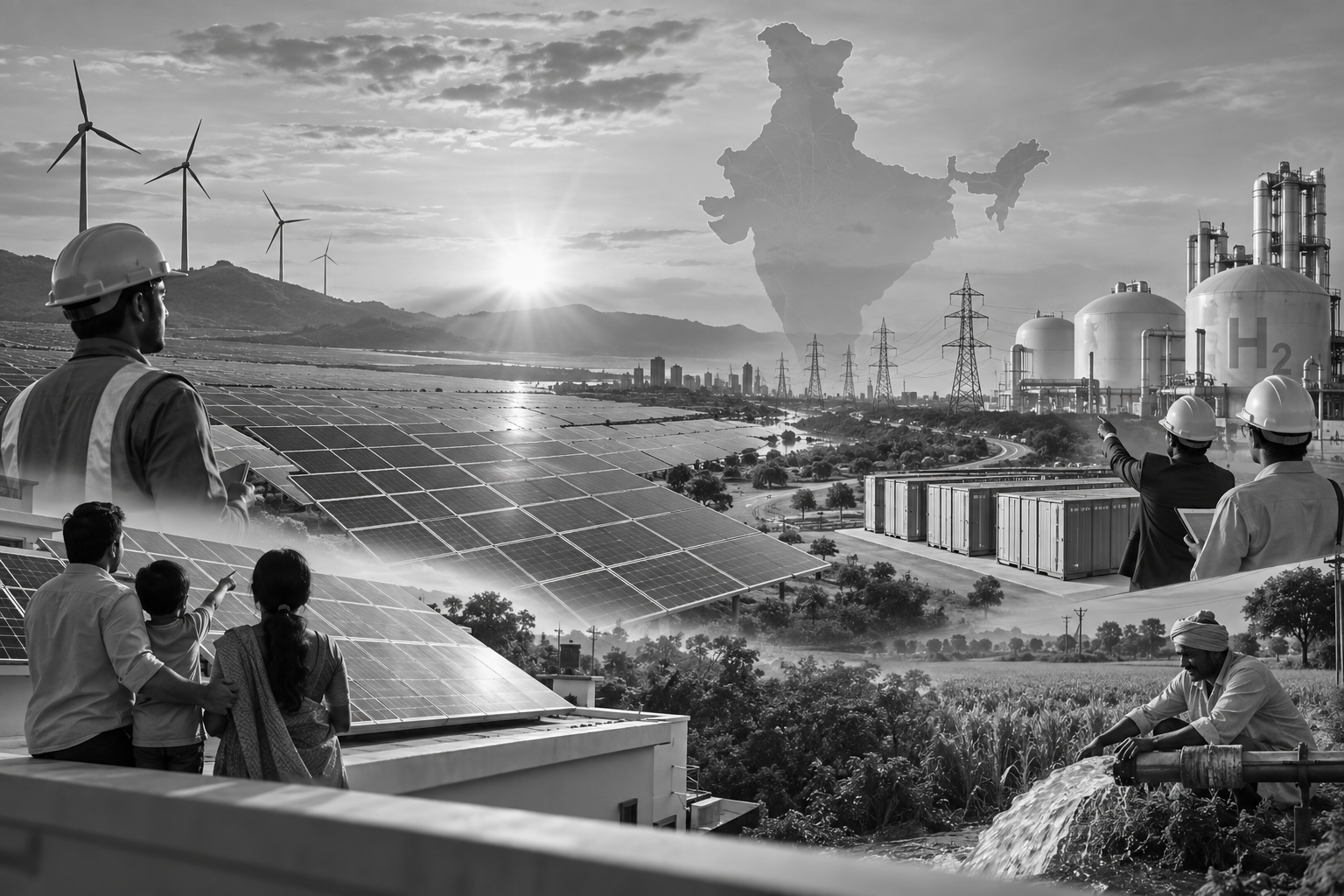
Building India's Clean-Energy Economy: SECI's Journey from Solar to Hydrogen
Fifteen years after its creation, the Solar Energy Corporation of India (SECI) has grown from an implementing agency for the National Solar Mission into one of the key institutions shaping India's renewable-energy market. Its journey mirrors the transformation of India's solar sector - from a government-supported programme to a commercially driven industry attracting private investment, foreign capital and manufacturing commitments. India had just 2.82 GW of solar capacity in March 2014, but that figure reached 168.04 GW by August 2026, nearly a 60-fold increase.
From Solar Mission to Market Maker
SECI, incorporated on September 20, 2011, initially focused on implementing the National Solar Mission. Its role expanded significantly after becoming a commercial company in 2015 and taking responsibility for the wider renewable-energy sector. Competitive bidding became central to its operations, allowing developers to compete for long-term power contracts. By May 2025, SECI had awarded more than 73.8 GW of renewable-energy capacity, including 45.9 GW of solar, 16.4 GW of wind and 11.5 GW of hybrid projects. It had also commissioned 21.67 GW of solar capacity by March 2025. The organisation's current mandate increasingly includes storage, hybrid renewable power and green molecules.
The Auction Model That Changed Solar
One of SECI's biggest contributions has been changing how renewable electricity is procured. Competitive auctions helped bring down tariffs while long-term PPAs gave developers greater visibility over future revenues. An early SECI-linked procurement involved a tariff of around ₹4.43 per unit, while the 2017 Bhadla auction discovered tariffs as low as ₹2.44 per unit without viability-gap funding. Falling module prices, economies of scale, improved financing and growing competition also contributed to the decline. The auction model nevertheless helped establish solar as a commercially competitive source of electricity.
Private Capital Drives Expansion
SECI's importance lies not only in the projects it develops but in the investment it enables. Its 15th Foundation Day figures put cumulative market investment enabled through its activities at around ₹3.6 lakh crore, while renewable-generation capacity commissioned through third-party developers has crossed 41 GW and power-sale agreements have exceeded 67 GW. Companies including Adani Green Energy, ReNew, ACME, Azure Power, Avaada and JSW have used SECI-linked procurement mechanisms to build large renewable portfolios. A major manufacturing-linked SECI award involving Adani included 8 GW of solar projects and 2 GW of solar manufacturing capacity, with an announced investment of around ₹45,000 crore.
Government Support and Foreign Investment
The Centre's role has increasingly been to create the conditions for private investment rather than finance the entire renewable expansion. The solar PV manufacturing PLI scheme carries a ₹24,000-crore outlay, while PM-KUSUM has central financial support of ₹34,422 crore and PM Surya Ghar has an overall programme outlay of more than ₹75,000 crore. The 2026-27 allocation for PM Surya Ghar is ₹22,000 crore. Meanwhile, DPIIT data shows cumulative FDI equity inflows into India's broader non-conventional-energy sector reached ₹1.55 lakh crore ($21.3 billion) between April 2000 and December 2024. These figures demonstrate how public support has increasingly acted as a catalyst for domestic and international capital rather than replacing it.
From Solar Parks to Manufacturing
Solar parks helped overcome some of the infrastructure barriers that previously slowed projects by providing common facilities such as land development, roads and transmission. SECI's six state joint ventures have a combined planned capacity of 11,820 MW, with more than 8,100 MW commissioned. The 750-MW Rewa Ultra Mega Solar Project, spread across about 1,590 hectares, illustrates this model and achieved a first-year tariff of ₹2.97 per unit. Meanwhile, India is attempting to build a domestic manufacturing ecosystem. The solar PLI programme's second tranche selected manufacturers for approximately 39.6 GW of capacity, with around ₹13,937 crore in PLI allocation and projected investment of about ₹93,041 crore.
Beyond Solar: Storage and Green Hydrogen
The next stage of SECI's evolution is moving beyond conventional solar generation. With renewable power becoming a larger part of the grid, the need for storage and reliable supply has grown. SECI introduced standalone energy-storage tenders in 2022 and has increasingly moved towards solar-plus-storage, hybrid and firm renewable-energy procurement. It is also participating in the development of markets for green hydrogen and green ammonia, marking a shift from renewable electricity to renewable-derived industrial fuels.
The Changing Electricity Mix
The renewable expansion has changed India's electricity mix, but it has not eliminated conventional generation. Renewable sources accounted for more than 22% of India's electricity generation in 2024-25, while solar alone generated 144.15 billion units during the year. Thermal power, however, continued to provide the majority of electricity. The significance of the transition is therefore not that coal and other conventional sources have suddenly disappeared, but that renewable energy is taking an increasingly larger share of a rapidly expanding electricity system.
What SECI's Journey Means for India
SECI's 15-year journey reflects a fundamental shift in India's energy economy. Solar has moved from a relatively small government-supported technology to a major infrastructure industry attracting private developers, foreign investment, manufacturing, financial institutions and household consumers. India's challenge now extends beyond installing capacity. It must expand transmission, storage and grid flexibility, strengthen DISCOM finances, develop domestic manufacturing and eventually address solar-panel recycling. SECI's first 15 years were largely about building the renewable-energy market; its next phase will be about making that market capable of supplying reliable, affordable and increasingly clean energy to support India's economic growth.