
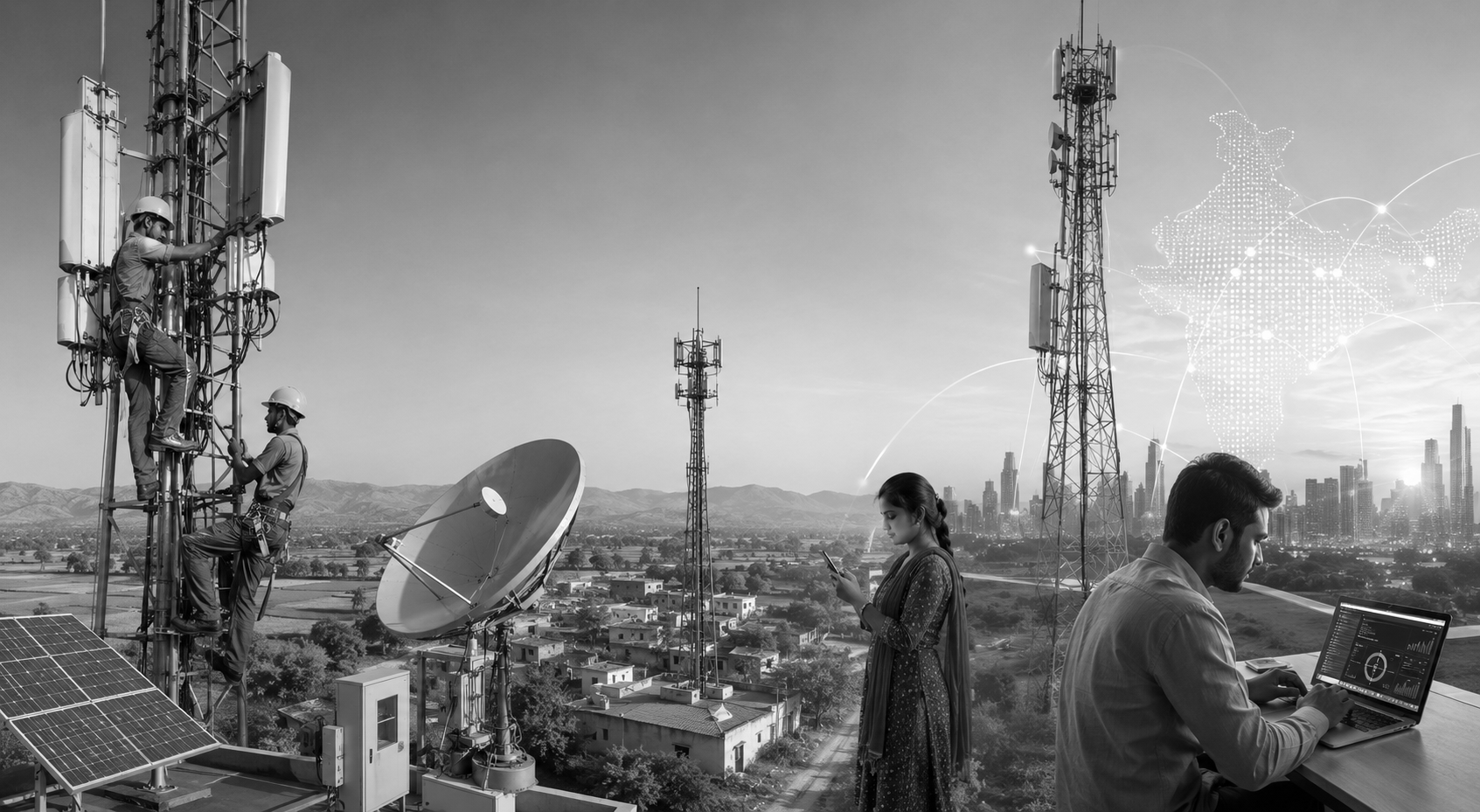
BSNL’s Revival Hinges on Indigenous Technology, Rural Reach and Telecom Self-Reliance
For nearly a decade, Bharat Sanchar Nigam Limited (BSNL) symbolised the steady decline of India’s public-sector telecom ambitions. Once the country’s dominant telecom operator, BSNL gradually lost relevance amid rising competition from aggressive private players, ageing infrastructure, delayed technology upgrades and mounting financial losses. In urban India, the company became associated with weak connectivity and shrinking customer confidence, while private telecom giants such as Reliance Jio and Bharti Airtel transformed the telecom sector through cheap data, rapid 4G expansion and large-scale 5G rollout.
Today, however, BSNL is attempting one of the most ambitious revival stories in India’s telecom history. The Centre is no longer presenting BSNL merely as a struggling public sector company seeking survival. Instead, the telecom operator is increasingly being positioned as the centrepiece of India’s push toward digital sovereignty , indigenous telecom technology and universal digital inclusion.
At the heart of this transformation lies an important question that continues to dominate industry discussions: Why is BSNL investing heavily in 4G when private telecom companies are already racing toward 5G and beyond?
For the government and telecom policymakers, the answer lies not only in technology, but also in economics, national security and India’s digital realities.
Why 4G Still Matters in India
Although 5G dominates telecom advertisements and urban conversations, much of India still depends heavily on reliable and affordable 4G connectivity . Millions of users across rural and semi-urban India continue to rely on basic smartphones, affordable mobile data and stable voice networks rather than high-speed 5G applications.
Telecom experts point out that even today, a large portion of India’s mobile internet traffic continues to run on 4G networks. In villages and remote regions, the immediate priority is not ultra-fast download speeds, but dependable connectivity that supports digital payments, telemedicine, online education, government services and day-to-day communication.
This is precisely the segment BSNL is targeting.
Unlike private telecom operators that prioritise commercially profitable urban clusters, BSNL is focusing aggressively on rural India, tribal belts, border villages and areas affected by left-wing extremism where private telecom investment has historically remained limited because of weak commercial returns.
According to government estimates, nearly 35,000 villages across India previously lacked reliable telecom connectivity because of difficult terrain, poor commercial viability or security challenges. Officials say around 25,000 telecom towers have already been installed in such regions, while another 10,000 towers are currently under development.
In areas affected by extremism, particularly parts of Chhattisgarh , improved telecom access is reportedly helping local populations communicate more effectively with administrative authorities and security agencies. Officials argue that connectivity in such regions is contributing not just to digital access, but also to governance and social stability.
Financial Revival After Years of Decline
Union Minister of State for Communications Dr. Chandra Sekhar Pemmasani , in a recent interview with DD India, described BSNL’s transformation as “challenging yet deeply satisfying,” saying the government adopted “systematic rigour and private-sector discipline” to revive the company.
The financial turnaround, according to official figures, has been striking. BSNL’s revenue reportedly increased from nearly ₹21,000 crore to ₹25,000 crore over the last two years. More importantly, EBITDA surged dramatically from around ₹50 crore to nearly ₹7,000 crore , indicating a major improvement in operational efficiency.
Behind these figures lies a large-scale infrastructure overhaul.
In several telecom circles, particularly in states such as Andhra Pradesh , tower uptime had reportedly fallen to nearly 75% . BSNL responded by replacing nearly 50,000 batteries , upgrading power systems, modernising cables and introducing tighter accountability and performance-monitoring systems across circles and states. Officials claim these measures helped improve uptime levels to nearly 95% , stabilising network performance and improving customer experience.
The revival strategy also involved modernising operational culture inside the PSU, with increased focus on enterprise business targets, subscriber acquisition and infrastructure reliability.
The Indigenous 4G Mission
The most significant pillar of BSNL’s comeback is its ambitious rollout of indigenous 4G technology .
Unlike earlier telecom expansions in India that depended heavily on foreign telecom vendors such as Ericsson , Nokia and Chinese infrastructure suppliers, BSNL’s new network has been built using a largely Indian-developed telecom stack.
The indigenous ecosystem has emerged through collaboration between C-DOT , a TCS-led consortium , Tejas Networks and several domestic technology partners. The government says this effort has positioned India among a small group of nations capable of developing deep end-to-end telecom infrastructure domestically.
Prime Minister Narendra Modi officially launched BSNL’s nationwide indigenous 4G expansion in 2025, commissioning nearly 97,500 mobile towers built at an estimated investment of around ₹37,000 crore .
The rollout has accelerated across multiple states. In Kerala alone, BSNL recently deployed nearly 6,979 indigenous 4G sites , including hundreds of towers in tribal settlements, remote hilly terrain and underserved border regions where private telecom operators often see limited commercial viability.
Communications Minister Jyotiraditya Scindia has acknowledged that BSNL’s delayed 4G rollout was directly linked to India’s decision to prioritise telecom self-reliance over importing ready-made foreign technology.
What Makes Indigenous 4G Different?
The key difference between BSNL’s indigenous 4G network and conventional telecom deployments lies in ownership and strategic control.
Traditional telecom networks in India largely depended on imported hardware and foreign telecom vendors. In contrast, BSNL’s indigenous stack has been designed, developed and integrated primarily by Indian companies and institutions.
This approach gives India greater control over telecom infrastructure, cybersecurity systems and supply chains. It also reduces long-term dependence on foreign technology providers at a time when telecom infrastructure is increasingly viewed as strategic national infrastructure similar to defence or energy systems.
Officials argue that indigenous telecom infrastructure strengthens: India’s digital sovereignty, Domestic telecom manufacturing, Cybersecurity oversight, Supply-chain resilience, Long-term technological independence
The project is closely linked to the government’s broader Atmanirbhar Bharat vision, which seeks to reduce dependence on imported strategic technologies.
Another major advantage is that BSNL’s indigenous 4G network has been designed to be software-upgradable to 5G . Unlike traditional upgrades that require large-scale hardware replacement, the current architecture allows migration toward 5G through software modifications and selective equipment upgrades, potentially reducing future rollout costs significantly.
So When Will BSNL Launch 5G?
While private telecom operators are already expanding commercial 5G services aggressively, BSNL is following a slower infrastructure-first approach.
Telecom Minister Jyotiraditya Scindia has indicated that BSNL will move toward phased 5G rollout after stabilising its indigenous 4G network nationwide. Reports suggest pilot-level preparations for BSNL’s 5G deployment are already underway in major cities such as Delhi and Mumbai .
Industry estimates suggest selective BSNL 5G launches could begin during 2026 , especially in enterprise-focused and high-demand urban markets.
Because the indigenous 4G stack is already technically prepared for future upgrades, experts believe BSNL could eventually transition toward 5G more efficiently once network stabilisation is complete.
Unlike private telecom companies that prioritised rapid 5G branding and subscriber acquisition, BSNL appears to be prioritising long-term technological independence and nationwide infrastructure coverage.
eSIMs, Doorstep Connectivity and Rural Expansion
BSNL’s revival strategy is also extending into digital consumer services.
The telecom operator recently partnered with Tata Communications to launch nationwide eSIM services , allowing customers to activate mobile connections digitally through QR-code provisioning without needing physical SIM cards.
Powered by Tata Communications’ GSMA-accredited MOVE™ eSIM platform , the service supports 2G, 3G and 4G networks and is expected to benefit smartphone users, enterprise IoT deployments and digital-first consumers.
BSNL has additionally expanded doorstep SIM delivery services , allowing users to order prepaid or postpaid SIM cards online, complete self-KYC verification digitally and receive activated SIMs at home without visiting telecom stores.
The company is also leveraging its partnership with India Post , using nearly 1.65 lakh post offices to distribute SIM cards, provide recharge services and spread awareness about improved telecom services in rural India.
As part of its customer acquisition strategy, BSNL also introduced highly affordable onboarding campaigns, including the widely discussed ₹1 SIM initiative , aimed at rebuilding customer trust and attracting first-time users in semi-urban and rural regions.
The Long Battle Ahead
Despite the optimism surrounding BSNL’s revival, the road ahead remains challenging.
Private telecom giants Reliance Jio and Bharti Airtel continue to dominate India’s telecom market with stronger urban coverage, premium network perception and large-scale 5G deployment.
BSNL still faces significant structural challenges, including delayed nationwide 4G penetration, urban subscriber losses, legacy perception issues and slower public-sector operational structures.
Yet the company is increasingly positioning itself differently from private telecom rivals.
Rather than competing solely through aggressive pricing or premium urban services, BSNL is attempting to establish itself as India’s strategic digital infrastructure provider focused on rural inclusion, indigenous technology, affordable connectivity and telecom sovereignty .
For the government, BSNL’s revival now represents something larger than the turnaround of a telecom PSU. It reflects India’s ambition to emerge not only as one of the world’s biggest telecom markets, but also as a producer of strategic telecom infrastructure and indigenous digital technologies.
And in the words of Dr. Chandra Sekhar Pemmasani , BSNL’s future vision can ultimately be summed up in three words: “Trustworthy, proud and profitable.”