
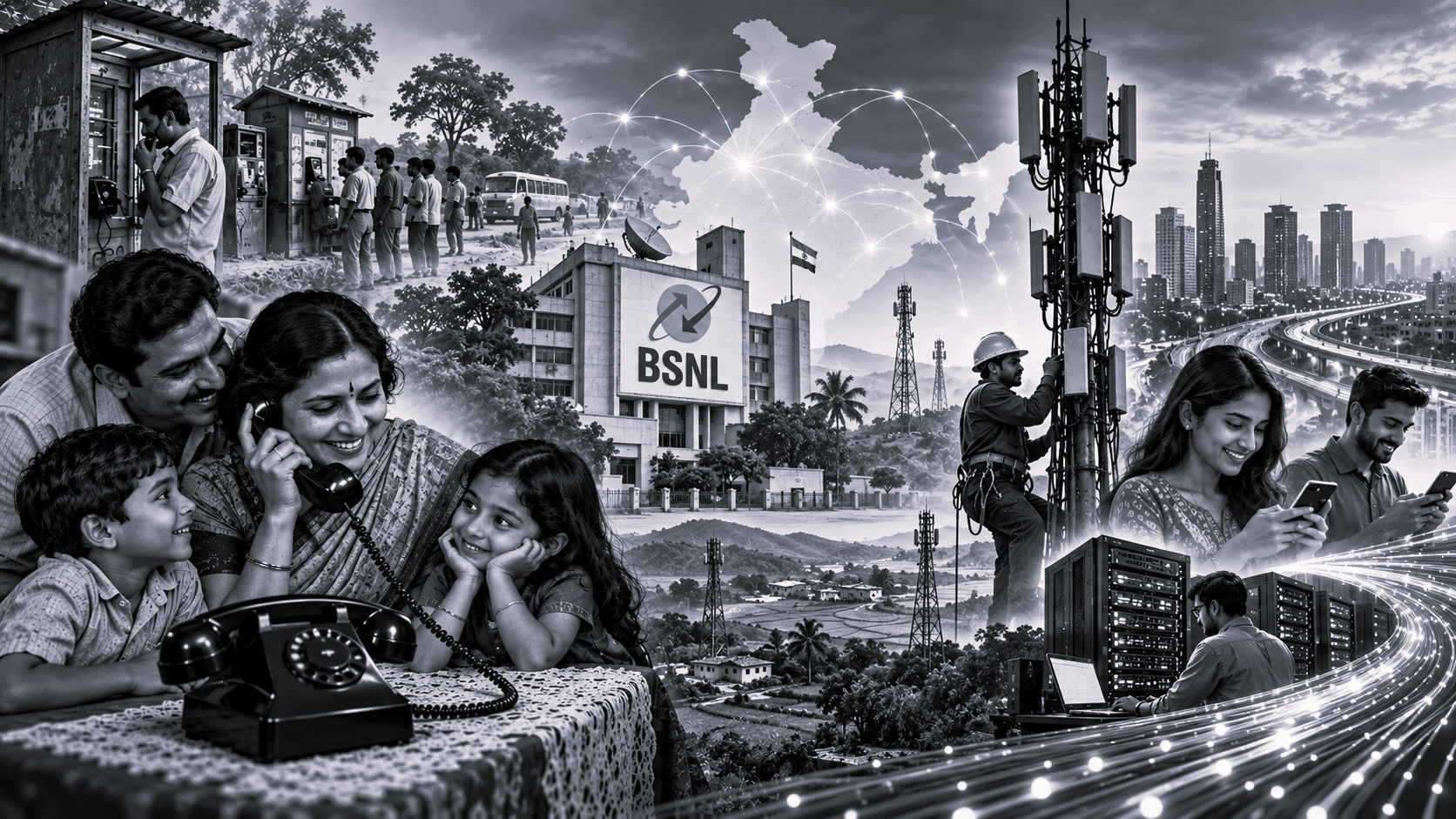
BSNL at 27: The Rise, Fall and Reinvention of India’s Telecom Giant
On October 1, 2000, when Bharat Sanchar Nigam Limited (BSNL) began operations, a telephone was still something that lived in a house rather than in a pocket. Mobile phones were expensive, internet access was limited and getting a landline connection could itself be an achievement. Twenty-six years later, BSNL is entering its 27th Foundation Day in a dramatically transformed telecom landscape. The company that once formed the backbone of India's communication network is now attempting to regain technological and commercial relevance in a market overwhelmingly dominated by private operators.
Yet BSNL's story cannot simply be described as one of decline. It is a story of extraordinary growth, technological disruption, financial crisis, government intervention and reinvention. Its journey also mirrors India's own transformation from a country waiting for telephone connections to one preparing for 6G.
When BSNL Connected India
BSNL was formed on October 1, 2000, through the corporatisation of the erstwhile Department of Telecommunications' service operations and inherited a vast nationwide network. It became a 100% government-owned public-sector telecom company providing services across the country, except Delhi and Mumbai, which were served by MTNL.
At the beginning of BSNL's journey, India's telecom market was overwhelmingly dominated by fixed-line connections. In 2001, the country had just 3.58 million mobile subscribers, compared with 32.70 million landline subscribers. By 2010, the mobile base had exploded to 584.32 million, while landlines had slipped to 36.96 million.
BSNL was an important part of that transformation. It expanded from traditional telephone services into mobile communications, broadband and enterprise connectivity, launching 2G mobile services in 2002, MPLS services in 2003 and 3G services in 2009.
For millions of Indians who grew up in the 1980s and 1990s, however, BSNL means something more personal.
The BSNL Generation
For an entire generation, the telephone was a fixture of family life. The number was memorised rather than saved. Friends called the house rather than an individual's mobile. A ringing telephone could bring the entire family into the room. Long-distance conversations often meant visiting an STD or PCO booth, watching the meter and carefully calculating how long one could afford to talk.
There were no smartphones, WhatsApp calls, unlimited data plans or video calls. BSNL was the connection to the outside world.
That nostalgia is important because it illustrates how profoundly India's communication habits have changed. The same company that once represented the country's march towards modernity eventually found itself struggling to adapt to the speed of the next technological revolution.
The Warning Signs Came Before Jio
BSNL's financial troubles did not begin with Reliance Jio's entry in 2016. The warning signs were already visible.
BSNL recorded a net loss of ₹1,822.65 crore in FY2009-10. The government attributed the deterioration partly to declining wireline revenue as customers moved from fixed-line telephones to mobile services, falling ARPU and intense tariff competition. Rising expenditure, including employee costs and spectrum-related depreciation, added to the pressure.
The arrival of Jio subsequently accelerated the disruption. The industry moved rapidly towards cheap mobile data and 4G, while private operators invested aggressively in newer networks. BSNL, carrying a huge legacy infrastructure and organisational structure, struggled to respond with comparable speed.
In that sense, Jio did not create BSNL's structural problems; it exposed them at unprecedented speed.
From Landlines to Data
The decline of the traditional telephone market captures the transformation. India's landline subscriber base reached 41.42 million in 2005, but fell to 19.13 million by 2020. Interestingly, the fixed-line market subsequently began recovering, reaching 20.24 million in 2021, 24.82 million in 2022, 28.36 million in 2023, 32.89 million in 2024 and 43.81 million in 2025.
The apparent revival, however, does not mean that the old landline era has returned. Much of today's fixed connectivity is associated with fibre broadband and FTTH. The old wire that once carried a voice call is increasingly carrying high-speed internet, video and digital services.
The wireless market tells a different story. Private operators now dominate India's mobile ecosystem, while BSNL and MTNL together account for only a small share. The transformation from fixed-line voice to mobile data fundamentally altered the competitive landscape.
The Government Chooses Revival
Rather than allowing BSNL to retreat further, the government has pursued an extraordinary revival programme. Three major revival packages worth approximately ₹3.22 lakh crore have been approved, covering capital infusion, spectrum, debt restructuring, rural viability-gap funding and 4G/5G network expansion.
The first major intervention came in 2019, involving measures such as voluntary retirement, 4G spectrum support, sovereign-guaranteed bonds, employee-cost reduction and asset monetisation. The package also included an in-principle proposal for a BSNL-MTNL merger.
The ₹1.64 lakh crore revival package of 2022 was much more comprehensive. It included ₹44,993 crore for spectrum, ₹22,471 crore in capital expenditure support, ₹13,789 crore in viability-gap funding for rural wireline operations, ₹33,404 crore for AGR-related support and sovereign guarantees for long-term borrowing. The package also merged Bharat Broadband Network Limited with BSNL to strengthen the company's fibre network and BharatNet role.
A further ₹89,047 crore package in 2023 strengthened the company's 4G and 5G spectrum position and network expansion.
The Indigenous 4G Gamble
Perhaps the most significant part of BSNL's second life is its indigenous 4G rollout.
BSNL ordered one lakh indigenously developed 4G sites for nationwide deployment. By January 15, 2026, 97,672 sites had been installed and 95,511 were on air. The equipment is designed to be upgraded to 5G.
This is not simply a BSNL modernisation programme. It is also part of India's effort to build domestic telecom technology capability. The government has described the indigenous 4G stack as an important achievement under the Aatmanirbhar Bharat initiative.
But there is a paradox. BSNL has had to catch up while simultaneously helping develop the technology with which it is catching up. That strategic decision offers India greater technological autonomy, but developing, testing and deploying a domestic telecom ecosystem takes time. Meanwhile, consumers move quickly towards networks offering better coverage, speed and reliability.
Signs of a Revival
There are now measurable signs that the government's intervention is beginning to produce results.
BSNL's customer base increased from 8.86 crore in March 2024 to 9.28 crore in December 2025, while the government has reported substantial improvements in network deployment.
Its average revenue per user rose from ₹71 in FY2024-25 to ₹101 in FY2025-26, representing a 42% year-on-year increase.
The company has also moved towards profitability after years of losses, with the government highlighting net profits of ₹262 crore in Q3 FY2024-25 and ₹280 crore in Q4.
These developments suggest that the revival is producing operational improvements. But recovery should not be confused with competitive parity. BSNL still operates in a mobile market where private companies command the overwhelming majority of subscribers.
Why the Government Still Needs BSNL
The case for retaining BSNL is not purely commercial.
The government considers BSNL strategically important for rural connectivity, indigenous technology, disaster relief and national telecom infrastructure. Under the 4G Saturation Scheme, the company is involved in expanding connectivity to previously uncovered villages, while it also implements projects covering border areas and Left-Wing Extremism-affected regions.
BSNL is also a key implementing agency for BharatNet, India's major rural broadband programme. This gives the company a role that extends beyond competing for urban mobile subscribers.
That creates a difficult balancing act: BSNL must operate as a commercially viable telecom company while also providing services in areas where purely commercial investment may not always be attractive.
Privatisation or Reinvention?
The possibility of privatising BSNL has existed in policy debates for years. The Sam Pitroda Committee had recommended 30% disinvestment through a strategic investor and IPO, along with professional management and organisational restructuring. The proposal was not implemented.
The government's current strategy is clearly different. It has repeatedly supported BSNL rather than pursuing disinvestment, while using asset monetisation and restructuring to improve its financial position. The creation of BSNL Tower Corporation Limited and the merger of BBNL illustrate attempts to extract greater value from infrastructure without selling the company itself.
The distinction matters: asset monetisation is not the same as privatisation.
The 4G-6G Paradox
BSNL's biggest challenge now extends beyond 4G.
India is already preparing for 5G and 6G, while BSNL is still completing its nationwide 4G transformation. There is nothing inherently contradictory about India developing future technologies while upgrading existing networks. The real question is whether BSNL can move between generations quickly enough.
The company cannot afford to spend another prolonged period catching up. Its indigenous 4G equipment is technically 5G-upgradable, offering a potential bridge to the next generation. But technology alone will not solve the problem. BSNL must also improve procurement speed, network density, customer experience, workforce capabilities and decision-making.
A Telecom Giant Searching for Its Second Life
BSNL's 26-year journey is therefore neither a simple success story nor a story of institutional failure.
It began as India's telecom lifeline, became a household name for an entire generation, lost ground as the industry shifted from landlines to mobile data, accumulated financial and technological pressures, and is now undergoing an unprecedented government-backed revival.
The company's first chapter was about connecting India. Its second became a struggle to keep up with India's rapidly changing communication needs. Its third chapter is now being written through indigenous 4G, fibre broadband, BharatNet and preparations for 5G.
The ultimate test will not be how much money the government puts into BSNL, how many towers it installs or how many subscribers it regains. It will be whether the organisation can turn that support into sustainable competitiveness and technological agility.
For those who remember the sound of a BSNL telephone ringing in the living room, the company's transformation from a landline provider to a 4G network operator is already remarkable. But the next phase will determine whether that nostalgia becomes merely a memory of India's telecom past or the beginning of a second life for one of the institutions that helped connect the country in the first place.