
BRICS Summit In Delhi Overshadowed By West Asia War Crisis
Iran's Foreign Minister Abbas Araghchi has made a statement that has sent shockwaves through the Gulf. He has openly accused the United Arab Emirates of being an active partner in the aggression against Iran , not a bystander, not a neutral party, but a direct participant. Speaking before attending the BRICS Foreign Ministers' Summit in New Delhi , Araghchi claimed that the UAE did not merely watch as the United States and Israel launched their war against Tehran. According to him, the UAE may have actively participated in the attacks , a charge that aligns with a recent report suggesting the Gulf nation secretly joined Washington in its military operations. The UAE, for its part, has not taken these accusations lying down. Iran's strikes on UAE territory have drawn a fierce defensive response, as of early April 2026, the UAE had intercepted and destroyed 537 ballistic missiles, 2,256 drones, and 26 cruise missiles fired from Iran, using THAAD and Patriot missile defence systems, with the attacks killing 13 people and injuring 224 others. The diplomatic and military relationship between Tehran and Abu Dhabi has, in other words, collapsed entirely.
Araghchi did not stop there. He pointed squarely at the United States and Israel as the architects of the current chaos, warning that "regional instability is a lose-lose proposition for all sides, including the aggressors." His words carry particular weight now, as the conflict continues to bleed beyond borders and into the waters of the broader region.
A grim reminder of that came on the morning of May 13th, when an Indian-flagged vessel was targeted near the coast of Oman . The vessel, a mechanized sailing ship named Haji Ali , registered at Salaya port in Gujarat, was on a routine voyage from Somalia to Sharjah, carrying livestock. It encountered what is believed to have been a drone attack in Omani waters, which triggered a fire on board and ultimately caused the ship to sink. All 14 crew members were safely rescued by Omani authorities, sparing what could have been a far greater tragedy. India's Ministry of External Affairs was blunt in its response, calling the incident "unacceptable." While responsibility for the attack has not yet been formally assigned, the incident has sharpened India's anxiety over the safety of its nationals and vessels in a region it has long depended on for trade and energy.
The episode is not isolated. Maritime security across the Arabian Sea and the Persian Gulf has been deteriorating steadily ever since the conflict erupted. But the most consequential chokepoint of all is the Strait of Hormuz , a narrow waterway that, until recently, carried roughly a fifth of the world's daily oil and gas supply . The closure of the Strait following the outbreak of military conflict on February 28, 2026 is expected to raise the average West Texas Intermediate price of oil to $98 per barrel and lower global real GDP growth by an annualized 2.9 percentage points in the second quarter alone. A dual blockade, enforced by both Iran and the United States, has effectively strangled one of the world's most critical trade arteries. International benchmark Brent crude futures have hovered around $100 a barrel, with oil falling slightly on hopes of a potential US-Iran deal to end the war and reopen the strait, only for prices to firm again after a senior Iranian official appeared to rebuff the US proposal.
What makes the current situation even more alarming is that Iran is no longer merely threatening to close the strait, it is monetising it . Tehran's naval forces have begun selectively allowing ships to pass through the waterway, and, in a striking development, Iran recently permitted a group of over 30 Chinese vessels to cross the strait since Wednesday evening, a passage reportedly requested directly by Beijing. An Iranian military spokesperson was candid about the strategic logic: controlling the strait generates significant economic revenue and strengthens Iran's international position. Iran's Parliament has already finalised a management plan for the waterway. The strait, it appears, has been transformed from a threat into a toll booth and Tehran is now the toll collector.
The Gulf's inner tensions are escalating too. Kuwait has become the latest country caught in Iran's orbit of confrontation. Kuwaiti authorities confirmed this week that four Iranian men were arrested attempting to enter the country by sea . Two were identified as Navy colonels, with the others holding the ranks of captain and lieutenant commander, all allegedly members of Iran's Islamic Revolutionary Guard Corps. Kuwait says the men were tasked with infiltrating the island . Iran has flatly denied the accusations, claiming its officers entered Kuwaiti waters by mistake due to a disrupted navigation system. Iran's Foreign Minister took to social media to denounce what he called an "illegal act" by Kuwait and demanded the immediate release of the detained men, adding pointedly that Tehran "reserves the right to respond."
Meanwhile, Donald Trump , who has been notably quieter since his visit to China for the Trump-Xi Summit in Beijing, broke his relative silence in dramatic fashion. In the early hours of Tuesday, he launched a social media blitz of over 50 posts in the span of three hours . He dismissed media coverage that portrayed Iran as a strong or capable power, calling such narratives "virtual treason." He declared that the United States would win the Iran war, "peacefully or otherwise" and made clear that halting Iran's nuclear programme remains his administration's absolute priority, even if it comes at significant economic cost to Americans.
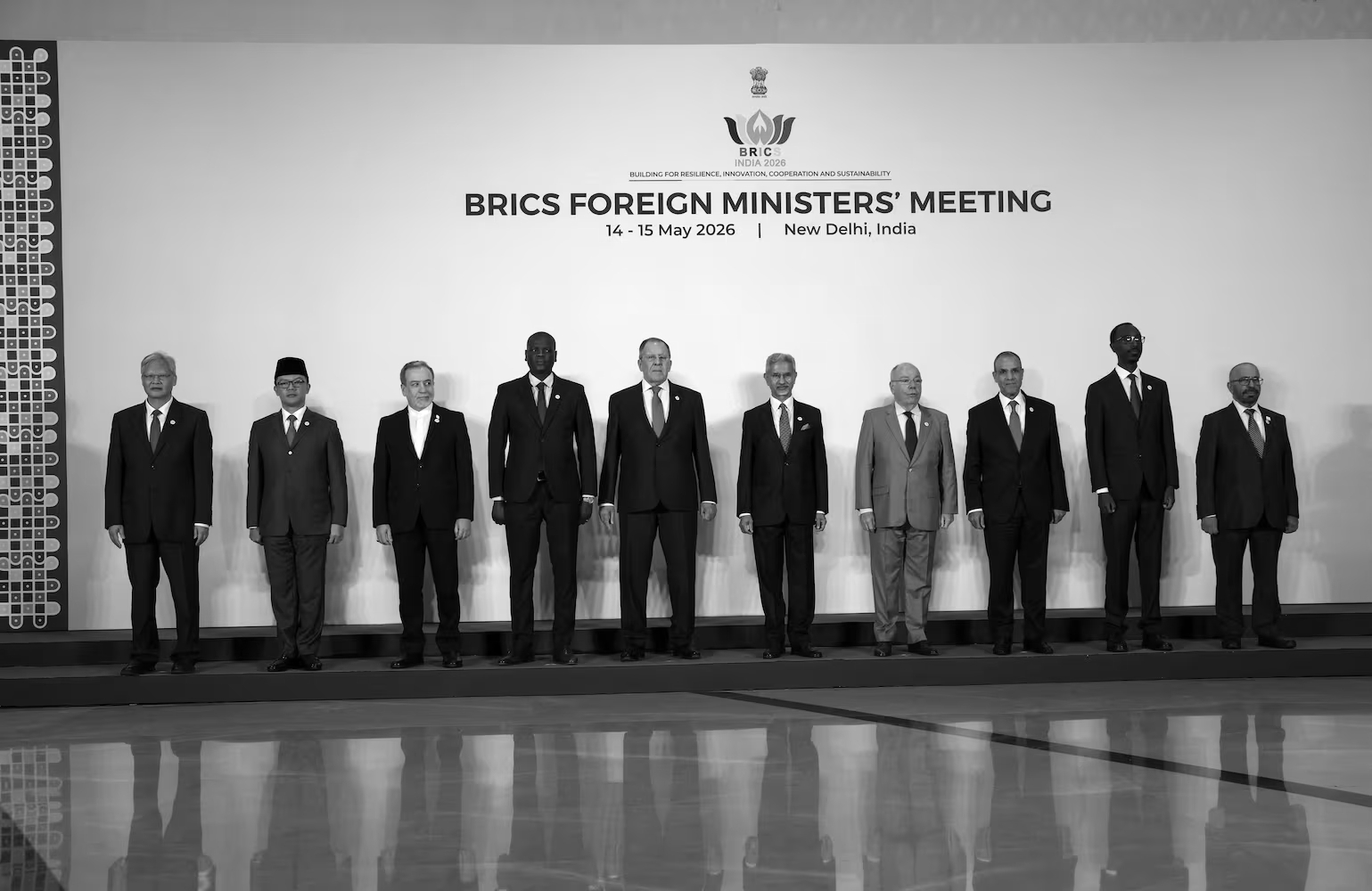
The BRICS Foreign Ministers' Summit in New Delhi has given the conflict a multilateral dimension. With major emerging economies gathered in the Indian capital, the war in West Asia is not just a bilateral American-Iranian confrontation, it is a problem landing squarely on the desks of the world's largest developing nations. India, for its part, has twin anxieties: the safety of its nearly nine million citizens in the Gulf region , and its heavy dependence on West Asian oil imports that now flow through a dangerously contested waterway.