
Brewing 2047: Can Indian Tea go from Chai glass to Global luxury?
India’s tea sector is standing at a turning point, where a 200-year-old plantation legacy is being forced to adapt to climate stress, shifting global demand and a new wave of technologies that reach from the soil of Assam to supermarket shelves in Europe. From indigenous brews in the forests of the North-East to Union Commerce and Industry Minister Piyush Goyal’s recent call in New Delhi for blockchain-enabled traceability, eco-friendly packaging and new globally competitive varieties, the story of Indian tea today is about whether a traditional commodity can reinvent itself as a high-value, innovation-led industry.
Tea’s journey in India began long before the British turned it into an export empire. Indigenous communities such as the Singpho in present-day Assam were already cultivating and consuming leaves from wild [Camellia sinensis var. assamica] plants, brewing a local version of tea as part of their everyday life. In 1823, Scottish trader Robert Bruce encountered these native bushes in the Upper Brahmaputra valley, learning from local leaders like Maniram Dutta Baruah and setting in motion a process that would redraw the global tea map. Alarmed by Britain’s dependence on expensive Chinese tea, the East India Company seized this discovery. From the 1830s it began organised trials in Assam, combining local Assamica plants with cultivation methods and sometimes plant material brought from China, and by 1837 the first commercial garden was established at Chabua, followed soon after by the Assam Tea Company. By the 1870s, tea cultivation had spread to Darjeeling, the Dooars–Terai belt and later the Nilgiris, and India had become a major supplier to Britain, using cheap plantation tea, the railways and aggressive promotion to embed chai into daily life.
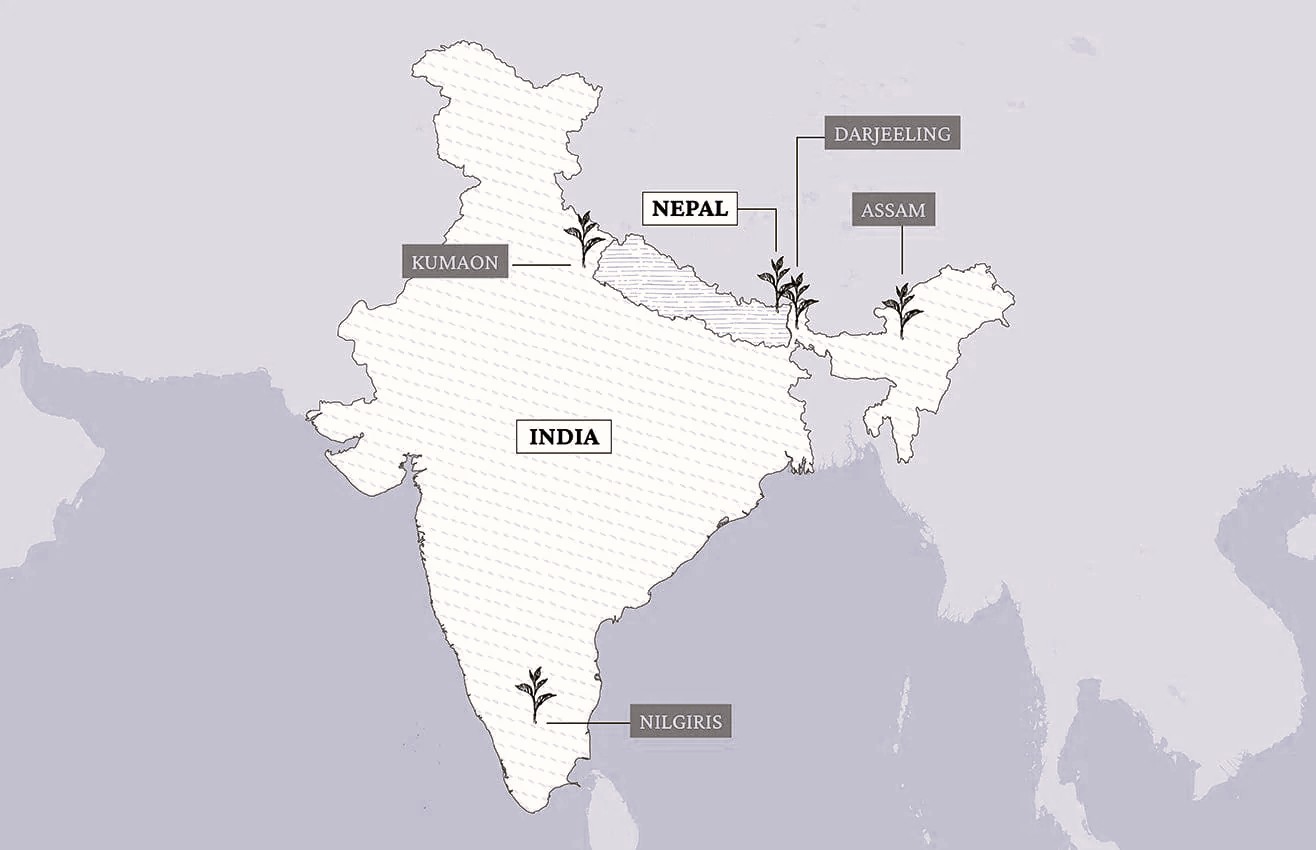
In the 21st century, that colonial plantation is now a vast, complex ecosystem. India is among the world’s top two tea producers and top three exporters, accounting for roughly 21–25% of global tea output, second only to China. Annual production hovers around 1.3–1.4 billion kg, largely from Assam and North Bengal in the north and the Nilgiris and other high ranges in the south. Assam’s plains produce the strong, malty CTC and orthodox teas that power everyday chai and bulk exports, while Darjeeling’s high-altitude gardens yield light, floral teas celebrated as the “champagne of teas” and protected by a Geographical Indication (GI) tag. Dooars–Terai in North Bengal supplies bright, full-bodied leaf crucial for mass blends, Nilgiri gardens in Tamil Nadu contribute brisk, aromatic teas that work well in orthodox and iced formats, and regions like Kangra in Himachal Pradesh, Munnar and Kerala’s high ranges and smaller North-Eastern states provide niche regional flavours.
Behind this geography lies a human story that makes tea one of India’s most socially important agri-industries. Government data indicate that about 1.16 million workers are directly employed in plantations and factories, making tea one of the largest organised employers after the Railways and a major source of women’s employment. An almost equal number of people are indirectly associated through transport, warehousing, auctions, packaging and ancillary services, taking formal and informal livelihood dependence to over 2.3 million. Broader academic and sectoral studies suggest that when Small Tea Growers (STGs), family labour and local economies in Assam and North Bengal are fully counted, up to 10 million people derive at least part of their income from tea, underlining how deeply this crop is woven into the rural fabric.
Structurally, the sector is a mix of large corporates and a fast-growing smallholder base. On one side stand big brands like Tata Consumer Products and Hindustan Unilever, whose labels Tata Tea, Tetley, Red Label, Taj Mahal and others dominate domestic and export shelves, backed by large estates or long-term supply chains. Plantation majors such as McLeod Russel, Goodricke, Jayshree Tea, Duncans and others control dozens of gardens across Assam, Dooars and North Bengal, supplying both domestic blenders and international buyers. On the other side, Small Tea Growers—typically farming less than a hectare now account for a significant share of green leaf output in Assam, North Bengal and the Nilgiris, but often depend on bought-leaf factories and have limited bargaining power or access to finance, irrigation or certification. Their vulnerability becomes acute when weather hits yields or auction prices fall, making policy support critical.
Climate change has emerged as perhaps the biggest structural challenge confronting this ecosystem. Studies and on-ground reports from Assam and North Bengal show how erratic rainfall, more frequent floods, heatwaves and shifting pest patterns are disrupting yields and quality. Years of drought-like conditions or excessive rain can reduce crop, alter the chemical composition of the leaf and trigger spikes or crashes in auction prices that filter down as wage uncertainty, bonus cuts or even garden closures. For workers and small growers already on thin margins, this volatility compounds long-standing issues of low wages, inadequate housing, health gaps and limited alternative livelihoods in plantation belts. Tea is no longer just a question of agronomy; it is also a question of climate resilience and social justice.
Yet India remains a tea powerhouse in global trade terms. Tea exports rose to about 254.67 million kg in 2024 and further to roughly 257.88 million kg in FY 2024–25, giving India around a 10% share of global tea exports even though most of its production is consumed domestically. Export markets span Russia, the CIS region, West Asia, Europe and North America, with both bulk and value-added teas in play. Imports, by contrast, stay minor generally under 10–15 million kg annually consisting mainly of low-cost or specific-origin teas from Kenya, Sri Lanka, Vietnam and others for blending or re-export. The arithmetic is clear: India is a strong net exporter, and what happens in its gardens influences global availability and pricing.
Recognising this strategic position, the Government of India has tried to move from a maintenance mindset to a renewal mindset. The Tea Development & Promotion Scheme for 2023–24 to 2025–26, with an outlay of about ₹664 crore, focuses on replantation of old, low-yielding bushes, quality upgradation, R&D, market promotion and worker welfare rather than indiscriminate expansion into new areas. Under its plantation development components, estates and small growers receive support to uproot senile bushes and plant improved varieties, provided they follow norms on plant density and approved material, while earlier mechanisms like the Special Purpose Tea Fund created a framework for long-term rejuvenation of ageing gardens. Targeted programmes such as Plantation Development for Small Tea Growers (PDSTG) and subsidies for small growers’ replanting and new planting aim to ensure that productivity and quality gains are shared beyond the big estates.
Institutionally, this push is anchored by the Tea Board of India, a statutory body under the Ministry of Commerce and Industry created by the Tea Act of 1953 and headquartered in Kolkata. The Board operates through regional and development offices across key producing belts Assam’s Guwahati, Jorhat and Dibrugarh; North Bengal’s Siliguri and Kurseong; Nilgiri and high-range centres in Tamil Nadu and Kerala; Tripura and other North-Eastern states as well as liaison offices in metros for trade and promotion. Its functions range from registration and development schemes to quality control, export facilitation and market promotion, effectively acting as the government’s on-ground arm in the tea economy.
Over the past few years, technology has moved from the margins to the centre of the tea conversation. In line with Goyal’s call, plantations are increasingly experimenting with precision agriculture using drones, sensors and AI tools to cope with labour shortages, rising input costs and climate uncertainty. In Assam, Nilgiris and other regions, AI-enabled drones fly over tea gardens with multispectral cameras to detect plant stress, pest attacks, nutrient deficiencies and moisture variability far more quickly than traditional field scouting. These drones also take on precision spraying of fertilisers and plant protection chemicals, reducing labour requirements, cutting wastage and helping keep chemical residues within strict export-market Maximum Residue Limits.
At the same time, Internet of Things (IoT) devices and remote sensors are entering both fields and factories. Soil-moisture and microclimate sensors in gardens feed data into digital dashboards, helping managers schedule irrigation and shade management based on actual conditions rather than guesswork. In withering and drying rooms, networked sensors monitor temperature and humidity, with analytics suggesting adjustments to safeguard flavour and cup quality. Layered over this are weather-forecasting and pest-risk models that can alert growers to likely disease outbreaks or adverse conditions, allowing them to respond early and reduce crop loss.
Perhaps the most transformative, and still emerging, area is digital traceability and blockchain-linked tracking of tea from “bush to cup”. Some Indian producers and agritech firms are piloting systems where each lot of tea is assigned a QR code or barcode tied to a secure ledger showing its garden of origin, plucking date, input profile and processing path. For exporters, this helps meet tightening food safety and sustainability standards in Europe and other markets, while for domestic consumers it offers a way to verify authenticity and avoid adulteration or mixing with cheaper imported teas. For small growers, if integrated well, such platforms can eventually support better price discovery, reputation-building and direct linkages with buyers who are willing to pay a premium for traceable, ethically produced tea.
All of this innovation unfolds against the backdrop of changing global demand. Consumers abroad and increasingly at home are moving beyond plain CTC chai to specialty and wellness teas green, white, herbal, organic, single-origin and functional blends aimed at stress relief, sleep, detox or metabolic health. China, Japan and Sri Lanka have cultivated strong identities in many of these segments, leveraging both terroir and tradition. India’s iconic names Assam, Darjeeling, Nilgiri continue to command respect, but Goyal’s insistence that India must develop a wider catalogue of internationally competitive products points to a real gap: without a steady pipeline of new climate-resilient cultivars and innovative blends tailored to these niches, the country risks being locked into lower-margin bulk commodity trade.
In response, the minister has urged scientists and breeders to tap India’s diverse agro-climatic zones to develop new varieties and signature blends aligned with wellness trends and premium lifestyle markets, while simultaneously insisting on sustainable farming practices, responsible labour standards and eco-friendly packaging. Initiatives such as drip irrigation, mechanisation where feasible, biodegradable and recyclable packaging and skilling programmes for workers and youth in tea regions are being promoted as part of a broader “green and fair” repositioning of Indian tea. At the same time, digital tools like the Chai Sahayog App aim to give small growers better price information and advisory support so they can capture more value for their leaf.
Ultimately, tea’s future in India will be decided not only by rainfall patterns or auction prices, but by whether government, industry, workers and small growers can move in step towards a more resilient, tech-enabled and value-driven model. The sector’s contribution—roughly a quarter of the world’s tea output, about a tenth of global exports and livelihoods for millions—means that its trajectory matters far beyond plantation roads and hill slopes. If replantation, climate-smart technologies, digital traceability, fair labour reforms and brand-building succeed together, Indian tea can shift from being seen mainly as a bulk supplier to being recognised as a global benchmark for quality, heritage and responsibility. In every cup, from a street-side chai in Guwahati to a first-flush Darjeeling poured in London, the question now is not just how tea came to India but how India will carry tea into a very different, and more demanding, future.