
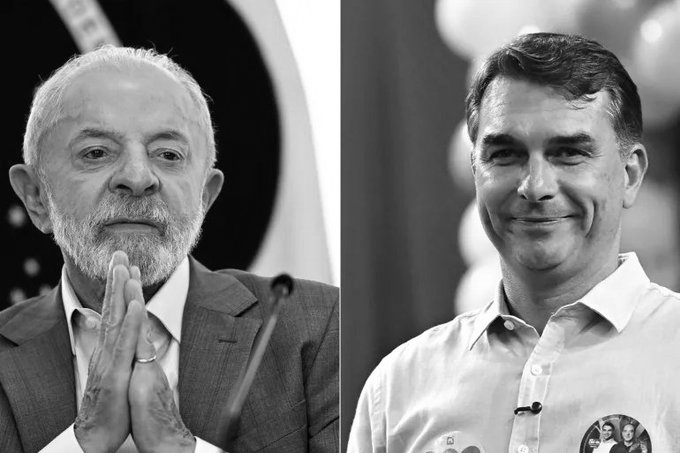
Brazil Election Round 2 Race Heats Up As Lula And Flavio Bolsonaro Battle For Power
Brazil's presidential election reached its decisive stage on Sunday, October 25, as voters chose between incumbent Luiz Inacio Lula da Silva and Senator Flavio Bolsonaro, the son of former president Jair Bolsonaro. The closely contested runoff will determine whether Latin America's largest economy continues under left-wing leadership or shifts to the right amid a broader regional political realignment.
Final opinion polls placed the candidates virtually neck-and-neck ahead of voting. Lula, who turns 81 next week, is seeking a fourth presidential term overall after finishing second in the first round. Flavio Bolsonaro, 45, secured 47.03% of valid votes in the first round, against Lula's 45.16%, a difference of more than 2.2 million votes.
Lula has presented himself as a defender of democracy, social welfare and national sovereignty, promising to protect social programmes and resist foreign interference. His government has overseen falling inflation and unemployment and reduced Amazon deforestation. However, the cost of living, crime and concerns over public spending have remained major challenges for his administration.
Flavio Bolsonaro has campaigned on tougher action against crime, reduced government spending and political change. He has also pledged to make freeing his father his first act if elected. Jair Bolsonaro is serving a 27-year sentence following his conviction over an attempted coup after losing the 2022 presidential election.
The former president's legacy has remained central to the campaign. Following Flavio's first-round performance, thousands of students and other demonstrators took to the streets of Rio de Janeiro in early October under slogans including 'Never Again Bolsonaro' and 'No to the Father, No to the Son'. Protesters raised concerns about democracy, public education, social rights and the prospect of a return to power by the Bolsonaro family. They also recalled Jair Bolsonaro's handling of the COVID-19 pandemic, Amazon deforestation and cuts to public programmes. Meanwhile, supporters of both candidates staged large rallies ahead of Sunday's vote, highlighting Brazil's deep political divisions.
Social welfare has also been a major point of disagreement. Lula's supporters credit government assistance with helping millions escape poverty and hunger, while critics argue that expanding welfare programmes puts pressure on public finances. Crime and household expenses have further shaped voter concerns.
The campaign extended into social media, where Lula's team accused Meta, the parent company of WhatsApp, Facebook and Instagram, of algorithmic manipulation favouring his rival. Meta denied the allegation but acknowledged that technical errors had mistakenly deactivated some of Lula's campaign advertisements.
The election's aftermath could bring further political confrontation. Political analyst Thomas Traumann warned that a Lula victory could leave his government facing a hostile Congress and impeachment threats. A Flavio Bolsonaro victory, meanwhile, could intensify tensions with the Supreme Court. Flavio has said he would seek the impeachment of Justice Alexandre de Moraes, who led the case against his father.
The result is also being closely watched in Washington. US President Donald Trump, an ally of the Bolsonaro family, has clashed with Lula's government over trade and security and imposed tariffs on Brazilian exports in 2025, explicitly linking the move to Jair Bolsonaro's prosecution. Lula has described US pressure as interference in Brazil's affairs, while Flavio has highlighted his ties with the Trump administration and called for better relations with Washington.