
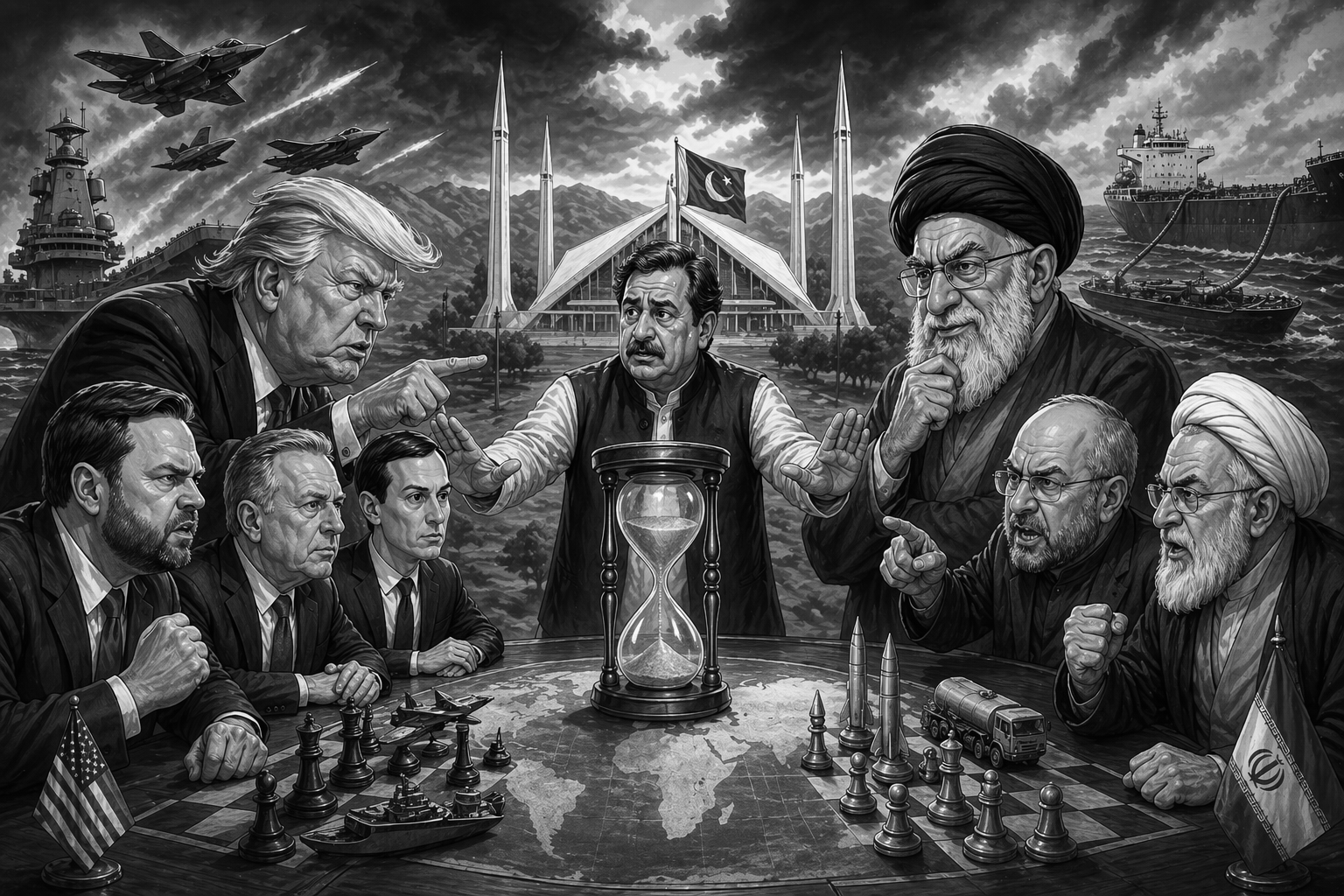
Bombs or Bargains: Iran Still Not at the Table as Islamabad Peace Talks Enter Their Final Hours
As the clock ticks mercilessly toward the ceasefire deadline of April 22 , the Pakistani capital of Islamabad finds itself once again at the epicentre of one of the most consequential diplomatic confrontations of the modern era. The second round of US-Iran peace talks is shrouded in deep uncertainty, with both sides trading threats, ultimatums, and pointed warnings even as the world watches with bated breath.
Vice President JD Vance is leading the American delegation back to Islamabad, accompanied by special envoys Steve Witkoff and Jared Kushner . The American side has confirmed plans to travel to Pakistan, with Vance set to attend alongside National Security Council, State Department, and Pentagon officials. The Iranian side, however, remains conspicuously noncommittal. Iranian state media reported that no delegation has yet departed for Islamabad, directly contradicting earlier reports that a team of representatives was travelling. And yet, behind this wall of public defiance, something quietly significant emerged: Iran's new Supreme Leader Mojtaba Khamenei has reportedly given the "green light" for the Iranian negotiating team to travel to Islamabad, a signal that Tehranʼs back-channel machinery may still be running, even as its front-facing rhetoric burns hot.
President Donald Trump, speaking to CNBC's Squawk Box on Tuesday morning in characteristically blunt fashion, set the tone for what could be the most decisive day of this fragile diplomatic process. "I think they have no choice," Trump said, when asked what he expected from the second round of negotiations. "We've taken out their navy, we've taken out their air force, we've taken out their leaders," he added, framing Iran's negotiating position as one of near-total strategic exhaustion .
On the question of extending the ceasefire, which technically expired as a two-week truce agreed on April 7, though Trump himself has since told Bloomberg it ends " Wednesday evening Washington time ," effectively granting an extra 24 hours, the president was characteristically firm. Asked if he would extend the ceasefire, Trump said plainly, "Well, I don't want to do that." He declared the extension " highly unlikely ," drawing a hard line even as diplomats scramble on both sides.
What made Trump's remarks particularly striking was the simultaneous carrot and stick on open display. In the same breath as threatening devastation, he posted on Truth Social boasting: "THE DEAL we are making with Iran will be MUCH BETTER THAN the JCPOA (Joint Comprehensive Plan of Action), known as the Iran Nuclear Deal." This is, of course, the very agreement that Trump himself abandoned in 2018 during his first term, a fact not lost on observers who note the rich irony of a president lambasting a deal he walked away from, while now promising something grander in its place. The White House press secretary Karoline Leavitt chimed in, saying: "The United States has never been closer to a good deal with Iran, unlike the horrible deal made by the Obama Administration." Trump has made clear he wants a deal that covers not just nuclear limits , but Iran's missile program, the Strait of Hormuz, and its support for armed regional proxies, a far more sweeping ask than the original JCPOA ever attempted.
Yet even as Trump promises a transformational agreement , he makes explicit what happens if talks collapse. His tone on CNBC mirrored this: when Tehran pushed back on his terms, Trump threatened to send " lots of bombs " unless it agreed to US conditions. The president added that the US military is "raring to go" , a phrase that reads less like diplomatic pressure and more like a countdown.
Tehran's response to this torrent of threats has been defiant, layered, and in the view of many analysts strategically calculated. Iranian Parliament Speaker Mohammad Bagher Ghalibaf took to social media to accuse Trump of imposing a siege and violating the ceasefire, and to warn that Iran was holding fresh leverage in the standoff. "In the past two weeks, we have prepared to reveal new cards on the battlefield ," he wrote, without elaborating. In perhaps his most stinging line, Ghalibaf accused Trump of seeking to "turn this negotiating table, in his own imagination, into a table of surrender or to justify renewed warmongering." Iran's message is unmistakable: it will negotiate from a position of strength , not desperation; it will engage on its own terms, not under the shadow of a naval blockade.
Iran's Judiciary Chief Gholamhossein Mohseni-Ejei reinforced this posture forcefully, asserting that "Islamic Iran has not stepped back an inch from its demands" and will not do so. In an address on April 19, Mohseni-Ejei declared that Iran's legal system has moved to a "war footing" .
Through all of this turbulence, Pakistan has continued to play the role of the steadfast, quietly desperate peacemaker. Pakistani Information Minister Attaullah Tarar posted on X that his country has made "sincere efforts to convince" Iran to attend the negotiations, noting that a "formal response from the Iranian side about confirmation of delegation to attend Islamabad Peace Talks is still awaited."
Amid the rhetoric and recrimination, one story from the high seas underscored that Iran is not simply waiting at a negotiating table, it is actively demonstrating capability. An Iranian National VLCC supertanker departed Iran in late March 2026, sailed to the Riau Archipelago off Indonesia, where it transferred 2 million barrels of crude oil to another VLCC, and then returned home via the US blockade line , arriving back at Kharg Island. Iranian state media, led by Fars News Agency , hailed the mission as "Another Iranian Tanker Breaches the U.S. Siege," framing it as a significant breakthrough against Western maritime restrictions.
As Tuesday gives way to Wednesday and the ceasefire's final hours drain away, the world faces a stark binary. The ceasefire expires at 4:50 a.m. Pakistan time on Wednesday and the next few hours in Islamabad may very well determine whether diplomacy or devastation defines what comes next.