
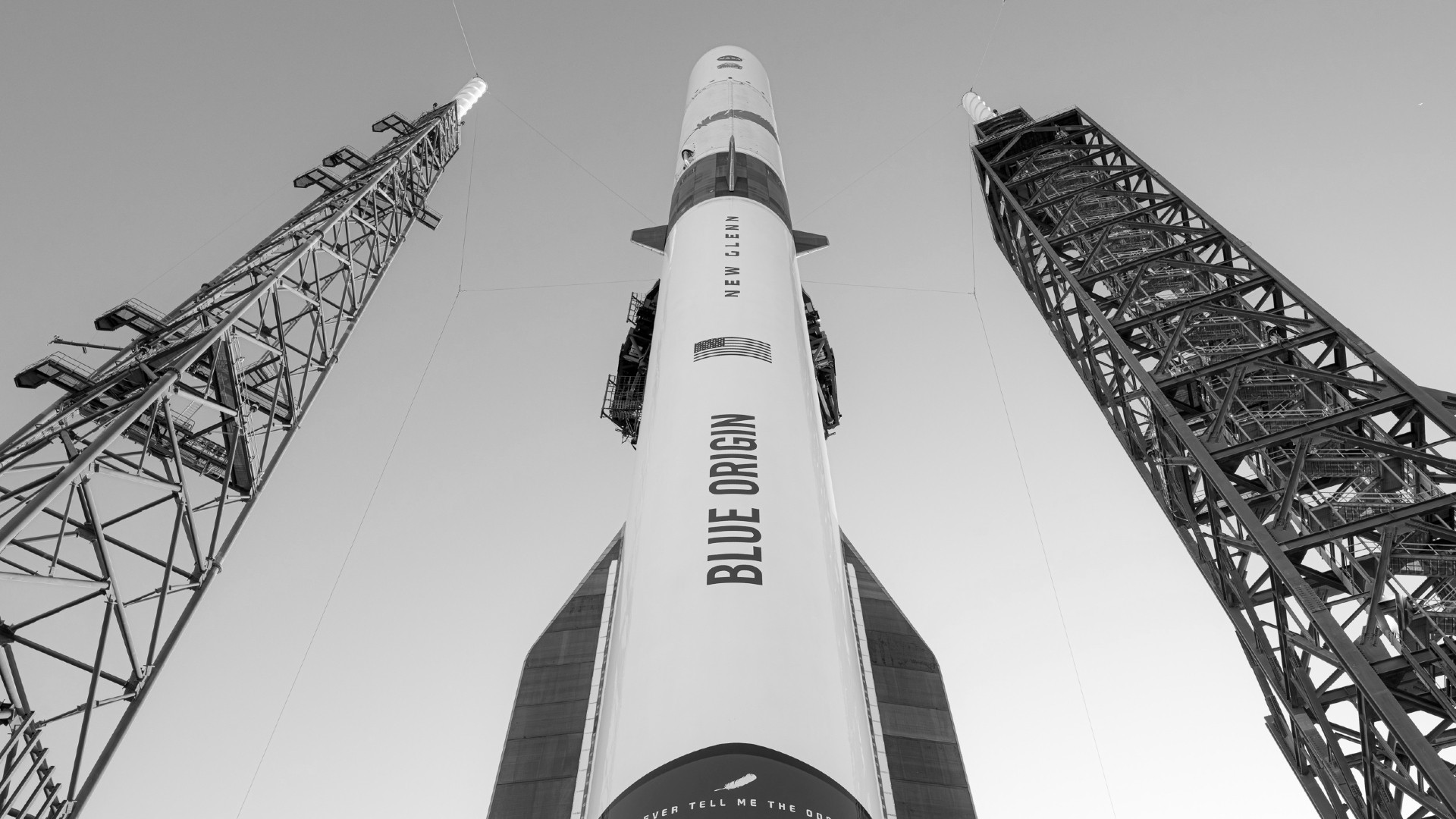
Blue Origin hit pause but the next new Glenn launch could rewrite rocket economics
Blue Origin’s ambitions to rival SpaceX in the reusable rocket race hit another pause on Sunday, as the company scrubbed its second New Glenn launch due to bad weather, minor launch pad issues, and even a wandering cruise ship that drifted into the rocket’s flight path.
The mission, now rescheduled for Wednesday, November 12, is more than just a retry; it's a defining technological milestone for Jeff Bezos’ space company. Beyond reaching orbit, Blue Origin is attempting to land New Glenn’s booster stage for the first time, a feat that could dramatically lower launch costs and position the company as a serious contender in the global space launch market.
A* *t* *est of* *t* *rue* *r* *eusability :
New Glenn first reached orbit in January 2025, proving the rocket’s power and stability. But the booster failed to land safely, exploding before it could reach its ocean platform. Engineers have since spent months refining the rocket’s landing systems and intricate choreography of engine throttling, guidance software, and heat-resistant materials designed to bring the massive booster back in one piece.
Unlike SpaceX’s Falcon 9, which relies on the proven Merlin engine family, New Glenn is powere d by Blue Origin’s BE-4 engines methane- fueled powerhouses that promise higher efficiency and cleaner combustion. Each BE-4 engine produces about 550,000 pounds of thrust, and seven of them power New Glenn’s first stage. A successful landing would validate the engine’s performance and durability under extreme flight conditions, particularly during reentry burns and descent stabilization.
Behind the* *p* *ad,* *g* *round* *s* *ystems* *s* *till* *m* *aturing :
Blue Origin described Sunday’s problems as “minor launch pad equipment issues,” but the lack of detail hints at growing pains in the company’s ground systems. The complexity of cryogenic fueling, engine purging, and telemetry synchronization means even small hardware or software mismatches can halt a launch.
While SpaceX has spent over a decade refining its launch cadence through automation and pad redundancy, Blue Origin’s infrastructure is still evolving. This second launch will test not only the rocket itself but also the reliability of the automation, monitoring, and control systems that support it, all essential for scalable, high-frequency launches.
NASA’s ESCAPADE :
Riding atop New Glenn is NASA’s ESCAPADE (Escape and Plasma Acceleration and Dynamics Explorers) mission, a twin-spacecraft project bound for Mars. ESCAPADE will study how solar wind interacts with the Martian magnetosphere and its success depends on New Glenn’s precision in payload deployment and trajectory control.
For Blue Origin, this marks its first commercial and scientific payload, a test of its ability to integrate complex NASA hardware, meet strict environmental standards, and maintain orbital accuracy. The company is also flying a Viasat technology demonstrator, further signaling its intent to diversify its launch portfolio.
AI, Autonomy, and the* *p* *ath to* *r* *ecovery :
Landing a booster isn’ t just about strong engines, it's about intelligent control. Blue Origin has been investing in AI-driven guidance, navigation, and control (GNC) systems that help the booster make real-time corrections during descent. Using a combination of onboard sensors, radar, and high-speed computing, New Glenn’s landing algorithms are designed to adapt to wind conditions, engine irregularities, and variable ocean states.
If these systems succeed, Blue Origin could soon achie ve partial or full booster reuse, mirroring the cost efficiencies that have made SpaceX’s Falcon 9 and Falcon Heavy so dominant.
Reusability* *,* *t* *he* *b* *illion-* *d* *ollar* *b* *enchmark :
Reusable rockets are not merely a technological achievement, they are a business model. SpaceX’s ability to reuse boosters up to 20 times has slashed costs and increased launch frequency, giving it an unshakable market lead. Blue Origin’s success with New Glenn could reset that balance, giving commercial and government customers an alternative with similar co st efficiency and payload flexibility.
But the path forward depends on consistent reliability, not just a single successful flight. Each launch will provide data for refining thermal shielding, engine cycles, and landing gear stress tolerances, the invisible work that defines real progress in aerospace engineering.
A* *d* *efining* *m* *oment for Blue Origin* *:
The coming Wednesday launch will be watched closely by the entire aerospace industry. A successful flight and booster recovery would signal that Blue Origin is finally moving from the “deve lopment” phase into operational maturity, a state that allows rapid iteration, higher payload confidence, and better pricing power.
For now, though, the story isn’t about a delayed launch. It’s about a company on the brink of proving that its years of quiet development, heavy investment, and iterative engineering can finally lift off and land safely back on Earth.