
Bisleri Faces FSSAI Prosecution Over Unsafe Water Sample, Company Defends Quality, Timing Raises Eyebrows
Bisleri International has maintained that its packaged drinking water is safe for consumption after the Food Safety and Standards Authority of India (FSSAI) sanctioned prosecution against the company on November 22, following a dispute over test results from samples collected at its Goa facility.
Interestingly, the regulatory action came just a day after Reliance Consumer Products Ltd (RCPL), the FMCG arm of Mukesh Ambani-led Reliance Industries, commenced production at its new beverage manufacturing facility in Orvakal, Kurnool district, Andhra Pradesh. Described as Asia's largest beverage manufacturing plant, the facility will produce packaged drinking water, carbonated beverages and fruit-based drinks for domestic and export markets.
The near-simultaneous developments have brought fresh attention to the changing dynamics of India's packaged drinking water market, where established brands are facing competition from large corporate groups with expanding manufacturing and distribution networks.
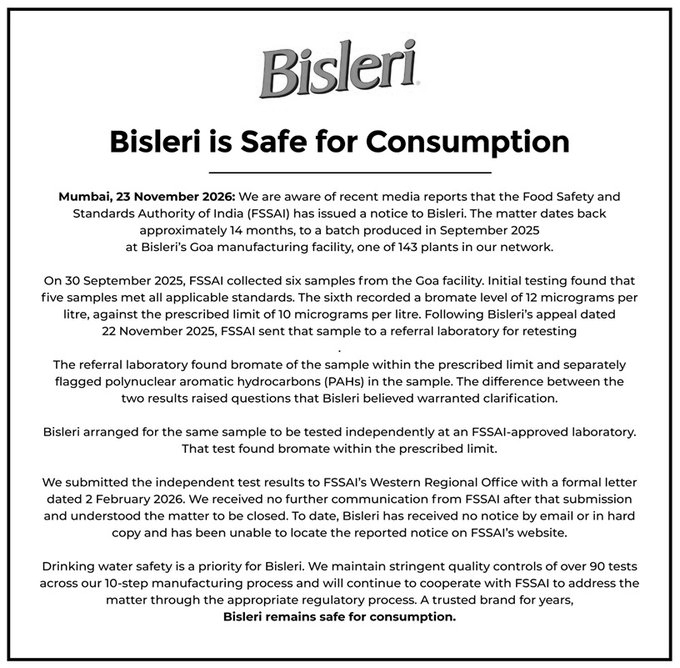
Bisleri said the regulatory case originated from samples collected at its Goa plant on September 30, 2025. According to the company, five of the six samples met the prescribed standards, while one showed bromate levels of 12 micrograms per litre, against the permissible limit of 10 micrograms per litre.
The company challenged the finding on November 22, 2025. It said a referral laboratory subsequently found bromate within the permissible limit but detected polycyclic aromatic hydrocarbons (PAHs) and classified the sample as unsafe. Bisleri later had the same sample tested independently at an FSSAI-approved laboratory, which also found bromate within the prescribed limit. The company submitted the results to FSSAI's Western Regional Office on February 2, 2026.
Bisleri said it received no further communication and believed the matter had been closed. It also claimed that it had not received the reported prosecution notice either electronically or in hard copy. The company maintains that its water undergoes more than 90 quality tests as part of a 10-step manufacturing process across its 143 plants and has said it will cooperate with the authorities.
Meanwhile, Reliance has been strengthening its presence in the beverage sector through brands such as Campa Sure and investments in manufacturing capacity. The new Orvakal facility marks another significant step in that expansion.
While the two developments are not known to be connected, their timing is noteworthy. As a major new player rapidly expands its presence, an established market leader is facing regulatory action over a long-running quality dispute. This coincidence inevitably puts the spotlight on the competitive balance in the sector and the importance of ensuring that regulatory scrutiny remains transparent, consistent and uniform for every company.
With large corporate groups increasing their reach, the bigger question is whether India's beverage market will remain genuinely competitive or see market power increasingly concentrated in the hands of a few players. The credibility of regulation will depend not only on action against individual companies but also on the assurance that the same standards apply to everyone.