
Bihar Unveils ₹3.47 Lakh Crore Budget, Bets Big on Education and Women’s Enterprise
The Bihar government led by Nitish Kumar has unveiled a ₹3.47 lakh crore budget for 2026–27, marking a significant increase from the previous fiscal’s ₹3.17 lakh crore and signalling a firm push toward education, infrastructure and women-led economic empowerment . Presented by Finance Minister Bijendra Prasad Yadav , the new budget seeks to balance welfare commitments with long-term investment in human capital and physical connectivity.
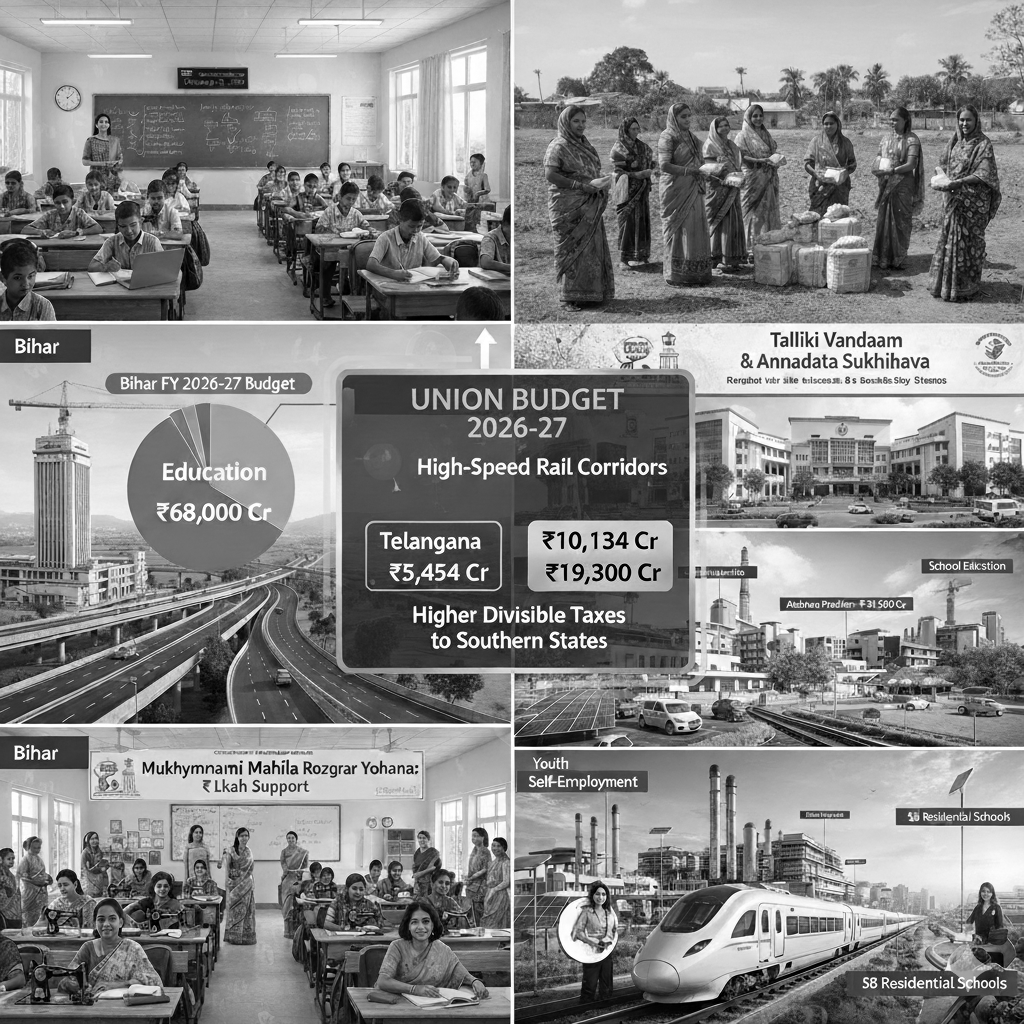
A standout feature of Bihar’s spending blueprint is its record allocation to education around ₹68,000 crore , making it the single biggest sectoral outlay. This funding is intended for new degree colleges, enhanced teacher recruitment, improved school facilities and expanded vocational training , underscoring the state’s strategy to build workforce capabilities and stimulate broader economic progress. Complementing this is an ambitious infrastructure push of over ₹63,000 crore toward roads, expressways, power and water systems to boost connectivity and investment appeal. Health services received more than ₹20,000 crore for upgrades in both urban and rural centres.
One of the most politically and economically significant initiatives is the expansion of the Mukhyamantri Mahila Rozgar Yojana . Previously, ₹10,000 cash transfers had been made to 1.56 crore women , but under the new budget selected beneficiaries can now access follow-on support of up to ₹2 lakh to grow their enterprises effectively creating a ladder from welfare to entrepreneurship.
In comparison, major southern states such as Andhra Pradesh and Telangana have framed their recent budgets and financial planning with different mixes of priorities and scale, influenced both by state fiscal choices and allocations from the Union Budget 2026-27 .
Last year, Andhra Pradesh’s budget for 2025-26 was around ₹3.22 lakh crore , with key funding directed to welfare, education and rural development schemes such as Talliki Vandanam (₹9,407 crore) and Annadata Sukhibhava (₹6,300 crore) , along with major allocations for school education (over ₹31,800 crore) and health (nearly ₹19,300 crore). The overall fiscal strategy emphasised inclusive growth and enhancement of social services , even as the state projected a Gross State Domestic Product (GSDP) of about ₹18.3 lakh crore with a 14 % growth expectation and a nearly 19 % increase in total expenditure from the previous year.
Telangana’s 2025-26 budget also reflected a broad development agenda, with projected GSDP of ₹18.00 lakh crore and estimated total expenditure of ₹2.84 837 crore , marking roughly a 14 % rise over the prior year. The state emphasised education (including setting up 58 integrated residential schools), youth self-employment schemes and support for women entrepreneurs in industrial parks, indicating a blend of human capital investment and economic inclusion.
For the current fiscal, both Andhra Pradesh and Telangana’s fiscal planning are also shaped by allocations from the Union Budget 2026-27 . Union Budget provisions such as high-speed rail corridor funding for example rail allocations of ₹5,454 crore to Telangana and ₹10,134 crore to Andhra Pradesh are expected to strengthen regional connectivity and economic integration across southern states. Additionally, the Centre’s higher share of divisible taxes is projected to benefit southern states by thousands of crores compared with previous recommendations, enhancing their fiscal space.
While Bihar’s budget clearly prioritises education, roads and grassroots enterprise support to promote long-term capacity and socioeconomic equity, Andhra Pradesh’s recent fiscal focus has combined welfare spending with expansion of social schemes and Telangana’s budgets have blended education, youth schemes and strategic infrastructure planning . The influence of the Union Budget further accentuates southern states’ emphasis on connectivity and growth infrastructure, whereas Bihar’s bold internal allocations suggest an attempt to build foundational sectors first before pivoting toward large industrial investments.