
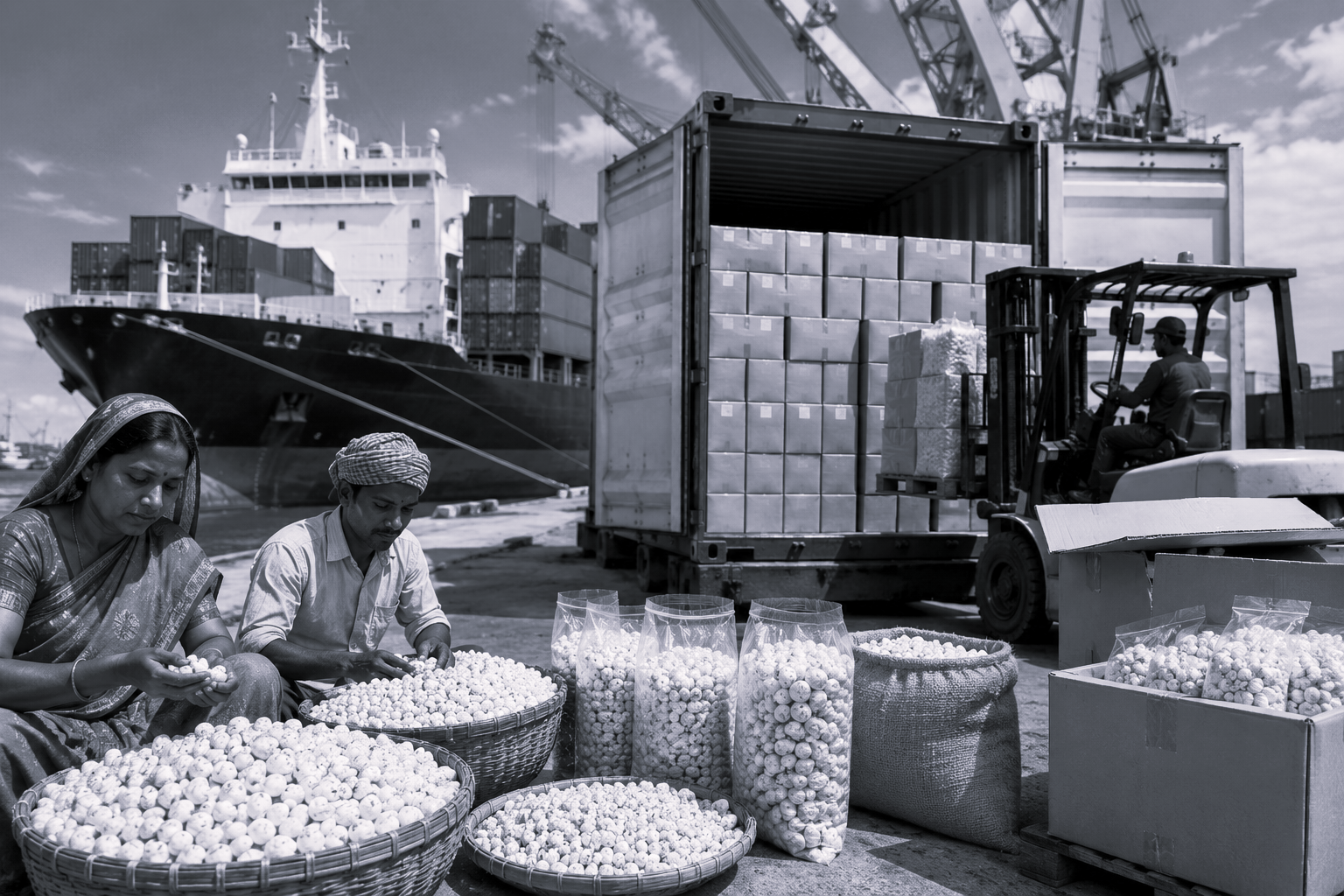
Bihar Sends 18 Tonnes of GI-Tagged Mithila Makhana to Australia
India has taken another step towards putting Bihar’s iconic Mithila Makhana on the global food map, with an 18-tonne consignment exported from Bihar to Australia by sea. Sourced from makhana growers in Darbhanga district, the shipment is expected to expand the international presence of the state’s flagship GI product and create better income opportunities for farmers through export-led market access.
The consignment marks an important development for Bihar, which accounts for nearly 85 per cent of India’s makhana production. Union Commerce and Industry Minister Piyush Goyal said farmers involved in the shipment received nearly 18 per cent higher returns than the prevailing market price, highlighting the potential of direct overseas market linkages to improve producer incomes.
Mithila Makhana received its Geographical Indication (GI) tag in 2022, strengthening its identity as a premium product associated with the traditional Mithila region. The latest shipment also comes amid efforts to streamline international trade in makhana. A separate Harmonised System (HS) Code for makhana came into effect in July 2025, enabling clearer classification and better tracking of the commodity in global trade.
India’s makhana exports have been expanding rapidly. During 2025-26, more than 7,000 metric tonnes of makhana and value-added products were exported to over 20 international destinations, including the United States, the Middle East and Africa. Earlier consignments have also taken GI-tagged Mithila Makhana to markets such as the UAE, reflecting growing international demand.
The Centre has simultaneously begun building an institutional framework to support the sector. The National Makhana Board, announced in the Union Budget 2025-26 and constituted in September 2025, is tasked with strengthening cultivation, processing, branding, marketing and exports.
A ₹476.03-crore Central Sector Scheme, running from 2025-26 to 2030-31, supports research, quality seeds, farmer training, post-harvest management, value addition, branding, export promotion and quality control. The programme also focuses on infrastructure for grading, drying, popping and packaging.
Research institutions, including Bihar Agricultural University, Sabour, are working on improved cultivation and mechanisation. Its Sabour Makhana-1 variety has reported yields of up to 3.5 tonnes per hectare.
The Australia shipment thus represents more than a single export milestone. It reflects Bihar’s effort to transform a traditional crop into a globally competitive, value-added agricultural product, while ensuring farmers capture a greater share of the value created by international markets.