
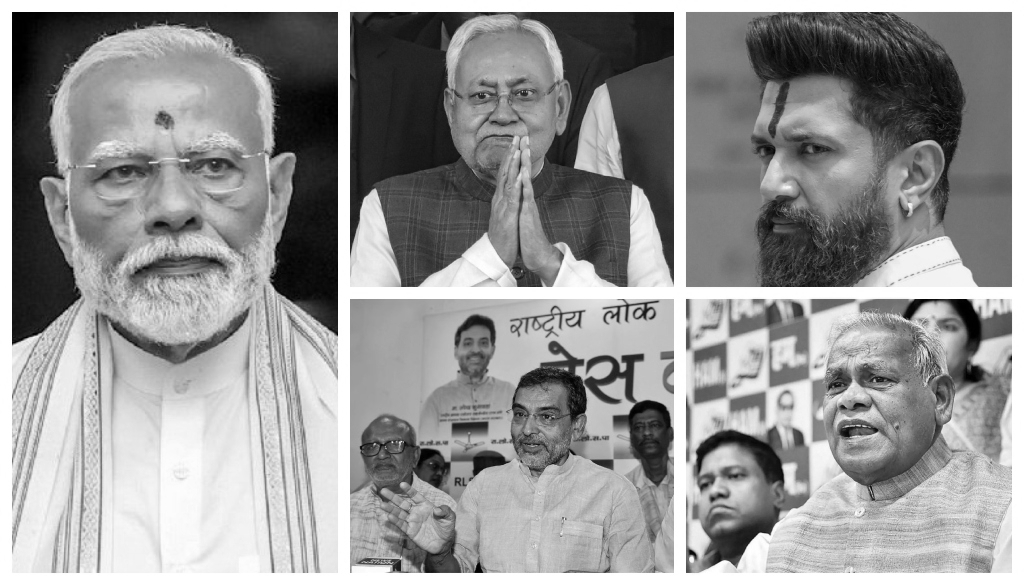
Bihar polls 2025: NDA finalises seat-sharing
The National Democratic Alliance (NDA) in Bihar on Sunday finalised its seat-sharing arrangement for the upcoming assembly elections, which will decide the 243-member state legislature. Chief Minister Nitish Kumar’s Janata Dal (United) [JD(U)] and the Bharatiya Janata Party (BJP) will each contest 101 seats, leaving the remaining constituencies for smaller allies within the alliance.
The official announcement came through the X handles of key NDA leaders: JD(U) working president Sanjay Kumar Jha, deputy chief minister and BJP leader Samrat Choudhary, and union minister Chirag Paswan, whose Lok Janshakti Party (Ram Vilas) has been allotted 29 seats. The Hindustani Awam Morcha (HAM) led by Jitan Ram Manjhi, which had demanded “at least 15 seats,” has been given only six constituencies. Rajya Sabha MP Upendra Kushwaha’s Rashtriya Lok Morcha will contest six seats as well.
The leaders, who had been camping in New Delhi for discussions over the past few days, described the deal as reached in an “amicable atmosphere.” However, Manjhi is reportedly dissatisfied with the reduced allocation. On X, he affirmed his loyalty to Prime Minister Narendra Modi, saying, “I will stay with Prime Minister Narendra Modi till my last breath.”
A strategic shift for JD(U)
Compared to the 2020 assembly elections, most NDA constituents are contesting fewer seats this time. In 2020, JD(U) had the lion’s share with 115 seats, BJP contested 110, HAM seven, and Paswan’s LJP(Lok Janshakti Party) fought independently in 135 constituencies. Another 2020 ally, the Vikasshheel Insaan Party of former state minister Mukesh Sahani, which is now part of the opposition INDIA bloc, had contested four seats.
JD(U)’s decision to not insist on a larger share appears strategic, reflecting on its poor performance in 2020, when it won only 43 seats, far below BJP’s 74. Analysts suggest that Paswan’s revolt in the last elections, reportedly backed by BJP, had weakened JD(U), even leading Nitish Kumar to temporarily exit the NDA for 17 months.
Balancing core strengths and smaller allies
This seat-sharing formula highlights NDA’s attempt to consolidate its core base while accommodating smaller allies. Chirag Paswan’s LJP(RV) now has a significant presence with 29 seats, while HAM and Rashtriya Lok Morcha have limited influence. Political observers note that the smaller parties may struggle to make a substantial impact, but their alliance with NDA could prove crucial in closely contested constituencies.
Critical takeaways
• The JD(U) and BJP are focusing on strongholds rather than overextending, learning from past electoral setbacks.
• The reduction in seats for smaller allies like HAM could test the NDA’s internal cohesion, despite Manjhi’s public loyalty.
• Chirag Paswan’s expanded share indicates NDA’s recognition of his regional influence and the need to prevent vote-splitting.
• Overall, the alliance appears to have prioritised strategic calculations over individual party egos, aiming for maximum electoral efficiency.
With assembly elections approaching, this seat-sharing deal sets the stage for intense political battles across Bihar, where the NDA must balance its dominant parties with smaller partners to secure a decisive majority.