
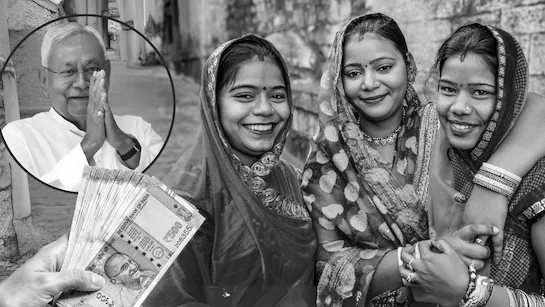
Bihar launches Mukhyamantri Mahila Rojgar Yojana: Rs 10,000 transferred to 75 lakh women
Prime Minister Narendra Modi on Friday launched the Mukhyamantri Mahila Rojgar Yojana in Bihar, calling it a step toward women’s service, prosperity, and self-respect (“seva, samriddhi, swabhiman”) and another milestone in the journey towards Aatmanirbhar Bharat. Speaking via video conference, he said, “With the help of this scheme, sisters in Bihar can start small businesses, in utensils, cosmetics, toys, stationery, or animal husbandry, and take control of their livelihoods.”
The scheme, aimed specifically at economically weaker women, seeks to empower them by providing financial support to launch micro-enterprises and become self-reliant contributors to their families and communities.
The scheme, which comes ahead of state elections, has transferred Rs 10,000 each to 75 lakh women, totaling Rs 7,500 crore. Additional support of up to Rs 2 lakh may follow as beneficiaries grow their businesses. The Prime Minister emphasized that funds are sent directly into women’s bank accounts, ensuring there is no leakage or delay, building on the Jan Dhan Yojana framework.
Bihar government highlights progress in women’s empowerment
Bihar Chief Minister Nitish Kumar welcomed PM Modi, calling the launch a historic step connecting women to employment opportunities. He revealed that the scheme had received 1.6 crore applications and announced that transfers would continue weekly from October 3. He stressed that the initiative is not a handout, but a way to help women fulfill their dreams.
Reflecting on past efforts, Nitish noted that earlier governments, primarily led by RJD and Congress, had done “very little” for women. While some programs existed, widow pensions, maternity benefits, skill training, and small self-help group initiatives, they were limited in reach, inconsistent in implementation, and underfunded. Education, healthcare, and Panchayati Raj representation existed, but outcomes in literacy, employment, and economic empowerment remained low.
Since 2005, under his leadership, milestones include:
• 50% women in Panchayati Raj bodies
• 35% representation in police recruitment and government jobs
• Growth of Jeevika self-help groups covering 1.4 crore rural women in 11 lakh groups and 3.85 lakh urban women
These programs combine financial inclusion, training, and community support, giving women direct tools to start businesses, a significant improvement over earlier fragmented efforts.
Although the Mukhyamantri Mahila Rojgar Yojana was officially launched today, September 26, 2025, the first installment of ₹10,000 had already been transferred to the bank accounts of 75 lakh women across Bihar. This early transfer was made to allow beneficiaries to plan and prepare for their businesses ahead of the official launch. The scheme aims to empower women economically and promote self-employment through direct financial assistance and support.
Early impact: Beneficiaries planning and preparing businesses
• Ranjita Kazi (West Champaran)
• Praised improvements in roads, electricity, water, toilets, and education.
Acknowledged schemes like cycles, dress codes, Ujjwala gas, and housing that helped women.Plans to use the ₹10,000 and later ₹2 lakh to start a small business, employ people, and improve her family’s standard of living.
• Rita Devi Hatte (Bhojpur)
• Initially planning to buy 4 goats and 50 chickens with the first installment.After receiving further support of ₹2 lakh, she wants to start a poultry farm and expand her business.
• Noor Jehan Khatun (Gaya)
• Plans to use ₹10,000 to open a counter in her sewing shop with her husband.Expressed excitement about women being able to start work freely and become self-reliant.
Challenges and Sustainability Despite promising beginnings, women entrepreneurs face multiple hurdles:
• Limited business experience: Many women are new to entrepreneurship and may struggle with financial management, inventory planning, or marketing.
• Market access: Selling products beyond their local villages remains difficult, and even Rs 2 lakh may not be enough to scale businesses for long-term growth.
• Infrastructure constraints: Household responsibilities, limited electricity, transport, and storage facilities can restrict business expansion.
• Patriarchy and societal restrictions: In many communities, women face cultural barriers that discourage or even prohibit them from working outside the home, limiting opportunities for economic participation.
• Financial vulnerability: Lack of financial independence can lead to men misusing funds meant for women’s businesses, reducing the impact of the scheme.
The scheme’s timing ahead of elections raises questions about political motivations. While cash transfers provide immediate relief and visibility, earlier programs like Jeevika combined financial inclusion, skill development, and peer networks, offering a stronger foundation for sustainable empowerment. The Mukhyamantri Mahila Rojgar Yojana is primarily cash-focused, with long-term success depending on how women use and expand their businesses.
Celebrating women during Navratri
Launched during Navratri, a festival celebrating women’s strength, the program is intended to strengthen women’s role in Bihar’s economic and social development. Both PM Modi and Nitish Kumar emphasized that women’s self-reliance will contribute to Bihar’s growth and an Aatmanirbhar Bharat. The true effectiveness of the scheme will become visible in the coming months as businesses take shape and expand.