
Bihar elections phase 1: Chaos, creativity, and record 64.66% turnout
The first phase of Bihar’s assembly elections witnessed a mix of enthusiasm, tension, and administrative innovation as voters in 121 constituencies across 18 districts headed to the polls. Covering approximately 3.75 crore electors, this phase set the stage for a high-stakes contest involving senior leaders, celebrity candidates, and newly intensified election management measures. Polling for Bihar Elections Phase 1 concluded with a record voter turnout of 64.66 per cent, the highest ever in the state’s history.
The Election Commission of India (ECI) actively monitored polling, emphasizing that voters should cast their ballots without fear. Chief Election Commissioner Gyanesh Kumar instructed the Bihar DGP to take strict action against anyone attempting to disrupt voting or take the law into their own hands, following reports of attacks on BJP Deputy CM Vijay Kumar Sinha’s convoy in Khoriari village. ECI officials clarified that voting was proceeding “smoothly across the state” and any claims of power cuts or disruptions were “completely baseless and misleading.”
The first phase also highlighted EC-led administrative reforms. The Special Intensive Revision (SIR) of electoral rolls added over 21 lakh new electors, and measures such as voter verification for women wearing burqas were implemented. Polling staff, especially female officials, conducted face checks to ensure identity confirmation and prevent voter impersonation, a step welcomed by local voters as a safeguard against “vote chori” (vote theft). Anganwadi workers and other EC officials were deployed across polling stations to assist with verification and facilitate smooth voter flow, particularly in rural areas and river-island constituencies.
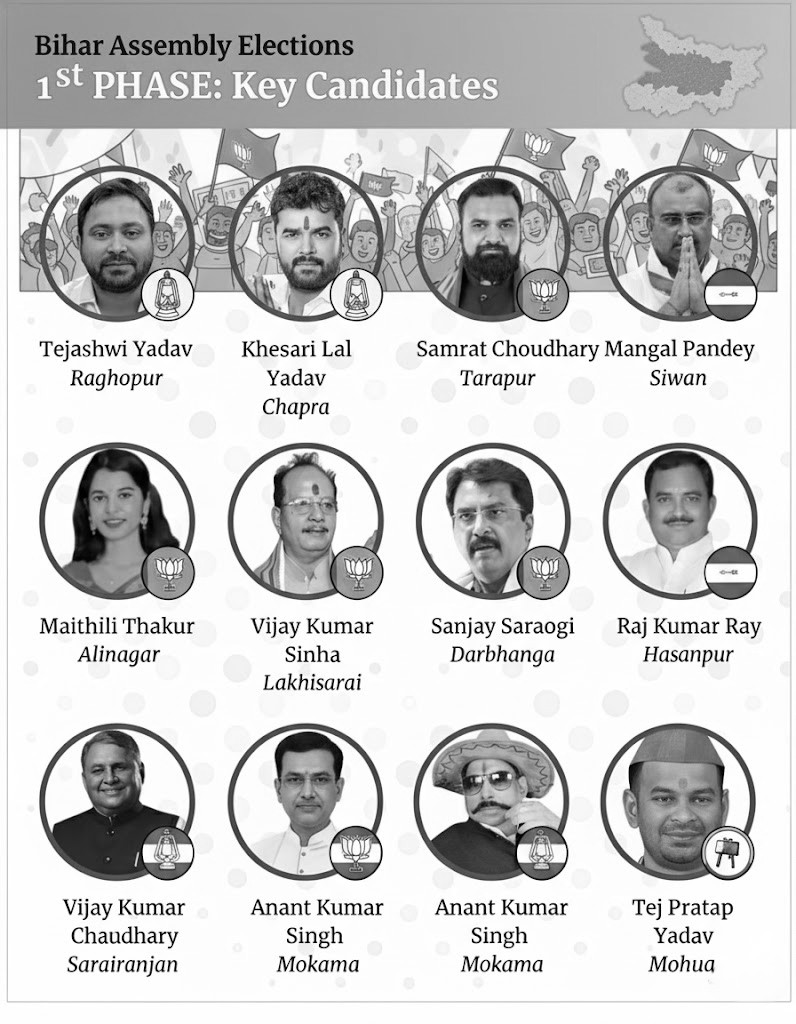
Key Leaders in this phase included RJD leader Tejashwi Yadav in Raghopur, BJP Deputy Chief Ministers Vijay Kumar Sinha in Lakhisarai and Samrat Choudhary in Tarapur, along with ministers like Mangal Pandey and JD(U) leaders Shravan Kumar and Vijay Kumar Choudhary. Celebrity candidates such as folk singer Maithili Thakur, Bhojpuri star Khesari Lal Yadav, and Ritesh Pandey also drew significant attention. The Election Commission maintained tight supervision in sensitive areas, including Naxal-affected regions, ensuring security and uninterrupted voting.
The day was not without incidents. In Lakhisarai, Vijay Kumar Sinha’s convoy was reportedly surrounded by RJD supporters who hurled slippers and stones while chanting “Murdabad,” preventing his polling agent from voting. The EC condemned such attempts to intimidate voters and reinforced that strict action would be taken against miscreants. Minor technical glitches in EVMs were quickly resolved by EC officials on the ground.
In Vaishali district, District Magistrate Varsha Singh stood out for her innovative voter outreach, performing a song in the local Bajjika dialect urging residents to participate in the “festival of democracy.” Singh, an IAS officer of the 2016 Bihar cadre, said the initiative aimed to motivate especially women voters and strengthen their sense of community involvement. She highlighted Vaishali’s historical significance as the world’s first republic and a cradle of early democracy, emphasizing that every vote contributes to a stronger democratic system.
Political reactions reflected the high-stakes nature of the polls. BJP leaders dismissed RJD allegations of power supply cuts at polling stations, calling them “baseless,” while Rashtriya Lok Morcha chief Upendra Kushwaha expressed confidence that the NDA would secure a strong victory. The EC’s continuous presence and statements served to reassure voters of a fair and transparent electoral process.
Phase 1 of the Bihar elections is critical, deciding the fate of several senior leaders and shaping momentum heading into Phase 2 on 11 November. Counting of votes is scheduled for 14 November, and observers will closely watch whether administrative measures, voter turnout, and isolated conflicts impact the overall results. With over 3.75 crore voters participating, this phase underscores Bihar’s vibrant democratic engagement while highlighting the Election Commission’s proactive role in ensuring fairness, security, and accessibility.
Comparing turnout with previous elections, this year’s Phase 1 turnout of 64.66 per cent marks a significant rise from the 57.05 per cent recorded in the 2020 Bihar Assembly elections and 57.33 per cent in the 2019 Lok Sabha elections in the state, reflecting growing voter enthusiasm and engagement.