
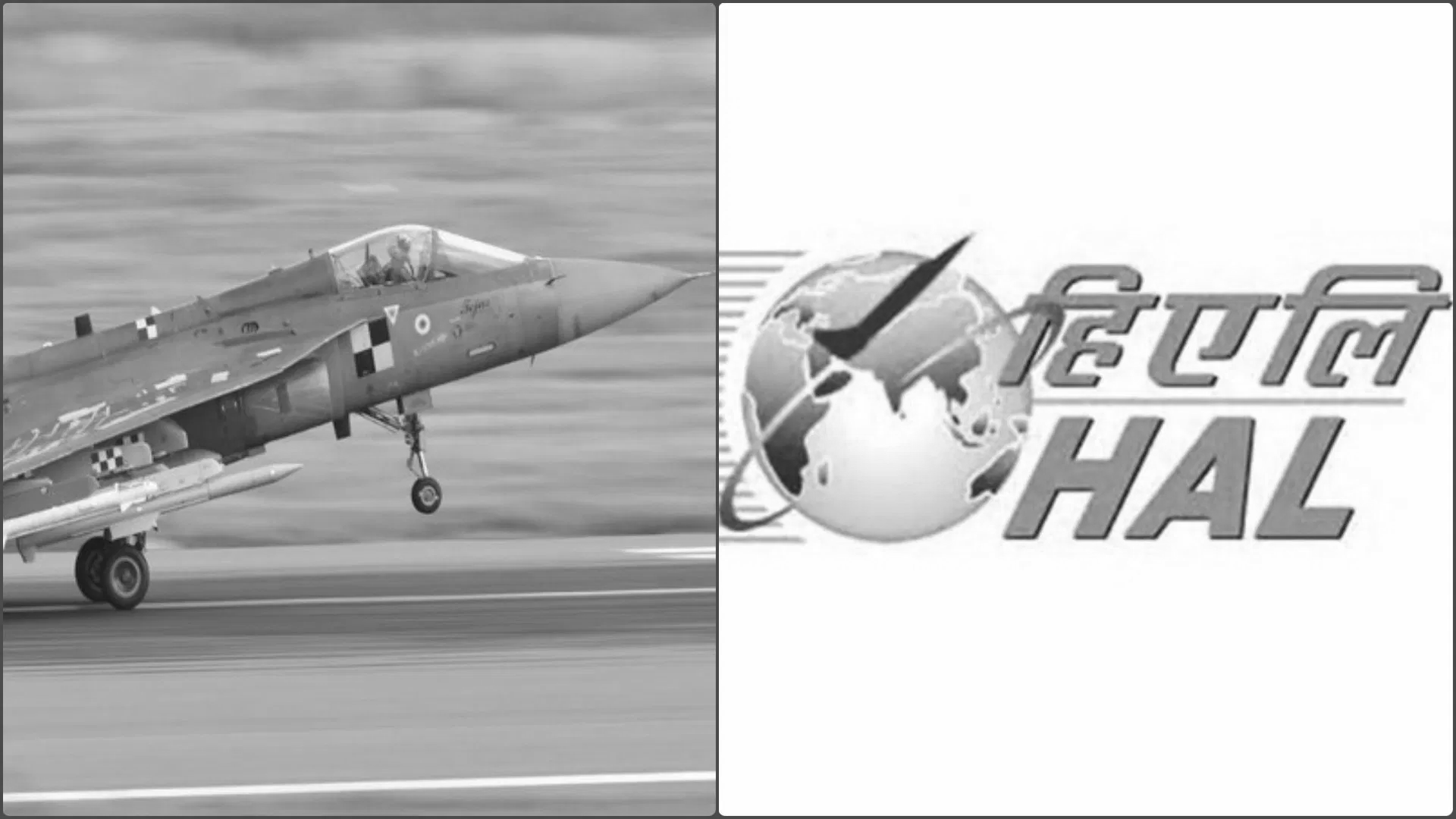
Big orders, bigger questions: HAL's ₹2.22 lakh Cr pipeline masks a turbulent truth for India's indigenous warplanes
Hindustan Aeronautics Limited (HAL) told Parliament's Standing Committee on Defence this week that it currently holds orders for 180 Tejas Mk-1A fighter jets, 156 Prachand attack helicopters, and 34 Dhruv helicopters, with major projects worth Rs 2,22,182 crore under execution through 2034. HAL leads all nine Defence Public Sector Undertakings (DPSUs) in order book value at Rs 2,60,960 crore as of December 2025, ahead of Bharat Electronics Limited (BEL) at Rs 73,400 crore. The disclosures, made through a report tabled in Parliament on Wednesday, offer the most comprehensive public account to date of India's indigenous defence aviation pipeline, alongside a set of unresolved questions around delivery timelines and platform safety.
The Tejas Light Combat Aircraft (LCA) programme, launched in 1983 and first flown in 2001, currently has 38 first-generation jets across two Indian Air Force (IAF) squadrons. The upgraded Mk-1A variant, featuring a new radar, electronic warfare suite, and beyond-visual-range missile capability, has been ordered in two tranches, 83 jets under a Rs 48,000 crore contract signed in 2021, and 97 more worth Rs 62,370 crore ordered in September 2025, bringing the total to 180. HAL said five Mk-1A aircraft are ready for delivery, with radar and digital weapon unit integration completed and both the Advanced Short Range Air-to-Air Missile (ASRAAM) and indigenous Astra missile successfully tested. A third production line at Nasik raises annual output capacity to 24 jets per year. If deliveries proceed as planned, Tejas is on course to become the IAF's second-largest fleet with nearly 350 fighters across all variants by the early 2030s. The main obstacle remains GE Aerospace , whose F404 engines were delivered nearly two years behind schedule, with the first engine arriving only in March 2025.
At Aero India 2025 , IAF chief Air Chief Marshal AP Singh publicly told HAL officials that he had been promised 11 Mk-1A jets and received none, stating that the aircraft displayed at the show did not meet Mk-1A specifications and that he was "not confident of HAL." HAL's chairman attributed the delays to GE's engine supply failures and sanctions imposed after India's 1998 nuclear tests . The Defence Minister asked both sides to resolve the matter privately. The programme has also seen three crashes in under two years, a March 2024 accident near Jaisalmer , the death of Wing Commander Namansh Syal at the Dubai Airshow in November 2025 during an aerobatic display, and a February 2026 runway incident attributed to a software glitch that led to the grounding of all 30 single-seat jets. A joint HAL-IAF software patch is under testing ahead of fleet-wide rollout.
The Dhruv Advanced Light Helicopter (ALH) fleet stands at 330 aircraft in service out of 410 produced, having accumulated 450,000 flight hours over 25 years. The platform has recorded 28 crashes in that period, resulting in at least 17 pilot fatalities. In January 2025, a Coast Guard ALH crashed at Porbandar , killing three crew members due to a fractured swash plate, prompting the grounding of the entire fleet. Army and Air Force variants have since returned to operations, while Navy and Coast Guard versions remain under restriction. HAL has delivered 72 Dhruv units under current contracts and holds orders for 34 more.
The Prachand Light Combat Helicopter (LCH) has had a more straightforward trajectory. Developed in response to lessons from the Kargil War of 1999 and inducted into service in 2022, the Prachand saw its initial batch of 15 units delivered ahead of schedule in August 2023. The helicopter's primary operational advantage is its ability to fly above 15,000 feet , making it the only attack helicopter in the world certified for high-altitude combat, with deployments focused on Ladakh, Arunachal Pradesh , and Sikkim . Its field performance led the Cabinet Committee on Security (CCS) to clear a Rs 62,700 crore follow-on order for 156 more helicopters in March 2025, with deliveries scheduled between 2028 and 2033. The Prachand was briefly grounded in early 2025 due to its shared design lineage with the Dhruv, but returned to full operations in June 2025 after component replacements. HAL is also restarting its Su-30 MKI production line at Nasik, dormant since 2019, under a Rs 13,500 crore contract for 12 jets signed in December 2024, while simultaneously delivering 240 AL-31FP engines in annual batches of 30, producing the first three Hindustan Turbo Trainer (HTT-40) aircraft from a new Nasik line, and executing Dornier Do-228 mid-life upgrades.
The IAF currently operates 29 fighter squadrons against a sanctioned strength of 42, a shortfall of over 260 aircraft following the retirement of the MiG-21 fleet. The parliamentary panel recommended that HAL expand into export markets, increase adoption of Artificial Intelligence (AI) in defence systems, and maintain sustained investment in Research and Development (R&D). With its order book at a historic high, HAL's principal challenge is now one of execution, delivering platforms on time and to specification against a backdrop of ongoing scrutiny over safety and reliability.