
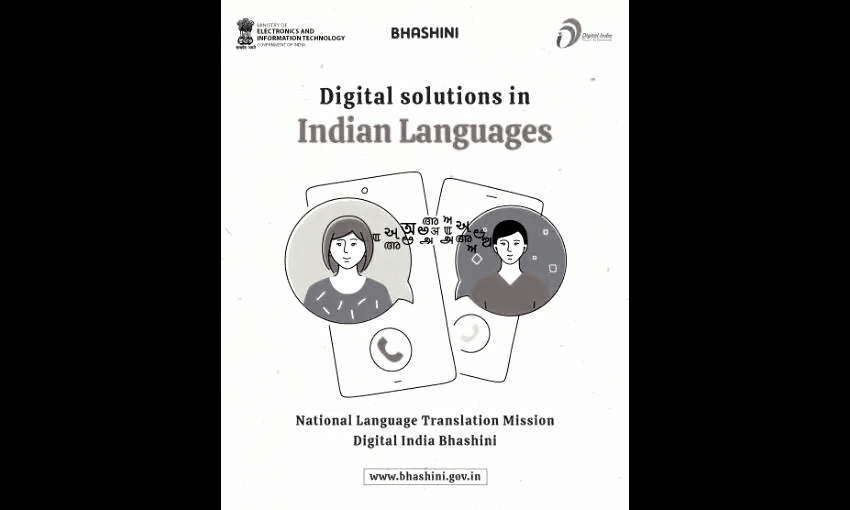
BHASHINI and the Push for Inclusive AI in Indian Governance
As India accelerates the use of artificial intelligence in governance and public services, BHASHINI has emerged as a key pillar of the country’s digital public infrastructure, aimed at breaking language barriers and expanding access to technology for millions of citizens.
BHASHINI, short for Bhasha Interface for India, is the National Language Translation Mission under the Digital India programme , implemented by the Ministry of Electronics and Information Technology (MeitY) . The platform uses artificial intelligence to enable real-time speech recognition, translation and transcription across Indian languages , allowing users to interact with digital systems in their mother tongue.
A National Language AI Infrastructure:
Unlike a standalone application, BHASHINI functions as a language technology backbone . It provides a suite of AI-powered speech and text services , including speech-to-text, text-to-speech and machine translation, which can be integrated into government portals, mobile applications and enterprise systems through open APIs .
The platform currently supports more than 22 Indian languages , with continuous expansion into additional languages and specialised domains such as governance, law, healthcare and agriculture.
According to MeitY, BHASHINI is designed to ensure that language does not become a barrier to accessing digital services , especially in a country where a majority of citizens are non-English speakers.
Key Capabilities:
At the core of BHASHINI are advanced AI models that enable: Real-time speech-to-text transcription , even in live, multi-speaker environments. Multilingual translation between Indian languages and English. Text-to-speech services for voice-based applications. Live captioning and documentation for public events and official proceedings.One of its prominent tools is Shrutlekh , a live transcription and translation system used in conferences, legislative forums and public addresses to provide on-screen captions and instant language conversion.
Expanding Use in Governance:
BHASHINI is increasingly being deployed across government and public administration , reflecting India’s push towards inclusive and transparent governance. Its applications include: Transcription and translation of legislative proceedings and public speeches. Multilingual grievance redressal systems.Judicial documentation and court transcription.Panchayati Raj and local body administration.Citizen-facing digital services and helplines
By enabling communication in regional languages, the platform aims to strengthen citizen participation and improve service delivery at the grassroots level.
Role in Education, Health and Agriculture:
Beyond governance, BHASHINI is being integrated into key development sectors. In education , it supports multilingual digital learning platforms and teacher training tools. In healthcare , it enables patient advisories, telemedicine communication and public health messaging in local languages. In agriculture , it supports voice-based advisories for farmers, covering crop management, weather updates and market information.
The platform’s open architecture has also encouraged startups and system integrators to build language-enabled chatbots, IVR systems and customer support solutions using BHASHINI services.
Alignment with IndiaAI and Responsible AI:
BHASHINI operates in alignment with the IndiaAI Mission , which seeks to promote responsible, ethical and inclusive artificial intelligence. Officials say the platform reflects India’s approach to AI focused on public good, accessibility and democratic values rather than purely commercial deployment.
Its emphasis on open datasets, shared infrastructure and public-private collaboration positions BHASHINI as a foundational layer for India’s AI ecosystem.
Growing Presence at Public Events:
Recent deployments at large public forums, including national and regional conferences, have demonstrated BHASHINI’s operational readiness and scalability . The ability to handle continuous, real-time translation and transcription in high-profile, multi-speaker settings has underlined its potential use in legislatures, policy summits and national events .
Bridging India’s Digital Language Divide:
With India’s digital economy expanding rapidly, policymakers view BHASHINI as critical to ensuring that technological progress remains inclusive. By enabling citizens to engage with digital platforms in their own languages, the mission seeks to democratise access to information and services.
As India continues to build its digital public infrastructure, BHASHINI is expected to play a central role in shaping how artificial intelligence is deployed across governance, development and citizen engagement.