
Bharatiya Vigyan Sammelan Highlights India’s Knowledge Legacy and Future Vision
The 7th Bharatiya Vigyan Sammelan (BVS-2025) was inaugurated on Friday at the National Sanskrit University in Tirupati, with Andhra Pradesh Chief Minister N. Chandrababu Naidu and RSS Sarsanghchalak Mohan Bhagwat attending the inaugural session. Several prominent dignitaries, including Union Minister of State for Science and Technology Dr. Jitendra Singh, took part in the event. The Chief Minister and Mohan Bhagwat jointly lit the ceremonial lamp and later visited the exhibition stalls showcasing indigenous innovations, defence-related models, and scientific exhibits rooted in Indian knowledge systems and modern technology.
Addressing the gathering, Chandrababu Naidu said India is on a firm path to becoming a global superpower, driven by science, technology, innovation, and a strong civilisational foundation. He described the Bharatiya Vigyan Sammelan as an important national platform for discussing India’s identity and intellectual heritage, while also popularising science among students, researchers, innovators, and the general public.
The Chief Minister highlighted India’s rich legacy as a knowledge-based civilisation since ancient times. He recalled that the Harappa civilisation demonstrated advanced urban planning thousands of years ago. Yoga, which originated in India nearly 2,900 years ago, is today practiced in more than 150 countries, promoting physical and mental well-being. He noted that under Prime Minister Narendra Modi’s leadership, International Yoga Day has been celebrated on a global scale.
He said India had developed advanced medical systems such as Ayurveda over 2,600 years ago and established world-renowned institutions like Takshashila and Nalanda universities centuries before modern education systems emerged elsewhere. Indians discovered zero and invented chess, a game that sharpens intellectual ability. The country has produced legendary scholars such as Aryabhata in astronomy, Bhaskaracharya in mathematics, Charaka and Dhanvantari in medicine, and Kautilya in economics, whose contributions continue to inspire generations.
Chandrababu Naidu observed that India was among the world’s leading nations nearly 2,000 years ago and remained a dominant force in the global knowledge economy for centuries. While foreign rule and certain post-Independence policies slowed progress, he said economic reforms introduced in 1991 and the subsequent IT revolution helped India regain momentum. Today, Indians hold leadership positions in several top global institutions, reflecting the country’s growing influence.
Stating that India will emerge as the world’s number one nation by 2047, the Chief Minister described the country’s young population as a major strength. At a time when many developed nations are grappling with ageing population challenges, India’s demographic dividend provides a clear advantage. He stressed the need to reduce the gap between the rich and the poor as the nation advances and emphasised the importance of initiatives such as interlinking major rivers to ensure long-term water security.
The Chief Minister said India has become a champion in science and technology. He credited former Prime Minister Atal Bihari Vajpayee for laying the foundation for modern development and said Prime Minister Narendra Modi is now accelerating growth through innovation-driven governance. He underlined that India’s values, traditions, ethics, and strong family system will set the country apart on the global stage, and appreciated Mohan Bhagwat’s efforts to strengthen moral and cultural consciousness in society.
Speaking about Andhra Pradesh, Chandrababu Naidu said the state is implementing focused development plans across emerging sectors such as quantum technology, artificial intelligence, and green energy. He announced that a quantum computer would soon be operated from Andhra Pradesh and said telecom reforms have significantly improved connectivity across the state.
He added that projects such as Space City, Drone City, Aerospace City, Electronic City, and MedTech Parks are being developed to create future-ready infrastructure. Major investments are expected, including large-scale investments by Google in Visakhapatnam, with several other companies also planning to enter the state. Region-wise development strategies have been prepared to maximise growth potential across sectors, he said.
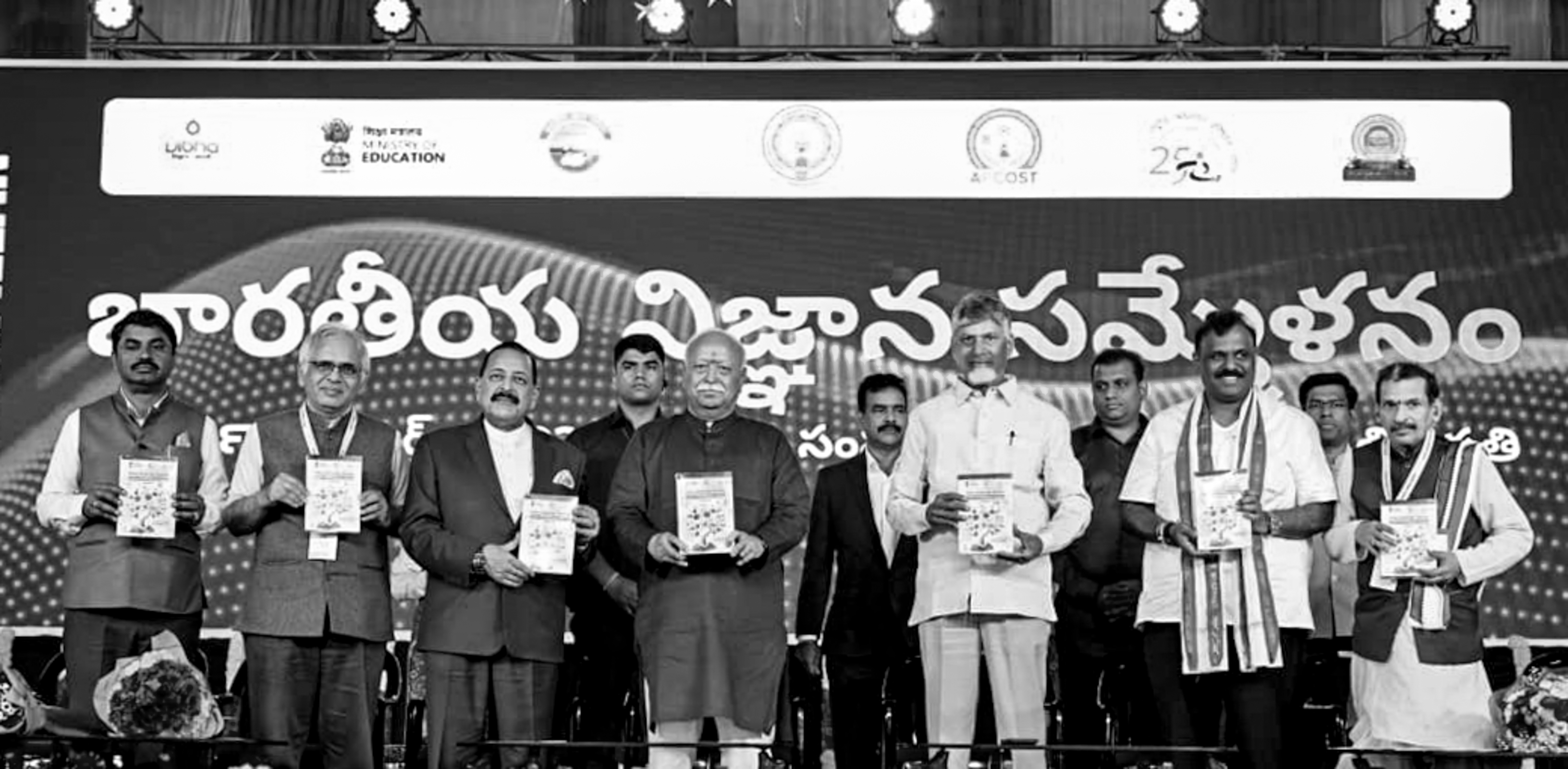
On the occasion, the Chief Minister released the book India’s Knowledge Systems . Revenue Minister Anagani Satya Prasad, Professor Bharat, Dr. Satish Reddy, Sanskrit Vidyapeeth Vice-Chancellor GSRK Sastry, and several scientists, academicians, and students attended the programme.