
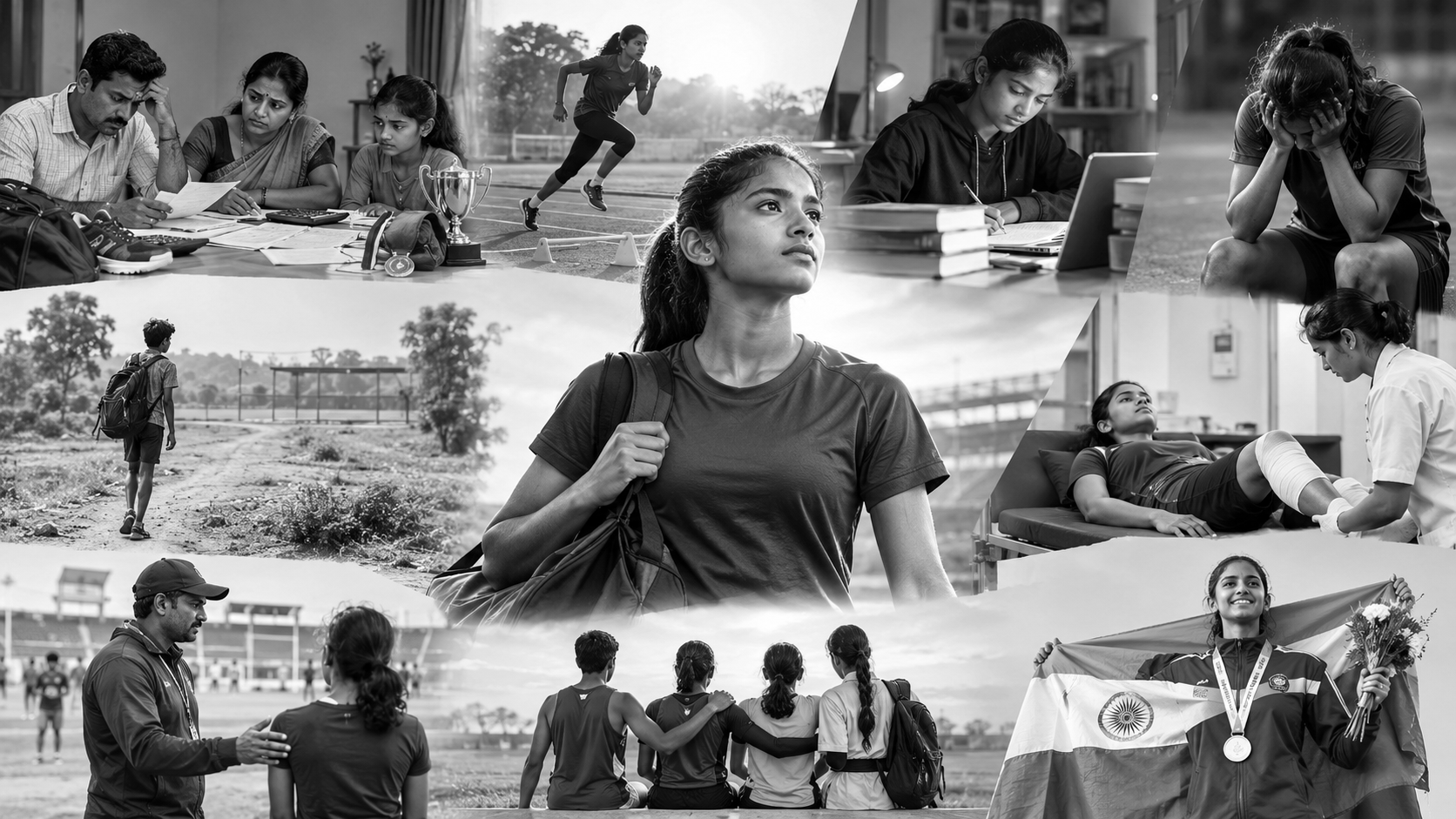
Beyond the Podium: The Price Young Athletes Pay to Chase Their Dreams
A medal-winning performance often lasts only a few moments, but the journey behind it can involve years of sacrifice, financial hardship, missed opportunities and emotional pressure. Long before young athletes stand on a podium, they and their families face challenges that rarely receive the same attention as victories. For many aspiring sportspersons in India, pursuing excellence means balancing training, education, family responsibilities and an uncertain future.
Behind every promising athlete is a demanding routine that begins long before competitions attract public attention. Early morning practice, school or college classes, evening training and hours of physical conditioning leave little time for rest. While talent and determination are essential, access to financial resources, professional coaching and suitable facilities can significantly influence how far a young athlete progresses.
Training for competitive sport involves expenses that extend well beyond coaching fees. Sports equipment, uniforms, footwear, nutritious food, transportation, competition registration, accommodation and medical treatment can place a considerable burden on families. The cost varies according to the discipline, training level and location, with sports requiring specialised equipment or frequent travel often demanding greater investment.
For a young athlete training locally, monthly expenses may run into several thousand rupees. For those pursuing professional-level training, particularly in sports such as tennis, swimming or badminton, costs can rise substantially. Frequent tournaments, specialist coaching, physiotherapy and travel can push household spending much higher.
These expenses become especially difficult for families with limited incomes. Parents may reduce household spending, postpone personal purchases, use savings or borrow money to support their children's ambitions. Some take additional work to meet coaching and travel costs, hoping that their investment will eventually lead to scholarships, selection or employment opportunities.
Nutrition is another important expense. Young athletes need adequate food to support growth, recovery and performance, but maintaining a balanced diet can be difficult when household budgets are tight. Injuries can create additional costs through consultations, diagnostic tests, medication and rehabilitation.
The financial pressure is particularly severe when a family invests for years without knowing whether its child will secure selection or earn an income through sport. For many parents, supporting a sporting dream becomes a long-term financial commitment without any guarantee of returns.
Balancing education with demanding training schedules is another major challenge for young sportspersons. Some wake up before sunrise for practice, attend school during the day and return to training in the evening. Homework, examinations and revision must fit into the remaining hours, often leaving little time for recreation or adequate sleep.
The situation becomes more complicated during examinations and major competitions. Athletes may have to choose between attending classes and travelling for tournaments. Missing lessons can create academic gaps, while concentrating on examinations may interrupt preparation for important sporting events.
Family support and effective time management can help, but individual discipline alone cannot solve every problem. Flexible attendance, academic mentoring, recorded lessons and additional examination support can make a significant difference.
Government-supported training programmes offer one possible solution. The Sports Authority of India's Training Centre scheme caters to selected junior athletes aged 10–18 and can provide facilities including accommodation, sports kits, stipends, competition exposure, educational expenses, medical care and insurance. Such arrangements can help athletes continue their education while receiving structured training.
However, access to these facilities depends on selection and availability. Youngsters who train privately or live far from established centres may have to manage their academic responsibilities with fewer resources.
Education must remain an essential part of an athlete's development, not a casualty of sporting ambition. A sustainable system should allow young people to pursue excellence without leaving them unprepared for life beyond competition.
Physical training is only one part of an athlete's journey. The emotional demands can be equally difficult. Young sportspersons face expectations from parents, coaches, teammates and themselves. As competitions become more demanding, the desire to succeed can turn into a fear of failure.
Selection disappointments can be particularly painful. An athlete may train for months only to miss a place in a team because of a narrow performance difference, limited vacancies or an injury at the wrong time. Repeated setbacks can undermine confidence and raise doubts about whether continued effort will lead to success.
Injuries can intensify this pressure. Being unable to practise while teammates continue competing may leave an athlete feeling isolated or anxious about losing fitness and selection opportunities. Some may return to training before fully recovering because they fear falling behind.
The pressure to prove oneself can also affect sleep, concentration and relationships. Young athletes may hesitate to discuss their difficulties because they worry that admitting stress will be interpreted as weakness.
Regular access to sports psychologists, supportive coaches and trusted adults can help athletes cope with disappointment and manage expectations. Mental well-being should be treated as part of athletic development, alongside physical conditioning, nutrition and technical training.
Winning cannot be the only measure of progress. Improvement, consistency, discipline and recovery from setbacks are also important indicators of development.
Behind many young athletes are parents who make considerable personal sacrifices. They may travel long distances to training centres, adjust work schedules, spend weekends accompanying children to competitions or use savings to purchase equipment. When tournaments take place outside their hometowns, transport and accommodation can become significant additional expenses.
Yet not every talented child has the same support system.
Youngsters in rural areas may have limited access to qualified coaches, well-maintained grounds, specialised equipment and regular competitions. Some must travel to towns or cities for training, adding both expenses and commuting time. Girls in certain communities may face further restrictions arising from safety concerns, household responsibilities or limited access to suitable facilities.
Children from economically weaker families can find it particularly difficult to continue when equipment wears out or competition expenses increase. A talented youngster may abandon a promising career not because of a lack of ability, but because the family can no longer afford the next stage of training.
Grassroots programmes, school sports facilities, district-level competitions and transparent talent identification can help address these inequalities. Support should reach athletes with potential before they become medal winners, rather than concentrating only on those who have already achieved national recognition.
India has several initiatives designed to strengthen sporting opportunities. The Khelo India programme focuses on grassroots participation, infrastructure and talent development, while the Sports Authority of India operates training centres and high-performance facilities for selected athletes.
The SAI Training Centre scheme can provide selected junior sportspersons with coaching, accommodation, equipment, educational assistance and medical support. Such programmes can reduce the financial burden on families and improve access to structured training.
Medical assistance is particularly important because a serious injury can interrupt years of preparation. The Central Athlete Injury Management System under SAI has helped strengthen sports medicine and injury management. Specialised centres also provide access to medical professionals and rehabilitation support.
The Pandit Deendayal Upadhyay National Welfare Fund for Sportspersons offers eligible athletes financial assistance of up to ₹10 lakh for injuries sustained during training or competitions, subject to the scheme's conditions. Separately, SAI has reported insurance coverage of up to ₹5 lakh per individual for covered athletes, coaches and support personnel, along with additional accident-related coverage under applicable terms.
These provisions demonstrate that support mechanisms exist, but eligibility requirements matter. Not every aspiring athlete automatically qualifies for financial assistance, and the availability of a scheme does not necessarily mean that every family can access help quickly.
The challenge is to ensure that information reaches athletes and parents, applications are processed efficiently and support is available when it is most needed. Local schools, coaches and sports associations can play an important role in helping families understand available opportunities.
Perhaps the most uncertain stage of an athlete's journey begins when progress stops. A serious injury, repeated selection failures or a decline in performance can force a young person to reconsider a career built around sport.
For families that have invested heavily, the consequences can extend beyond disappointment. Medical expenses may continue even after training stops, while the athlete may have to return to education or search for another career without adequate preparation.
Support for accomplished athletes does not always translate into equivalent assistance for those who have not yet reached the highest levels. Young players who lose selection may need affordable rehabilitation, counselling, academic guidance and opportunities to develop skills outside competition.
Career transition is also important for athletes who eventually retire. The Retired Sportsperson Empowerment Training (RESET) programme, launched in 2024, aims to help eligible retired athletes develop skills and explore opportunities in coaching, sports administration, mentoring and other fields through education, training and career guidance.
However, young athletes who leave sport before achieving major recognition need pathways of their own. Schools, academies and sports organisations can help by providing career counselling, educational continuity and vocational guidance alongside training.
A sporting setback should not automatically become a financial crisis or close the door to future opportunities.
The real measure of a country's sporting development lies not only in the medals it wins, but also in how effectively it identifies, develops and supports talent. Young athletes need affordable coaching, accessible facilities, proper nutrition, quality education, injury prevention, mental health support and realistic career guidance.
Families should not have to bear the entire cost of developing future champions. Government agencies, schools, sports federations, private sponsors and local communities can work together to expand scholarships, improve grassroots infrastructure and support athletes who lack financial resources.
More importantly, assistance should not depend solely on medals. Athletes who demonstrate commitment and potential deserve opportunities to progress, while those facing injuries or disappointing results should receive guidance to recover and rebuild their futures.
For a young sportsperson, success is rarely a straight path from practice to podium. It is a journey marked by uncertainty, sacrifice and resilience. Recognising these realities is essential to building a sporting culture that values people as much as performance.
A country's sporting success should not be measured only by the medals displayed on podiums, but also by how many talented children receive a fair opportunity to pursue their dreams without sacrificing their education, health or family's financial security.